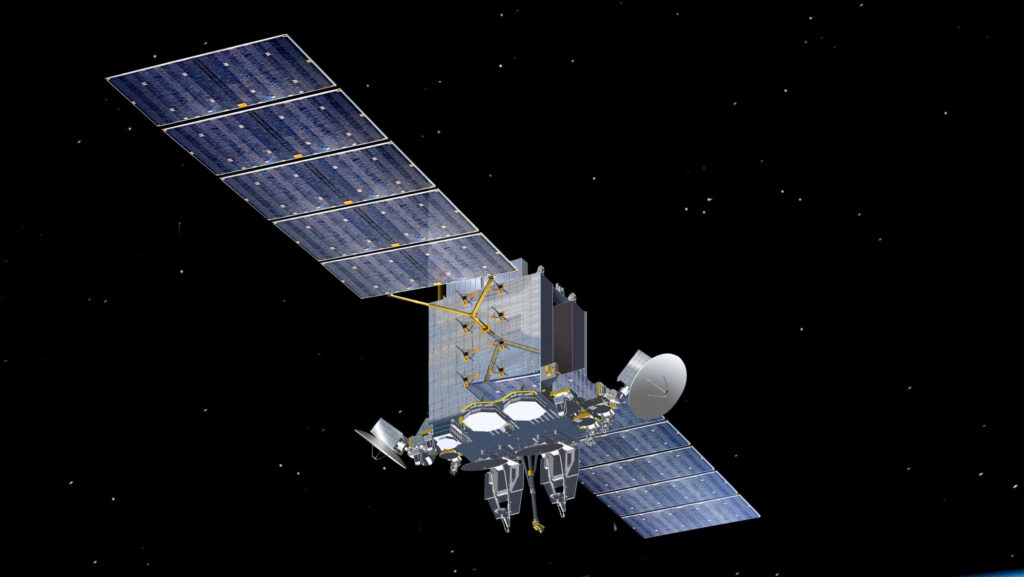
Pentagon taps five companies to rapidly deploy encrypted SATCOM in the face of growing threats.
In a bid to bolster secure satellite communications against enemy jamming, the Space Force has enlisted five companies to create prototype designs for a novel encrypted constellation in geosynchronous Earth orbit (GEO). The initiative, announced Tuesday, marks a shift toward leveraging existing commercial technologies for faster deployment.
PTS-G Program: A New Strategy for Resilient SATCOM
Space Systems Command (SSC) has awarded indefinite delivery/indefinite quantity (IDIQ) contracts to Boeing, Viasat, Northrop Grumman, Astranis Space Technologies, and Intelsat (now part of SES Global) under the Protected Tactical Satellite Communications – Global (PTS-G) program. These firms have also received initial delivery orders totaling $37.5 million.
SSC emphasized that the awardees will refine their designs and conduct demonstrations based on their existing commercial products to align with PTS-G requirements. The results of this initial phase will inform future competition for follow-on production orders.
Budget Boost Fuels Rapid Development
The Space Force’s fiscal 2026 budget request includes nearly $240 million for PTS-G, signaling the program’s importance in the service’s strategy to enhance secure communications.
Embracing Commercial Solutions for Speed
These PTS-G awards reflect a change in SSC’s acquisition strategy for anti-jam satellites. SSC is now focused on more quickly delivering baseline capabilities to the field by relaxing requirements and using existing commercial technologies and services — with an eye to incremental improvements over time.
PTS-G: Bridging the Gap in Protected SATCOM
Launched last March, PTS-G is a new tier in SSC’s Protected Anti-Jam Tactical SATCOM (PATS) family of systems, with the goal of starting operations in 2028. The new satellites will augment the other satellite and ground-system elements of PATS, which are based on the Protected Tactical Waveform (PTW). It is intended to serve as an interim service, bridging current commercial technology and future high-end capabilities developed under PTS-Resilient (PTS-R).
Evolution of PATS: A Multi-Tiered Approach
The overarching PATS program began in 2018 to take over the tactical mission of the current Advanced Extremely High Frequency satellites, which provide highly encrypted communications for strategic and tactical needs. The multi-tiered effort (including satellites, PTW, and ground systems) aims to provide a resilient SATCOM architecture by using multiple types of satellites with better encryption that are dispersed over various orbits to counter adversary jamming attempts.
Streamlining Acquisition: PTS-R Cancellation
The Space Force recently canceled the competition for PTS-R to focus on bringing the PTS-P prototypes into operation as quickly as possible. Highlighting this new acquisition approach, SSC renamed the PATS program to “Protected Tactical SATCOM Family of Systems.”
Other elements of the original PATS program remain unchanged. These include the Protected Tactical Enterprise Service ground system, Enterprise Management and Control, and the Air Force-Army Anti-Jam Modem.
The Pentagon’s FY26 budget request includes almost $686 million for the full Protected Tactical SATCOM Family of Services effort.