United Launch Alliance’s Heavy-Lifter Takes on Ambitious Mission for Space Force
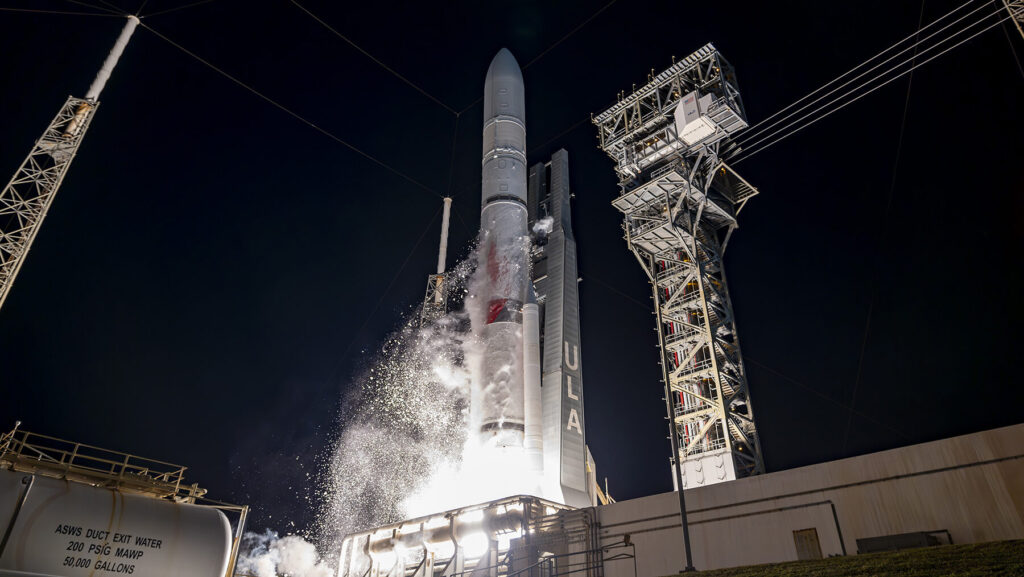
United Launch Alliance (ULA) is set to launch its Vulcan rocket tonight on its inaugural mission under the Space Force’s National Security Space Launch (NSSL) program. The mission will carry an experimental satellite designed to demonstrate new technologies for positioning, navigation, and timing (PNT).
Direct-Inject into GEO: A Challenging Feat
ULA CEO Tory Bruno emphasized that the Vulcan heavy-lifter is carrying two military payloads directly to geosynchronous Earth orbit (GEO), approximately 36,000 kilometers from Earth. Bruno highlighted that the Vulcan was specifically engineered for this „tough mission” of direct-inject into GEO, a departure from the conventional method of launching satellites into a lower transfer orbit and then maneuvering them into place using small thrusters.
Secrecy Surrounds Secondary Payload
While ULA has confirmed the presence of two payloads, the Space Force remains tight-lipped about the second one. Col. Jim Horne, Space Systems Command mission director, declined to provide any details beyond the officially announced Navigation Technology Satellite-3 (NST-3). However, a Space Systems Command press release referred to NST-3 as the „primary payload,” hinting at the existence of additional payloads.
NTS-3: A Leap Forward in Navigation Technology
The NST-3 satellite, built by L3Harris for the Air Force Research Laboratory (AFRL) at a cost of around $250 million, represents a significant advancement in navigation technology. Joanna Hicks, senior research aerospace engineer for AFRL’s Space Vehicles Directorate, noted that NTS-3 is the DoD’s first experimental navigation satellite in 48 years.
Enhancing Resilience and Accuracy
NTS-3 will conduct approximately 100 experiments over the next year, testing new technologies such as an electronically steered phased-array antenna, which will enable the Space Force to deliver higher power to overcome interference. The satellite will also test „advanced signals,” including a new signal for non-military users called CHIMERA, designed to protect civil users from spoofing.
Paving the Way for Multi-Orbit Constellations
Andrew Builta, vice president at L3Harris, highlighted that NTS-3 is the first satellite to support simultaneous GPS broadcast and receipt, enabling extended autonomous operation without ground contact. The experiments conducted by NTS-3 will also assess the feasibility of multi-orbit constellations, exploring the potential of integrating signals from satellites in GEO with those in medium Earth orbit (MEO) or low Earth orbit (LEO).
Vulcan: A Powerful Workhorse
The Vulcan Centaur V upper stage, powered by four solid rocket boosters, is designed to achieve the direct GEO inject. Gary Wentz, ULA vice president for government and commercial programs, explained that this configuration is more powerful than the two-booster setup used during Vulcan’s previous NSSL certification missions. The Space Force has ordered 25 Vulcan NSSL Phase 2 missions from ULA, with additional orders for NSSL Phase 3 launches.