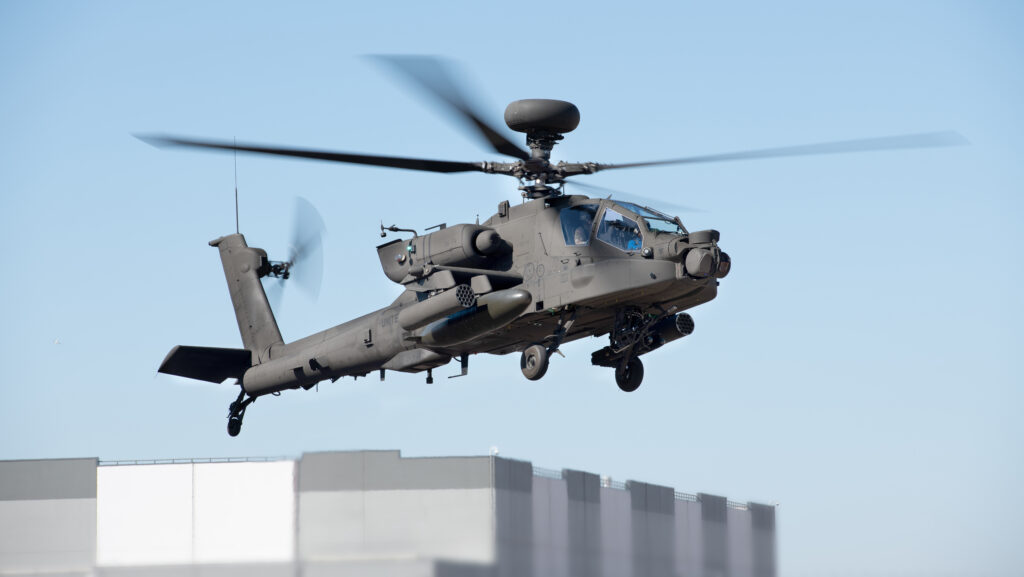
Following the U.S. Army’s decision to cancel the Improved Turbine Engine Program (ITEP), Boeing is shifting its focus to designing a next-generation AH-64F Apache attack helicopter. The company aims to enhance the aircraft’s capabilities through weight reduction and a composite fuselage, extending its operational lifespan to 2060 or 2070.
Future Apache: Weight Reduction Key
„We are ready to respond either way,” if ITEP is cut or goes ahead, Terry Jamison, director of attack helicopter programs at Boeing, told Breaking Defense at the MSPO trade show.
The proposed F-model variant will prioritize „reducing the weight of the aircraft to bring more payload and more capability into it [the in production AH-64E Apache Guardian] because ITEP was going to give us a little bit more power,” Jamison explained. „So now we’re focused on [learning] where can we use composites in the fuselage.”
ITEP’s Cancellation
ITEP, based on General Electric’s T901 engine, was intended to replace powerplants for both the Apache and UH-60 Black Hawk, promising a 50 percent increase in horsepower and a 25 percent improvement in fuel efficiency. However, the program faced disruptions and delays before the Army’s cancellation plan.
Past Rejection, New Approach
This isn’t Boeing’s first attempt at an F-model Apache. The Army rejected a previous concept in 2016 that was envisioned as a bridge solution before the arrival of Future Vertical Lift (FVL) aircraft.
This new push differs as it doesn’t prioritize high speed and is based on „joint working sessions” with the Army over the past two years to determine „requirements,” according to Jamison. The current vision of Apache helicopters utilizing air-launched effects for future missions diminishes the need for high-speed flight. „Whether or not [high speed is] going to be a customer requirement, I just don’t know at this point,” said Jamison.
Near-Term Production Continues
In the near term, Boeing is fulfilling its obligations under the U.S. Army’s Multi-Year II (MY2) Apache order, with a ceiling of $3.8 billion, signed in 2023. MY2 production will conclude in the summer of 2028, after which „Poland will fill those production spots” at Boeing’s Mesa, Arizona, facility until 2031, Jamison said.
International Demand
Poland’s 2022 acquisition of 96 Apaches under the KRUK program marked the largest export order for the aircraft. Jamison noted that potential new or additional orders depend on decisions from Canada, India, Indonesia, and Romania. „There’s a continued demand internationally for this capability and … we’re anxious and ready to support” it, he added.