AFA 2025 Highlights Growing Demand for Compact Powerplants Amidst CCA Uncertainty
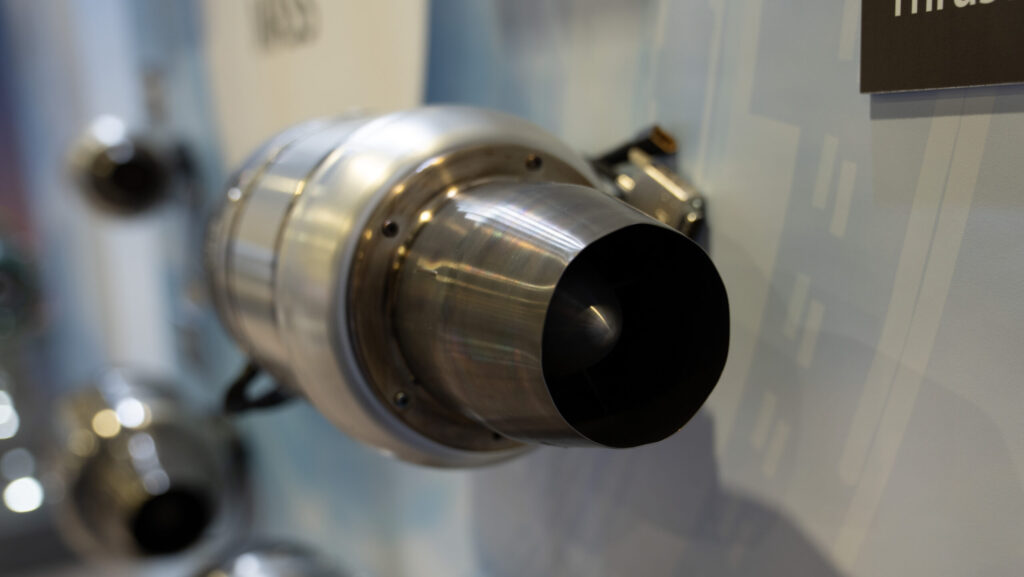
While large unmanned aerial vehicles (UAVs) dominated the show floor at this year’s Air and Space Forces Association (AFA) conference, a potent undercurrent of innovation emerged in the form of small engines, poised to power a new generation of attritable aircraft.
Demand Signal Clear: Compact Engines in the Spotlight
„It’s clear there’s some sort of demand signal,” noted Byron Callan, managing director at Capital Alpha Partners, regarding the surge of companies vying for the smaller engine market. This burgeoning sector promises to fuel Collaborative Combat Aircraft (CCA) drones, cruise missiles, and other affordable air vehicles, providing a cost-effective mass of munitions.
From Startups to Primes: A Diverse Field Emerges
The AFA conference showcased a diverse range of competitors, from established primes to nimble startups, each vying to capture a slice of the lower-end engine market.
- Honeywell unveiled its new 1,600-pound thrust HON1600 engine, complementing its existing F124 powerplant for CCA applications. Honeywell emphasizes a „low risk” approach, leveraging its existing supply chain and production facilities for auxiliary power units.
- Pratt & Whitney (RTX) announced its pursuit of „a new family of engines” scaling from 500 to 1,800 pounds of thrust.
- Rolls-Royce showcased the Orpheus engine family, jointly developed with the UK’s Ministry of Defense, targeting the attritable CCA market. With 120 test events and 40 hours of engine run time, Rolls-Royce aims for „low cost production” by utilizing a different supply chain.
- JetCat Defense, a joint venture, presented its new P420 and P850 powerplants, delivering 100 and 200 pounds of thrust, respectively.
- BeeHive Industries announced that its 200 pound-thrust Frenzy engine, under contract with the US Air Force, has reached development milestones and is slated for flight testing in early 2026.
CCA Design Uncertainties: A Murky Horizon
Despite the clear demand for affordable powerplants, companies are navigating the market with incomplete information about a major incentive driver: the CCA program.
The Air Force has selected two larger airframes for its initial CCA increment but has not specified its preferences for subsequent rounds, leaving manufacturers to speculate about the emphasis on low-end, high-end, or intermediate systems.
Air Force Ambiguity: A Need for Clarity
While the Air Force has issued a request for proposals (RFP) for engines in the lower thrust range, aimed at bolstering a dormant market segment, crucial details regarding the service’s requirements remain elusive. The Air Force did not respond to queries regarding communications to industry.
Industry Adjusts Amidst Evolving Priorities
With the Air Force’s priorities and leadership in flux, industry grapples with designing engines for attritable aircraft, a departure from the traditional focus on longevity and high tolerances. Honeywell’s Pope noted innovations like additive manufacturing and tradeoffs in cooling and lifespan, anticipating engine lifecycles measured in double-digit flight hours.
Market Dynamics and Strategic Considerations
The burgeoning field of lower-thrust engine suppliers, including established players and new entrants, is poised to capitalize on a growing market. AeroDynamic Advisory’s Richard Aboulafia believes incumbents may retain an advantage by repurposing commercial offerings, while startups could potentially disrupt the market with clean-sheet designs.
Prudent Bets and Global Implications
Despite the competitive landscape, analysts view investments in engine development as „prudent bets.” The ramp-up in global defense spending also presents opportunities for companies seeking to expand their CCA business abroad, while navigating the complexities of sovereign control and multidomestic manufacturing footprints.
Navigating Uncertainty: A Market Ripe with Potential
The future of CCA remains uncertain, but the allure of powering potentially thousands of systems is undeniable. While winners and losers will emerge, the market for small engines is poised for significant growth, driven by the irresistible prospect of shaping the future of air combat.