Stealth bombers and autonomous vessels take part in maritime strike scenarios
Two multinational exercises held in the Pacific this summer gave the U.S. military an opportunity to demonstrate its expanding ability to defeat enemy ships. The capabilities included long-range anti-ship strikes launched from low-observable bombers and the use of autonomous surface vessels to attack target ships directly.
The demonstrations took place during controlled sinking exercise phases, known as SINKEX, at Exercise Valiant Shield and the Rim of the Pacific exercise, or RIMPAC.
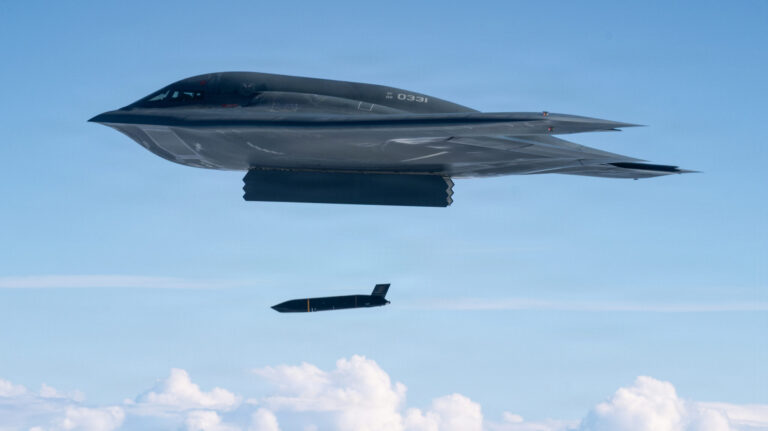
B-2 launches LRASM against the USS Juneau
The first SINKEX took place on June 27 during Valiant Shield, north of the Mariana Islands. A U.S. Air Force B-2 Spirit bomber launched an AGM-158C Long Range Anti-Ship Missile, or LRASM, against the decommissioned amphibious transport dock USS Juneau.
The event appears to have been the first publicly disclosed LRASM launch from a B-2 bomber. The development is significant because the B-2 is currently the only operational U.S. aircraft capable of carrying the missile internally.
Internal carriage allows the bomber to maintain its reduced radar signature. This gives the U.S. military the ability to conduct long-range anti-ship strikes with a lower risk of detection — a capability considered especially important in the vast and contested Pacific theatre.
U.S. Pacific Air Forces commander Gen. Kevin Schneider said the B-2’s performance demonstrated the military’s ability to adapt and respond flexibly to emerging security challenges.
He added that counter-maritime strike operations remain essential to preserving a strategic advantage over potential adversaries, protecting U.S. interests and maintaining freedom of navigation across the Pacific.
Valiant Shield tests cooperation across multiple domains
Valiant Shield brought together U.S. forces and military units from Japan, Canada, New Zealand and Australia. The exercise focused on improving the ability of joint forces to detect, locate, track and engage targets across multiple operational domains.
The training involved coordinated activity at sea, in the air, in space, on land and in cyberspace, with particular emphasis on rapidly combining intelligence and strike capabilities.
Two ships sunk during RIMPAC
Another SINKEX phase was conducted during RIMPAC, held off Hawaii from June 24 to July 31. This year’s exercise involved ships, submarines and aircraft from 30 countries.
On July 17, the decommissioned cruiser Mobile Bay and the amphibious assault ship Peleliu were sunk during a complex live-fire operation. The attack combined submarine-launched torpedoes with several types of missiles, including LRASM, Spike Non-Line of Sight and Naval Strike Missile systems.
Rear Adm. Suzanne Bailey, deputy commander of the U.S. 3rd Fleet and commander of the RIMPAC Combined Exercise Control Group, described the operation as a major test of the participating forces’ kill chain.
The scenario required U.S. and allied forces to detect, track, target and strike a vessel using live ordnance. The operation demanded simultaneous coordination across several domains and provided some of the most realistic maritime combat training available.
Autonomous surface vessel used in a SINKEX for the first time
RIMPAC 2026 also marked the first use during the exercise of unmanned surface vessels known as Global Autonomous Reconnaissance Craft, or GARC.
Footage released after the operation showed at least one of the vessels surveying the badly damaged hull of the Peleliu before deliberately colliding with the target.
The official material did not identify the precise type of unmanned vessel. However, Lt. Sarah Weinstein, commanding officer of Unmanned Surface Vessel Division 32, confirmed that the platform was a GARC built by Baltimore-based BlackSea Technologies.
She described the mission as a first for the U.S. Navy and praised the precision with which her team carried it out. The autonomous vessel also provided a perspective rarely captured during controlled sinking exercises.
U.S. combines long-range strikes with autonomous platforms
The Pacific operations highlighted the direction of U.S. maritime warfare capabilities. Stealth bombers, long-range anti-ship missiles, submarines and autonomous surface vessels are being integrated into an operational chain capable of detecting and attacking maritime targets from multiple directions.
Through these exercises, the United States and its partners are testing not only the effectiveness of individual weapons but also their ability to coordinate widely dispersed forces across a vast and increasingly contested theatre.