Supply chain and data rights issues remain challenges as Air Force eyes new refueling capabilities by mid-2030s.
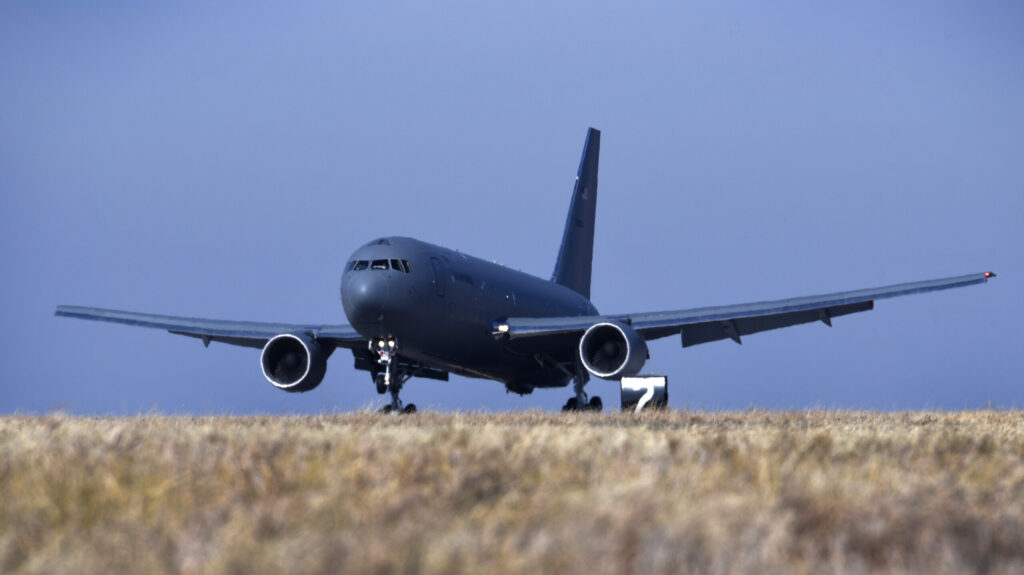
A renewed emphasis on fielding a next-generation air refueler by the mid-2030s has positioned Boeing’s KC-46 Pegasus as the only tanker readily available to meet the Air Force’s immediate needs, according to a new service document. However, supply chain and data rights issues could pose long-term challenges.
The justification and approval (J&A) notice posted by the Air Force on Oct. 2 outlines the service’s evolving plans for its air refueling fleet, culminating in a decision this summer to order up to 75 more KC-46s. The J&A was required because the service is contracting with Boeing for more tankers without a competition.
According to the document, requests for information for the now-defunct KC-135 Tanker Recapitalization Program garnered responses from a range of industry players, including a Lockheed Martin and Airbus partnership competing against Boeing. The Air Force determined that only Airbus and Boeing, after Lockheed withdrew from its partnership with Airbus, could „partially meet the draft requirements” of the program, including being ready for fielding by fiscal 2031.
A Shift in Strategy
However, in early 2025, „evolving global threats and competing DoD priorities” led the Air Force to prioritize a next-gen tanker known as NGAS. The Air Force concluded that both Boeing and Airbus would require „significant development” to meet the original recapitalization program’s requirements, making it unaffordable alongside the need to develop the NGAS platform.
As a result, the service opted to use existing tankers for the KC-46 program until NGAS comes online. This decision effectively cleared the way for Boeing, as the Airbus A330 MRTT would require „significant development to meet mandatory requirements.”
Time is of the Essence
A key driver of the decision to use KC-46 requirements was time. The Air Force is currently replacing its aging KC-135 Stratotanker fleet with the KC-46, but deliveries under an existing contract are set to conclude in 2030—roughly six years before NGAS would be ready at the earliest. The Air Force needs a tanker that can fill that six-year gap, which the service says only the KC-46 can do.
Challenges Ahead
Buying more KC-46s will present challenges. Boeing „will need to resolve” diminishing manufacturing sources and material shortages (DMSMS) along with parts obsolescence. Additionally, the document raises the prospect of negotiating for more rights to technical data and software, particularly when current rights are „less than the level required” for the KC-46’s production extension.
NGAS: A Critical Need
While NGAS’s fate was recently uncertain, the Air Force now considers it a critical need. The program has completed an analysis of alternatives, and further fact-gathering is underway to refine requirements.
According to Gen. John Lamontagne, chief of the Air Force’s Air Mobility Command, the service examined a wide range of potential NGAS platforms, from business jets to blended-wing body aircraft and stealthy refuelers. The platform is expected to operate in hazardous environments like the Indo-Pacific, where runways are few and air defenses are formidable.
An RFI for the NGAS program was released to industry in August.
Industry is preparing candidates for next-gen refueling. Roderick McLean, vice president and general manager of air mobility and maritime missions at Lockheed, stated that the company expects a survivable, clean-sheet aircraft will be needed for the mission.