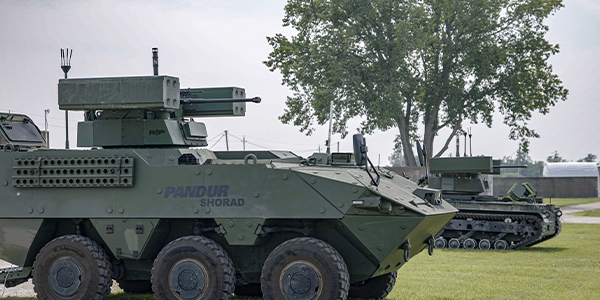
As the use of small unmanned aerial systems (sUAS) intensifies and tactics evolve at a breakneck pace, Moog is stepping up with a layered and modular approach to counter-UAS (C-UAS) solutions. Recognizing that „there is not a magic bullet,” as Paul Stoelting, director of engineering for the Space and Defense Group at Moog, emphasizes, the company aims to provide adaptable and affordable weapon systems that can scale to meet the ever-changing threat landscape.
Layered Defense: A Modular and Scalable Approach
Moog’s strategy aligns with the Department of Defense’s emphasis on layered defense solutions, ranging from platoon-level protection to brigade assets, and from mobile vehicles to static sites. This layering extends across the detect, track, and defeat kill chain, accommodating rapid integration with new sensors and command-and-control (C2) systems.
„It’s everyone’s responsibility to address counter-UAS,” said Stoelting. „The Army is calling it a Military Occupational Specialties (MOS)-agnostic approach, so they’re moving fast too.”
The Backbone of Moog’s C-UAS Offerings
Moog’s C-UAS products reflect this layered and modular approach. Three complementary elements form the backbone of its offerings:
- Reconfigurable Integrated-weapons Platform (RIwP): This unmanned turret merges precision motion control, sensors, and fire control into a single unit. A PlayStation-like hand controller allows for remote operation, while intelligent fire control and video tracking handle real-time tracking and targeting.
- Flexible Mission Platform (FMP): A ruggedized pan-and-tilt mount that can host a variety of sensors and/or weapons.
- Weapon Stores Management System (SMS): A Modular Open System Approach (MOSA)-compliant, commercial-off-the-shelf, weapon control system that integrates with sensors and mission management systems to provide a superior fire-control solution.
According to Andrew Layer, strategic opportunities manager for growth and innovation at Moog, this approach provides a „suite of offerings at different price points and varied sizes,” allowing for reconfiguration with any effector depending on the mission.
Versatility in Weapons, Platforms, and AI
The RIwP is vehicle agnostic, integrated on platforms ranging from Stryker vehicles to tracked robots. The FMP has been mounted on Humvees and light trucks, while the SMS has been installed on fixed and rotary-wing aircraft, including the UH-60 Black Hawk. The RIwP can carry guns (like the 30mm Bushmaster cannon), air-defense missiles (like Stinger, Advanced Precision Kill Weapon System (APKWS), and Coyote), and a variety of sensors.
Moog is also investing in AI and sensor fusion to deliver operator-centric capabilities for smart, fast, and robust target tracking. Their autonomous fire-control system, consisting of an edge computer running fusion and detection algorithms, enables a single gunner to operate multiple remote systems. This system can be deployed onto legacy systems like RIwP.
Layer noted that recent field tests of their advanced targeting system have demonstrated the ability to fire without radar using AI/ML for passive range estimation, dramatically reduce the time from detect to defeat using edge processing and autonomous targeting, and maintain targets through difficult tracking conditions.
Redefining the Battlespace: Demonstrations and Future Innovation
Mike Gruver, SVP – Space and Defense Group, Moog, asserts that their „RIwP turret is redefining the counter-UAS battlespace,” emphasizing their commitment to staying ahead of the curve and empowering the warfighter with adaptable technology.
Moog has showcased its systems at events like Project Convergence (PCC) and the Maneuver and Fires Integrated Experiment (MFIX). Engagements with various organizations are driving ongoing research and innovation, with new capabilities and products already in development. With a global presence and a focus on quality and on-time delivery, Moog is poised to make a significant impact on the evolving C-UAS landscape.