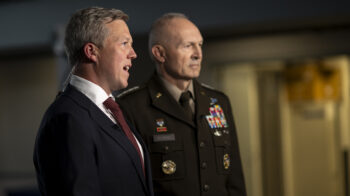
The US Army is embarking on a comprehensive reorganization of its weapons portfolio, marking the most significant acquisition shakeup the service has seen in years, officials exclusively revealed. This ambitious overhaul aims to drastically accelerate the delivery of critical capabilities to soldiers, cutting through bureaucracy and fostering a more agile procurement system.
A Quest for Speed: Combatting Risk Aversion
At the heart of the restructuring is a determined effort to overcome long-standing obstacles that have slowed down the acquisition process. „We had previously created a system that was wildly risk averse and… the cost of that risk aversion was being able to get tools into the hands of our soldiers fast enough for them to actually be able to use it,” Army Secretary Dan Driscoll .
This acquisition revamp, first reported in April, has been in the works for the better part of the year. Its implementation aligns with broader reform efforts recently outlined by Defense Secretary Pete Hegseth.
„This transformation is about preparing the Army for the future, whether it’s ensuring that we can quickly adopt the next generation of technologies or that we are ready to respond rapidly to a crisis,” Army Undersecretary Michael Obadal stated in a November 10 email. „A modernized acquisition system will position us ahead of our adversaries, strengthen our readiness, and maintain a technological edge in all domains.”
An Army official briefing highlighted that the driving force behind these changes is a desire to remove constraints and refine processes for greater speed. A crucial part of this solution involves „resetting and rebuilding” the relationship between the requirements and acquisition communities.
Consolidating Power: A Leaner, Faster Structure
The overhaul will see a host of consolidations, including a reduction in the number of general officers at the top rank, a significant contraction of the 12 Program Executive Offices (PEOs) responsible for acquisition, and an entirely new reporting structure.
Lieutenant Colonel Charlie Dietz, working in Obadal’s office, explained the goal: „Too often they are pointing at each other, ‘Like, well, we’re waiting on them.’ ‘[No,] we’re waiting on them right now.’” He added, „Hey, you guys are all together now, so you can’t blame each other. We’re going to make this quicker. We’re going to give you less paperwork… And, this is supposed to save money.”
While changes to the requirements process have already begun with the new Transformation and Training Command, Secretary Driscoll optimistically estimates that the complete overhaul could accelerate acquisition by as much as 30 percent, and potentially „even greater than 50 percent on a lot of projects because… we will have parallel execution of many of our processes.”
Introducing Portfolio Acquisition Executives (PAEs)
Under the reorganization, the top of the structure will remain the new Army Transformation and Training Command and the Assistant Secretary of the Army for Acquisition, Logistics and Technology (ASA(ALT)). The significant changes begin a step down the chain.
Below these two offices, six overarching „Portfolio Acquisition Executives,” or PAEs, will be established, each led by a two-star general or civilian equivalent, alongside a deputy. One will focus on operational roles, the other on acquisition. These PAEs will oversee broad mission areas:
- Fires: Located in Redstone Arsenal, Ala., incorporating PEO Missiles and Space, Self Propelled Howitzer Systems (from PEO Ground Combat Systems), and a majority of the Rapid Capabilities and Critical Technologies Office (RCCTO).
- Command and Control (C2) and Counter C2: Based in Aberdeen Proving Ground, Md., including PEO Intelligence, Electronic Warfare & Sensors (IEWS), PEO Command, Control, Communications, and Network (C3N), and most of PEO Simulation, Training and Instrumentation (STRI).
- Maneuver Ground: At Fort Benning, Ga., encompassing PEO Soldier, PEO Ground Combat Systems, and moving the Infantry Squad Vehicle (ISV) from PEO Combat Support & Combat Service Support.
- Maneuver Air: Situated in Fort Rucker, Ala., covering PEO Aviation, moving aircraft survivability from PEO IEW&S, and consolidating autonomy efforts.
- Agile Sustainment and Ammunition: Located in Picatinny, N.J., including Joint Program Executive Office Armaments & Ammunition, and most of PEO Combat Support & Combat Service Support.
- Layered Protection Plus Chemical, Biological, Radiological, and Nuclear: At Fort Leonard Wood, Mo., comprising Joint Program Executive Office for Chemical, Biological, Radiological and Nuclear Defense, and moving terrestrial sensors from PEO IEW&S.
PEO Enterprise, while outside the PAE structure, will align with the Chief Information Officer to centralize efforts for rapid delivery of automated tools and direct alignment with Army financial and comptroller functions.
Secretary Driscoll highlighted the streamlined reporting: „The requirements, teams, the system centers, programming, acquisition, the contracting and testing, will all now report to each of these PAEs, and they will report directly up to our ASA(ALT) who will report directly to me and chief, and we will be able to manage innovation as they push through different projects.”
Crucially, Army officials emphasized that these changes will alter the „reporting chain” but will not force soldiers or civilian personnel to relocate. „There’s no geographical relocation [for any PAE] at this time, everybody is going to stay in their spaces where they’re currently geographically set,” the Army official stated.
Enablers and Innovation Pathways
Nested within each PAE will be „enabler organizations,” which include the formally known PEOs, along with dedicated personnel for requirements, contracting, testing and evaluation, sustainment, and international efforts like foreign military sales. Each portfolio will also feature „system centers” enablers, often tied to the Combat Capabilities Development Command (DEVCOM), ensuring internal science and technology efforts are aligned with soldier needs to produce fieldable technology.
Beyond the PAE structure, the Army is establishing a new office called the Pathway for Innovation and Technology (PIT). This office, described as the „forward edge” of ASA(ALT), will focus on rapidly adopting and scaling promising new technologies. It will incorporate parts of the RCCTO office (established in 2018 for rapid prototyping), the Army Applications Laboratory, and the Joint Innovation Outpost.
The PIT is essentially the Army’s „innovation line,” designed to house non-traditional programs like the FUZE initiative and to assist companies that traditionally „struggle” to enter the defense industrial base.
The Road Ahead: „Proof Will Be In The Pudding”
While the Army began implementing these changes in October, officials acknowledge that it will take time, trial, and error to perfect the system, especially for PAEs combining multiple acquisition shops.
Ultimately, the service hopes this new construct will remove red tape and hurdles separating the requirements, acquisition, contracting, and testing communities. Secretary Driscoll concluded, „We are incredibly bullish that it will change our relationship with the American Defense Industrial Base and it will make us a much better, more powerful, predictable customer that will allow them to continue to invest around our needs and allow us as an Army to continue to transform quickly for the threats that exist.”