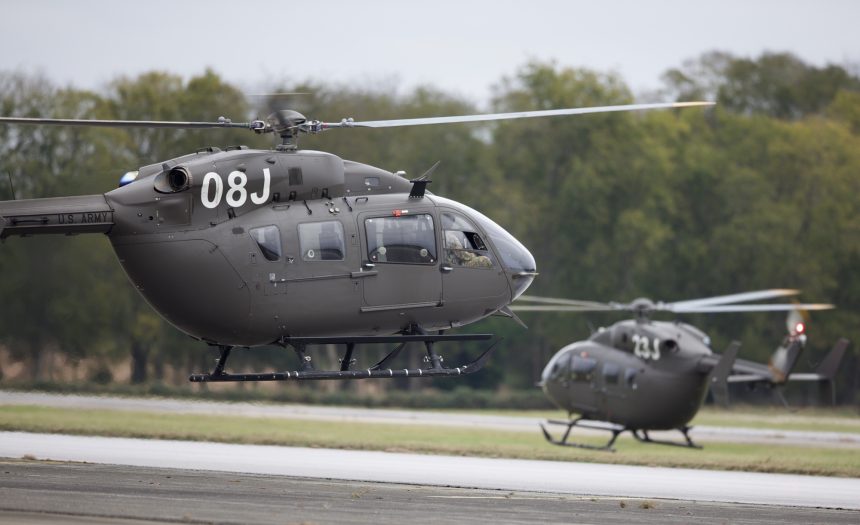
The U.S. Army is forging ahead with its ambitious Flight School Next program, designed to revolutionize aviator training at Fort Rucker. A select group of industry leaders has been chosen to proceed to the crucial second phase of the competition, signaling a significant step in the service’s quest for a new training helicopter fleet and curriculum.
The Race Intensifies: A New Phase Begins In a highly anticipated development, three prominent companies – Bell, M1, and Lockheed Martin – have publicly confirmed their advancement to Phase II of the competition. This next stage demands a more detailed exposition of their proposals, requiring them to „illustrate the full-scale of our turnkey solution,” according to a Bell spokesperson. The Army, maintaining a tight lid on official announcements, declined to comment on the selection of companies moving forward.
Leading Bidders and Strategic Partnerships The vying companies bring diverse solutions to the table. Bell is championing its 505 model helicopter, a platform it believes is perfectly suited for modern military flight training. M1 is leading a bid centered on Robinson Helicopter’s R-66 model, aiming to provide a robust training solution. Lockheed Martin, while confirming its prime contractor status, has yet to disclose its chosen helicopter subcontractor for this pivotal program.
Under the Flight School Next framework, prime contractors will shoulder the responsibilities of financing, major repairs, and logistical support. Subcontractors, in turn, will be tasked with supplying the helicopters, managing the supply chain, handling component-level repairs, and delivering the core flight school curriculum.
Jeffrey Schloesser, senior vice president of strategic pursuits at Bell, expressed the company’s honor and confidence: „With Bell’s extensive history in military flight training, the proven Bell 505, and the expertise of our teammates, we are confident that our turnkey solution will support the Army in developing the next generation of Aviation Warfighters.”
A New Vision for Army Aviation Training This multi-billion dollar initiative represents a radical departure from current training paradigms. The program aims to train between 800 and 1,500 rotary-wing pilots annually, with a substantial performance period spanning 26 years. A key element of this transformation is the shift to a Contractor-Owned, Contractor-Operated (COCO) model, transferring program ownership and operation from government management to industry partners. The contract award is currently anticipated by September 2026.
Beyond the Lakota: A Call for Simplicity The impetus for a new training fleet stems from the Army’s assessment that the incumbent UH-72 Lakota is overly complex and costly for initial flight instruction, partly due to its dual-engine design. Senior service officials have repeatedly voiced this concern. Last May, then-Vice Chief of the Army Gen. James Mingus famously remarked that the Lakota is „a very sophisticated aircraft that almost flies itself.”
Maj. Gen. Clair Gill, commanding general of the Army Aviation Center of Excellence at Fort Rucker, articulated the service’s desire for a „very simple aircraft” last fall. This emphasis on simplicity aims to get aviators back to fundamental skills, a critical objective given a recent uptick in helicopter accidents. A notice released last month explicitly stated that one of the qualifications for a „simple aircraft” includes a single-engine configuration.
Airbus Defends and Other Aspirants Remain Quiet Airbus, the current provider of the UH-72 Lakota, had also submitted a proposal for Flight School Next. While its spokesperson declined to comment on its selection status this week, the company has previously refuted claims of the Lakota’s complexity and expense. Airbus proposed a „hybrid” single-engine solution, stating, „We submitted a proposal that reduces Army training costs while meeting its stated training objectives… Our solution is affordable, sustainable, retains the safest rotary wing trainer in Fort Rucker history, and honors the U.S. taxpayer’s $2.2B investment in the program.”
Other notable contenders in the initial phase included Leonardo, offering its TH-73 helicopter with Boeing as the prime contractor. Both companies, however, have not commented on their current status in the competition. MD Helicopters with its 530 helo and Enstrom Helicopters with its 480B model also vied for the contract, but spokespeople for both companies similarly declined to comment on their advancement.
Congressional Scrutiny and Future Outlook While the Army targets a September 2026 contract award and has begun the crucial down-selection process, congressional oversight looms large. A provision within the recently signed National Defense Authorization Act (NDAA) mandates that funds cannot be obligated or expended for the program’s implementation at Fort Rucker in 2026 until the service’s secretary provides a „detailed report” on a one-year pilot program.
This pilot program, known as the „Part 141 Proof of concept flight training model,” commenced last spring and is designed to pave the way for Flight School Next by facilitating the transition from government-owned to a COCO training model. Furthermore, the NDAA requires the secretary to provide a thorough analysis of cost-effectiveness and a compelling rationale for any proposed changes to training systems or platforms, ensuring robust scrutiny of this transformative undertaking.