A audacious nighttime operation by the United States military to directly penetrate downtown Caracas and apprehend Venezuelan leader Nicolás Maduro encountered minimal ground-to-air resistance, but conspicuously absent was any aerial challenge from Venezuela’s fighter jet fleet. The „Absolute Resolve” raid, executed in the early hours of January 3, has sparked intense debate and revealed critical insights into the state of Venezuela’s air power.
While full details of the dramatic incursion are still emerging, defense experts suggest that the lack of aerial engagement points to two primary factors: the tactical element of complete surprise, and the long-term strategic hollowing out of the Venezuelan air force by its own regime.
The Unanswered Call: A Tactical Collapse
During the raid, observers believe Caracas was too stunned to mount an effective aerial response. „Caracas realized that any scramble would be quickly neutralized,” hypothesized Andrei Serbin Pont, president of the Argentina-based CRIES think tank. This understanding likely led Venezuela to „prioritize the withdrawal and dispersion” of its aerial assets rather than risk an open confrontation.
Retired Colombian Air Force Col. Iván González echoed this sentiment, stating that the Venezuelan air force’s „status is worse than in the year 2000.” He underscored the current „low level of capabilities of [Venezuela’s fleet of combat] aircraft, [and] limited quick-reaction capabilities.”
Venezuela’s Air Arm: A Legacy in Decline
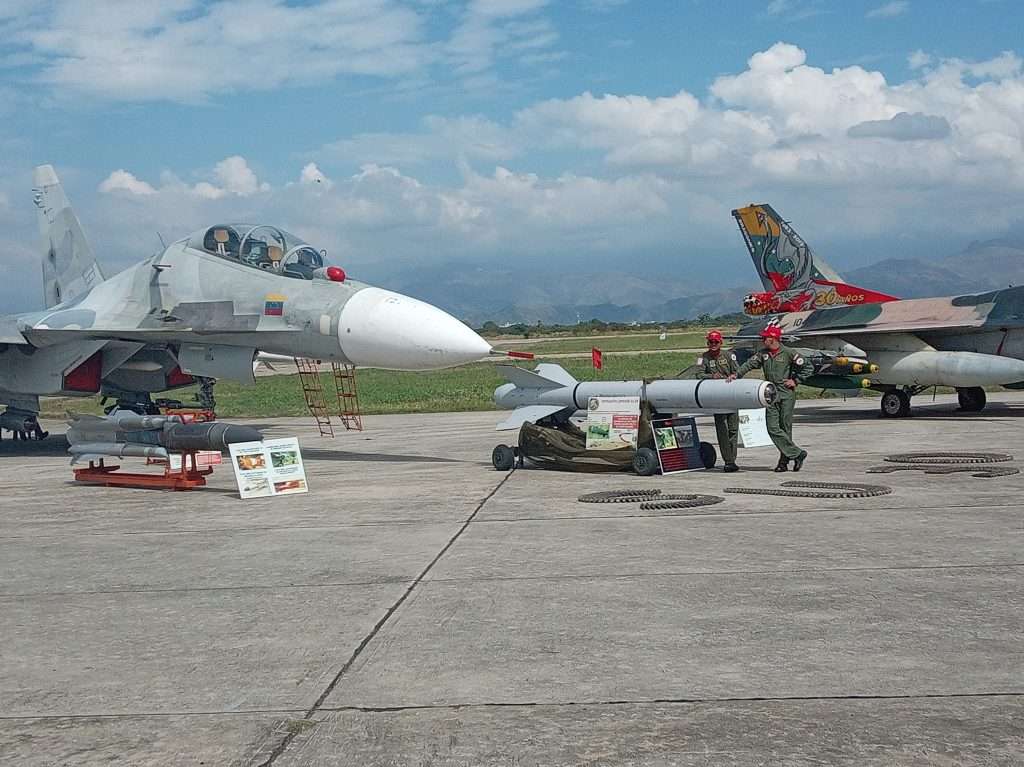
The Aviación Militar Bolivariana, Venezuela’s official air force, operates a diverse array of aircraft acquired from various nations, including the United States, Russia, and China. The fleet still includes F-16A/B Fighting Falcons, initially procured from the US in the early 1980s during a period of more amicable relations. These F-16s were notably seen conducting a fly-by of US ships in the Caribbean following a strike on suspected drug boats last September, demonstrating at least some operational capacity.
Under the administrations of Hugo Chávez (1999-2013) and Nicolás Maduro (2013-2025), Caracas significantly expanded its inventory with Sukhoi Su-30s from Russia and Hongdu K-8 light attack aircraft from China. Older Embraer 312 Tucano aircraft from the 1980s also remain in service.
According to the Military Balance 2025, a publication by the International Institute for Strategic Studies, the air force’s fighter and ground attack capabilities are theoretically divided among two F-16 squadrons, four Sukhoi squadrons, one Tucano squadron, and two K-8 squadrons.
However, the actual number of airworthy aircraft remains shrouded in secrecy. Decades of international sanctions, a crippling economic crisis, and a severe shortage of spare parts have undoubtedly forced the military to cannibalize some systems to keep others operational. Nonetheless, footage released by the Venezuelan military just days before the Absolute Resolve operation showed a Sukhoi belonging to combat group No. 11 “Diablos” taking off, indicating continued, albeit limited, activity. Based on open-source intelligence, Serbin Pont estimates the Venezuelan air force can likely field up to six single-seat warplanes, albeit with „limits in the available weaponry,” and approximately 12 airworthy Sukhois.
The Human Factor: A Critical Shortage of Skilled Pilots
Beyond the aircraft themselves, a significant challenge plagues the Venezuelan air force: its human capital. Crackdowns on perceived coup-plotters, widespread desertion of personnel, and severely restricted air training availability have led to a critical scarcity of qualified combat pilots. Serbin Pont notes that the air force likely relies on „few pilots of advanced age.”
González further elaborated on this deficiency, highlighting „low levels of pilot training” and a pervasive „low morale and will to fight” among those still available to fly.
The Night of the Raid: US Precision and Venezuelan Silence
Chairman of the Joint Chiefs of Staff Gen. Dan Caine provided a timeline for the US operation, which unfolded on the night of January 2 into the early hours of January 3. US forces deployed helicopters, flying at just 100 feet over water as they approached Venezuela’s coast. „As they approached Venezuelan shores, the United States began layering different effects provided by SPACECOM, CYBERCOM, and other members of the interagency to create a pathway,” Caine stated. This sophisticated integration of kinetic and non-kinetic capabilities ensured „the element of surprise” was maintained as the helicopters transitioned over Venezuelan terrain.
While US Southern Command has not provided details on aerial engagements, the lack of air-to-air combat strongly suggests the Venezuelan air force was incapacitated or simply unable to respond.
The Venezuelan Ministry of Defense confirmed attacks in Caracas and the states of Miranda, Aragua, and La Guaira during the early hours of January 3. Strikes hit the El Libertador air base in Macay, Aragua, and the Generalísimo Francisco de Miranda air base in Caracas, the latter known to house a Russian-supplied Buk-M2E air defense system. Several online videos, though unconfirmed, appeared to show the Buk-M2E system destroyed during the operation.
It remains unclear, however, how many, if any, Venezuelan fighter jets were damaged in these strikes, as Caracas has yet to confirm any aircraft destruction. Although social media videos from January 3 reportedly showed F-16s and Sukhois flying in Aragua and Puerto Ordaz, their veracity could not be independently confirmed.
González believes the rapid nature of the US operation left no time for a Venezuelan aerial response, suggesting they „did not receive early warning notifications or real-time intelligence.” According to Caine’s timeline, the US attack force was over Maduro’s residence by 1:01 AM ET and had departed Venezuelan airspace back over water by 3:29 AM.
Fallout and Future Scrutiny
In the wake of the raid, President Donald Trump announced he had „canceled” a second military operation, deeming it unnecessary. Meanwhile, interim President Delcy Rodríguez responded with leadership changes, naming Gen. Gustavo González López as the new commander of the counter-intelligence general directorate (DGCIM) and the presidential honor guard. Despite what many perceive as a catastrophic failure during the operation, Minister of Defense Gen. Vladimir Padrino López and Air Force Commander Major General Lenín Ramírez Villas have retained their positions.
Observers will undoubtedly continue to scrutinize Venezuela’s military posture following this unprecedented incursion, with the performance—or lack thereof—of its air force serving as a stark indicator of the regime’s diminishing capabilities.