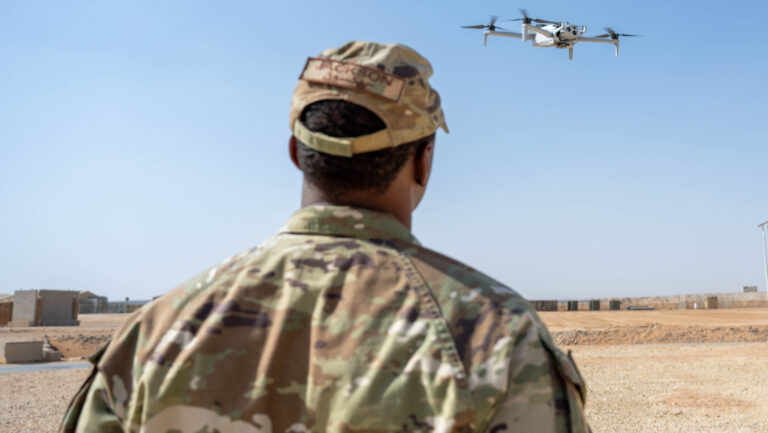
An intense debate is currently shaking U.S. defense circles, questioning the strategic direction of the Air Force. Critics argue that the prioritization of advanced fighters and high-end capabilities is a mistake, advocating instead for an air army built on a massive number of drones and inexpensive munitions, capable of ensuring persistence in modern warfare. It is contended that such an approach, based on mass and layered defenses, could deny adversaries freedom of action long enough to shape outcomes. However, this seemingly pragmatic vision conceals a fundamental and potentially dangerous redefinition of airpower.
A Dangerous Reframing of the Objective: Control or Denial?
At stake in this debate is a subtle yet crucial redefinition of airpower’s objective: shifting from controlling the air and gaining strategic advantages by doing so, to merely denying enemy access. Air denial, undoubtedly, has its place. It can serve as an effective defensive approach for nations whose primary goal is survival or cost imposition. States lacking the capability to achieve air superiority often adopt this strategy to make the air domain too dangerous for an adversary to dominate. Ukraine, for instance, serves as a prime example of how air denial is vital for survival against an enemy with superior air capability.
However, the United States is not a regional power seeking merely to blunt an attack. It is a global power whose strategy depends on projecting force, achieving desired strategic and operational effects, and sustaining operations across vast distances. For such a mission, denial is not enough. Air denial constrains both sides, whereas air control empowers one. In a near-peer conflict, the distinction between these two conditions lies between friction and initiative.
Air Superiority: A Local and Temporal Necessity, Not a Utopia
U.S. Air Force doctrine does not define air superiority as permanent, omnipresent dominance. It defines it as the degree of dominance in the air battle that permits operations at a given time and place, without prohibitive interference from enemy air and missile threats. These qualifiers are essential. Air superiority is inherently local and temporal, achieved where and when needed to enable joint effects. It does not require eliminating every enemy aircraft or missile; rather, it focuses on generating sufficient control in specific areas, for specific durations, to fulfill a particular mission.
Confusing superiority with supremacy is a category error. Supremacy implies near-total dominance, while superiority, as defined in doctrine, is operationally bounded. Against a near-peer, supremacy may be unrealistic; however, local and temporal superiority, correctly understood, is not. The danger lies in conflating the two and declaring air superiority unattainable because supremacy might be. In practice, this means air superiority is episodic. It is generated, exploited, contested, and regenerated throughout a campaign. These windows of control must be synchronized through integrated counterair operations and resilient air battle management, capable of sensing and directing combat power in degraded environments. Air superiority does more than just enable the Navy to sail or the Army to maneuver. It also allows the Air Force itself to attack, impose strategic effects, and achieve war-winning objectives. Air control is not merely a supporting function. It is a prerequisite for the decisive application of airpower.
Drones: Complement, Not Substitute for Air Superiority
The context of air superiority becomes crucial when the argument shifts to unmanned systems and air defenses. To be clear, small unmanned systems do matter and have dramatically changed the character of land warfare. The Russia-Ukraine war has significantly altered conventional infantry and armor tactics. Attritable drones and collaborative combat aircraft can extend sensing, distribute risk, and increase magazine depth. But quantity alone does not produce air superiority.
Substituting air denial for air superiority in force design risks institutionalizing stalemate across all domains. In theaters such as the Indo-Pacific, joint campaign concepts assume the ability to generate episodic air superiority to protect naval forces, support ground maneuver, and sustain operations across vast distances. Without this capability, deterrence weakens. Escalation becomes harder to manage. Operational risk increases across any joint operation. Air denial has a role and is a necessary layer in homeland defense and point defense of critical assets. However, it should never become the objective of theater-wide airpower application.
Costly Failures and Decisive Successes: Lessons from Ukraine and Iran
No mere words are needed to support this argument. The two most recent wars involving great powers, Ukraine and Iran, provide clear evidence. The absence of early air superiority in the Russia-Ukraine conflict has demonstrated the operational cost of this failure. Neither Russia nor Ukraine secured sufficient air control at the outset; both retained the ability to contest it, but the result has been a stalemate, not an advantage for either side. Both forces operate under constant threat from aircraft, surface-to-air systems, and unmanned systems. Maneuver is constrained. Gains are incremental and costly. The battlefield reflects persistent contestation rather than episodic air superiority. The lesson is not that air superiority is unattainable against a capable adversary. The lesson is that when it is not achieved, the campaign devolves into attrition. A key aspect of airpower exists to prevent this condition, not normalize it.
A similar dynamic is visible in the ongoing conflict with Iran. Recent U.S. and Israeli operations in the region have underscored how quickly the character of a campaign shifts once air superiority is established. When Iranian air defenses are suppressed and hostile aircraft are deterred from operating, coalition forces gain the freedom to strike military infrastructure, disrupt command networks, and impose strategic effects across the theater. The difference is not simply tactical advantage, but operational freedom. Air superiority creates the conditions for decisive action. Without it, campaigns slow, maneuver becomes constrained, and military operations revert to costly attrition. Iran’s approach illustrates the limits of this logic. Tehran has spent years investing heavily in large inventories of inexpensive drones and loitering munitions precisely because it lacks a modern fighter force capable of contesting the air domain. Iran’s experience shows that mass isn’t enough to control the skies. Its drones can harass infrastructure, impose costs, and complicate defenses, but they have not enabled Iran to control the air over any battlefield. Drone mass can support a denial strategy. It cannot generate air superiority. Achieving air control in a near-peer fight requires defeating advanced fighters, suppressing and dismantling integrated air defense systems, and coordinating forces in contested environments.
A Call to Reaffirm Air Superiority: America’s Strategic Future
The Air Force, combatant commands, and professional military education schools should reject calls to redefine airpower in terms of denial strategies. Instead, they should reaffirm air superiority as a foundational objective and invest in a force design built around next-generation fighters, teamed with collaborative combat aircraft, and enabled by resilient air battle management that can generate repeated windows of air control in contested environments. In a potential conflict with China, the objective will not be permanent supremacy across the entire theater. It will be the ability to generate air superiority at decisive times and places to protect naval forces, enable power projection, and sustain operations across the vast distances of the Indo-Pacific.
Recent conflicts reinforce the lesson: in Ukraine, the absence of air superiority has produced a stalemate. Iran’s reliance on large inventories of drones and missiles has imposed costs on its adversaries, but it has not produced air control. When U.S. and Israeli forces suppressed Iranian air defenses and neutralized hostile aircraft in the opening hours of the current conflict, their aircraft were able to strike targets across Iran with relative freedom. The contrast is instructive: drone mass can complicate an adversary’s operations, but it cannot prevent an opponent that achieves air superiority from imposing devastating effects. Air denial is how lesser powers preserve limited airpower when they cannot achieve air control. Air superiority is how great powers impose their will in the air domain. The United States has the capacity to achieve air control. It should reinforce and expand that capability. If the Air Force narrows its ambition from achieving air control and imposing strategic effects to merely contributing to denial, it risks duplicating defensive functions while neglecting its core responsibility to shape and win wars at scale. That is not modernization. It is abdication.