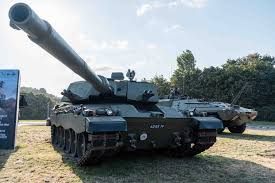
First Live Firing in Over Three Decades Marks Crucial Milestone
The British Army has reached a significant benchmark in its modernization program: the newly upgraded Challenger 3 Main Battle Tank has successfully completed crewed live firing tests. This historic moment, representing the first live firing of a UK-operated main battle tank in over 30 years, marks a key milestone for the £800 million ($1.08 billion) program, which aims to deliver 148 vehicles into service. The live firings took place at an undisclosed UK Ministry of Defence training center, as announced by German manufacturer Rheinmetall.
A Technological Giant Ready for Action
The Challenger 3, produced by the joint venture Rheinmetall BAE Systems Land (RBSL), is touted as a significantly more advanced and capable version of its Challenger 2 predecessor. Key improvements include the integration of Rheinmetall’s 120mm smoothbore gun, a digitized turret, state-of-the-art day and night targeting sights, Rafael’s Trophy active protection system, and a modular armor system. These features position it as a central pillar in the efforts to strengthen Britain’s land warfighting capability. The live firing trials followed a rigorous program, beginning with remote operation and culminating in firings conducted by RBSL personnel, thereby confirming the tank’s capabilities and systems prior to its operational service.
Production Challenges and Strategic Horizons
While technological advancements are evident, the Challenger 3’s production timeline remains under scrutiny. The vehicles are designed and produced at RBSL’s facility in Telford, England, with eight prototypes slated for delivery. However, serial production will only commence once the tank’s performance is fully proven, according to statements from Luke Pollard, UK Minister for Defence Readiness and Industry. He emphasized that the project team will regularly review the timeline to ensure alignment with delivery milestones, operational needs, and emerging technical risks. An Initial Operating Capability (IOC) is anticipated for 2027. Pollard also indicated that production issues are directly linked to the Challenger 3’s supply chain, with the MoD focusing on „securing the necessary materials, identifying opportunities and mitigating risk to deliver tanks to users as soon as practicable.”
British Army’s Ambitions in a Changing Geopolitical Landscape
The Challenger 3 program is vital to the British Army’s commitment to doubling its warfighting capabilities by the end of 2030, in response to growing threats from major adversaries such as Russia, China, and Iran. The context of this modernization becomes even more relevant given that, while the UK armed forces hold an inventory of 288 Challenger 2 vehicles, only 148 of these are slated for upgrade to the Challenger 3 standard. Despite difficulties faced by other high-profile land programs, such as the Ajax armored fighting vehicle, the successful completion of live firing tests for the Challenger 3 represents a confident stride forward in Britain’s efforts to bolster its security and strategic standing on the global stage.