As Iranian drones continue to slip through the air defenses of Gulf nations, the governments under fire are increasingly seeking assistance from an unexpected ally for anti-drone expertise: Ukraine. The Eastern European nation, at the forefront of hybrid warfare for years, has developed a range of innovative solutions to counter unmanned aerial threats, and this hard-won experience is now becoming a highly sought-after commodity globally.
Unprecedented Demand from the Middle East
Ukrainian defense companies are swamped with inquiries. “At the moment almost every nation of the Middle East that Iran is attacking — which is to say almost every nation — is trying to reach out,” stated a communications head for a major Ukrainian drone producer. Government representatives, private companies, funds, and NGOs are utilizing various channels to contact Ukrainian experts, generating a huge number of requests.
Major deals, such as the one reportedly brewing with Saudi Arabia, could mean a much-needed financial windfall for Kyiv as it braces for its fourth year of fending off a Russian invasion. Ukrainian President Volodymyr Zelenskyy recently confirmed that Ukraine had sent three teams to different countries in the Middle East to demonstrate drone defenses, hopeful for a financial return. “For us today, both the technology and the funding are important,” Zelenskyy underscored.
Ukraine’s Economic Imperative: Funding for Domestic Defense
While Ukraine’s economy is heavily militarized, money for buying more weapons is tight. Ukrainian manufacturers contend that new foreign funding could bolster both the local economy and their capacity to supply weapons for Ukraine’s domestic defenses. Experts suggest that export deals may be an effective way to ramp up production beyond what internal funding in Ukraine can offer.
Lessons from Ukraine: The Cost-Effective Response to the Shahed Threat
Iranian-made Shahed drones have swarmed across Ukraine’s skies since early in the war with Russia. Moscow acquired its first batches in late 2022, eventually building its own production of local copies, known by various names. These low-cost unmanned attack drones are often launched in massive swarms, with over 700 units flying in a single night.
In response, Ukraine has built an entire ecosystem of “layered” air defenses, where cheap aerial weapons are met with correspondingly cheap anti-air defenses. This approach avoids a scenario where a multi-million dollar Patriot missile destroys a $20,000 UAV – an unsustainable proposition, especially given that PAC-2 and PAC-3 missile production is already maxed out worldwide.
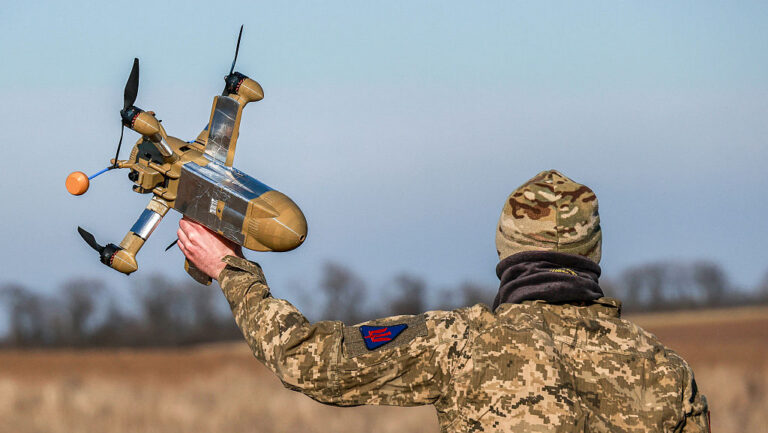
Ukraine’s interceptor drones represent a new and far cheaper means of shooting down a drone than any other on the market. This Ukrainian ability to economically counter drones is, for the moment, unique. The technology is „not high-tech at all,” developed to address a specific type of threat. Initial „interceptors” were functionally supercharged first-person-view (FPV) drones flown directly into Russian ISR drones. As the technology advanced, they gained the speed and strike power necessary to take on Shahed drones.
Wild Hornets, a Ukrainian firm, produces the Sting, the first mass-produced anti-drone drone and likely the model that has seen the most action. The company is now working on a “Sting 2,” whose primary advantage would be its ability to catch jet-powered Shaheds, which outpace many current Ukrainian interceptor models. Many of Iran’s stockpiled Shahed drones, by contrast, are clunky, flying in relatively straight lines at medium heights – targets ideal even for the oldest models of Ukrainian interceptor drones.
While total numbers of interceptor drones currently produced in Ukraine are a closely guarded secret, producers tout figures of tens of thousands. The commander-in-chief of Ukraine’s Armed Forces reported over 6,300 sorties by interceptor drones in February alone. President Zelenskyy recently told the British Parliament that his country could produce 2,000 such drones a day, needing approximately 1,000 for internal use, leaving some 30,000 per month open for export.
Navigating Export Barriers and Global Competition
Foreign interest is currently focused on Ukrainian interceptor drones, but there’s a significant catch. Since the start of Russia’s full-scale invasion, Ukraine has maintained strict export controls on domestic weapons. While manufacturers receive constant inquiries, the final decision remains with the government.
“As is well known, government leadership is looking for paths to help partners and at the same time not reduce Ukraine’s ability to defend itself,” stated a representative for TAF Drones. Ukraine’s export office maintained there had been “no new regulations” but emphasizes that foreigners seeking permissions should contact Ukrainian government agencies.
This „unique window of opportunity,” however, may be temporary. “The global military market is made in such a way that demand on interceptor drones will be filled by other developed nations,” warned a Ukrainian military expert. The US already produces advanced drones, such as the 10,000 Merops drones sent to the Middle East, demonstrating that other countries will step in. Even worse for Ukraine would be to lose out to industrial competitors from Russia, a country with whom some Gulf nations have traditionally shown no qualms in doing business.