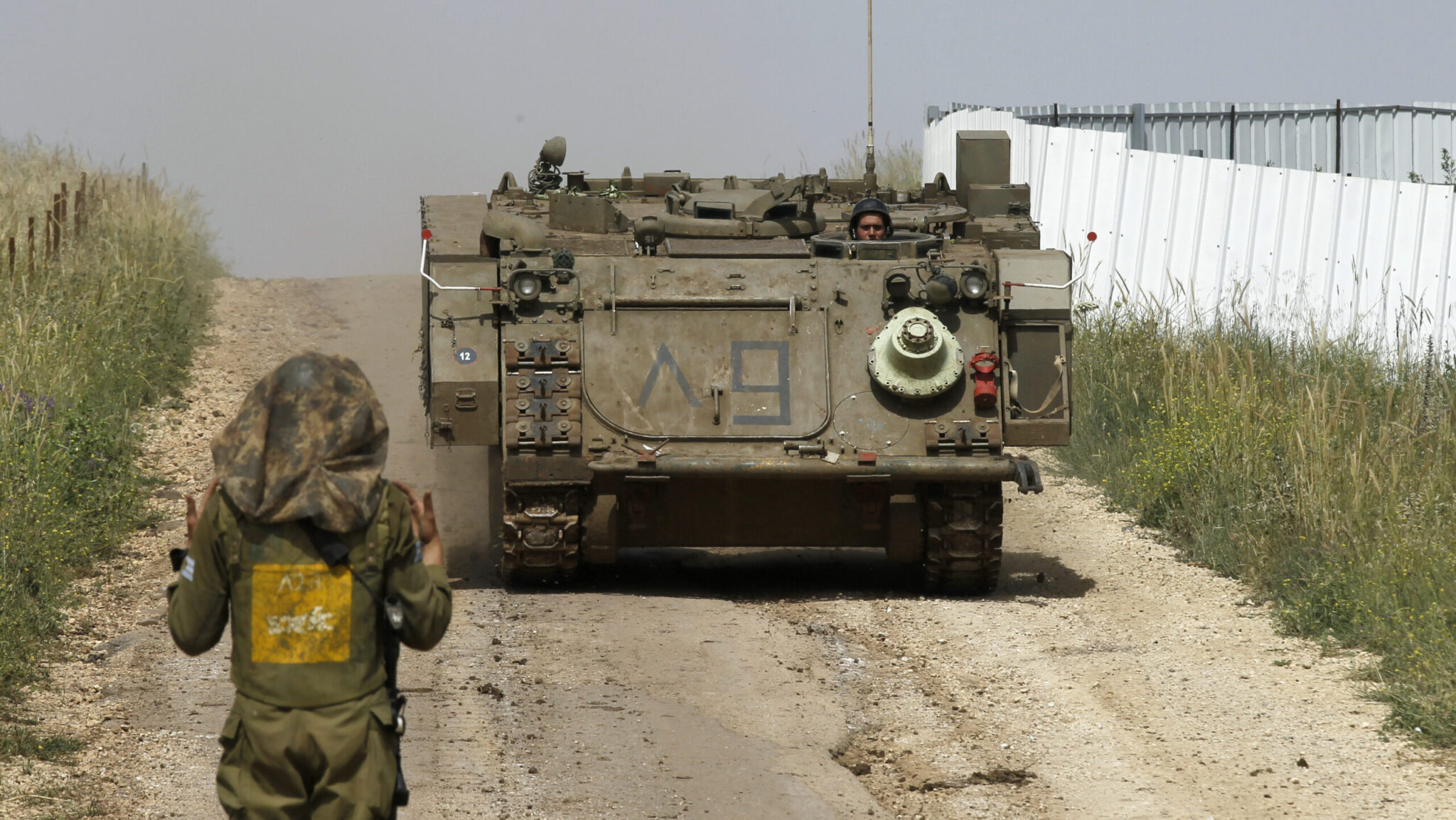
When Israeli armored personnel carriers enter combat zones in Gaza, they sometimes lack a traditionally crucial element: personnel. For months, the Israel Defense Forces (IDF) have reportedly been utilizing unmanned versions of various vehicles, capitalizing on advancements in technology to deploy these platforms in combat while minimizing risks to soldiers.
Recent reports have indicated sightings of unmanned M113 armored personnel carriers (APCs) being used in the ongoing Rafah campaign that began in May. Footage of one such modified vehicle in action has surfaced, leading to insights from a veteran of previous Israeli wars who observed the unmanned M113s. Preferring to remain anonymous for security reasons, the veteran stated, „There is utility in recycling [the vehicles] and finding a new purpose for them. They are sturdy to a certain extent. They can traverse a lot of terrain.” The M113, which has been in service for over 60 years, is one of the older APC models employed by the IDF, which now also utilizes the Namer and the newer Eitan APCs.
As early as 2015, the website Israel Defense reported on an unmanned version of the M113 developed by G-NIUS, a joint venture between Israel Aerospace Industries (IAI) and Elbit Systems. Israeli media outlets have been documenting sightings of unmanned ground vehicles since at least February. However, representatives from G-NIUS, Elbit Systems, IAI, and the IDF chose not to comment on the functionality of the M113 for this article. The IDF, in particular, has been reticent about discussing its expanding autonomous fleet.
An official at defense industry giant IAI, who went by the name Rani for security reasons, explained that IAI has developed upgraded versions of robotic and autonomous systems for various vehicle platforms. “We have developed upgraded versions of robotic and autonomous systems for different kinds of vehicle platforms,” he stated.
Rani highlighted that the transition from manned to unmanned vehicles requires the integration of both hardware and software. This includes sensors and processing systems that equip the vehicles with a “brain,” enabling them and their remote operators to make real-time decisions. „It’s a niche that necessitates suitability for robotics and autonomous capabilities for obvious reasons,” he explained.
An Israeli soldier with combat experience noted that some M113s have been modified to enhance their combat capabilities. Additionally, other variations of the M113 are also reportedly being used by the IDF as platforms for 120mm mortars. Rani was able to discuss the now-unmanned D-9 bulldozers, utilized in Gaza, which were revealed by the IDF in May.
“On this platform, we have the entire sensing equipment required to control it remotely,” noted Rani. “We are also implementing features to help navigate around obstacles, completing various combat engineering missions such as route clearing and supporting combat units in different capacities.”
In May, Israel’s Ynet outlet reported on 50-ton unmanned bulldozers, referred to as “Pandas,” which are designed to handle engineering tasks such as ground excavation, construction work, clearing rough terrain, establishing firing positions for tanks, and demolishing buildings—all without a human operator behind the wheel.
Other nations, including the United States and Australia, have also explored remote-controlled, unmanned, and uncrewed versions of the M113, with remote weapon stations installed for potential use in Ukraine.
For a vehicle that has been in service since the 1960s, integrating new technology appears to have revitalized the M113 platforms with new operational roles in modern combat scenarios.