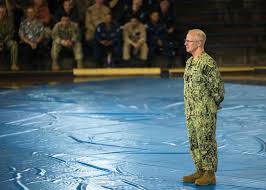
The top officer in the United States Navy has voiced profound concern that the military engagement in the Iran conflict is diminishing the ability of US forces to address other global threats and deter strategic rivals, such as China. The accelerated consumption of essential resources raises questions about long-term strategic balance.
„Mathematical Certainty”: Munition Stockpiles Under Strain Admiral Daryl Caudle, Chief of Naval Operations, recently stated it’s a „mathematical certainty” that intensively using a finite resource reduces its availability for other challenges. „It’d be silly for me to say anything other than I’m concerned. Readiness is being consumed. I mean, we’re built to do that. I mean, it’s a conflict. And so we’re designed to go do that,” Caudle explained. He highlighted that since operations in Iran began on February 28, hundreds of Tomahawk land attack missiles, Patriot interceptors, and Terminal High Altitude Area Defense (THAAD) anti-ballistic missile systems have been employed. As of March 28, US forces have struck over 11,000 targets and destroyed or damaged more than 150 Iranian vessels, according to US Central Command (CENTCOM). Although US leadership has maintained there are plenty of munitions, Secretary of Defense Pete Hegseth announced the Pentagon’s intention to request supplemental funds from Capitol Hill for Middle East operations and to replenish depleted stores.
US Aircraft Carriers: Extended Missions and Massive Deployments The implications of the conflict are also felt in naval deployments. The aircraft carrier USS Gerald R. Ford, which commenced its mission in June 2025, is now expected to remain at sea for 11 months, far exceeding the Navy’s standard seven-month deployment. This extension could set new records, reminiscent of intense conflict eras. Furthermore, the aircraft carrier USS George H.W. Bush is being sent to CENTCOM’s area of responsibility, bringing the total number of US carriers in the region to three. This buildup of forces also includes the transfer of weaponry from the Pacific theater of operations to the Middle East, signaling a strategic reallocation of resources.
Strategic Innovation: SOUTHCOM as a Lab for Future Forces Amidst these challenges, Admiral Caudle also revealed a new strategic approach, detailed in the „Fighting Instructions” issued in February. These guidelines propose supplementing carrier strike groups with customizable forces and provide combatant commanders with fresh, mission-specific formation patterns. The plans also aim to advance a „hedge strategy” that leverages unmanned systems and offers a range of tailored options to maximize flexibility.
The US Southern Command (SOUTHCOM) will likely serve as a „test bed” for these tailored forces. Caudle is working closely with General Francis Donovan, SOUTHCOM Commander, to identify the right force packages to address key operational problems in the region. „What does he need an enduring package [to] look like? Like an afloat forward staging base, an LCS? Can you do something with an LPD? And can I put together a thing that solves his problem? That’s not a natural muscle memory thing for us in the Navy,” Caudle explained. This approach requires reevaluating how units that fall outside traditional strike group structures are certified, marking an effort to adapt to an ever-evolving security environment.