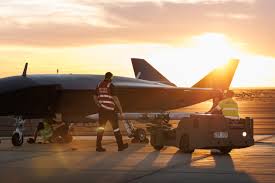
Berlin is bracing for a revolution in military aviation, and the race to supply its future Collaborative Combat Aircraft (CCA) is intensifying. In a strategic move, German giant Rheinmetall has announced a collaboration with Boeing, proposing the MQ-28 Ghost Bat drone to the German Air Force. This ambitious partnership aims to integrate an advanced autonomous platform into the Bundeswehr’s defense system by 2029.
A National System Manager for Cutting-Edge Technology According to Rheinmetall’s statement, the company will assume the role of „system manager” for the MQ-28 Ghost Bat in Germany. This entails full responsibility for integrating the drone with the Bundeswehr’s „existing and future command and weapon systems.” Plans include adapting the aircraft to specific national requirements and ensuring operational, maintenance, and logistical support. The objective is to deliver a robust CCA solution capable of operating within the dynamic European defense landscape.
The Battle for German Skies: Fierce Competition Ahead The German CCA contract, however, is attracting other industry heavyweights. The alliance between Airbus and Kratos is a formidable competitor, offering the US firm’s XQ-58A Valkyrie drone. Airbus has already announced preparations to fly two Valkyries equipped with a „sovereign European mission system” later this year, a move aimed at emphasizing European autonomy in advanced technology.
General Atomics Aeronautical Systems (GA-ASI) has also expressed interest in the European CCA market, leveraging the Air Force’s YFQ-42A prototype and proposing a „teamed operation” involving „independent U.S. and German aerospace affiliates.” A local option is also possible, with German-based defense and technology start-up Helsing potentially competing with its own CA-1 autonomous aircraft.
MQ-28 Ghost Bat: A Proven Force Multiplier The MQ-28 Ghost Bat, originally developed for the Royal Australian Air Force and manufactured in the Asia-Pacific region, is a proven platform. With over 150 flights to its credit, it has demonstrated its effectiveness as an autonomous system. „A proven autonomous CCA, it will act as a force multiplier, teaming with manned platforms to provide critical combat mass in highly contested airspace,” Rheinmetall underscored. Its modular design and autonomous behaviors enable it to perform a broad range of missions, from reconnaissance to electronic warfare and weapon system integration. This collaboration between Rheinmetall and Boeing follows discussions in August 2025 between Rheinmetall CEO Armin Papperger and Boeing and Lockheed Martin, in which he estimated Germany might require around 400 CCAs.
Challenges and Context: Beyond Partnerships This new industrial partnership also emerges against the backdrop of a challenging period for Rheinmetall. Recent comments by CEO Armin Papperger regarding the Ukrainian drone industry sparked a wave of online criticism and pushback from Ukrainian President Volodymyr Zelenskyy. Rheinmetall subsequently issued a statement on social media, reaffirming its „utmost respect for the Ukrainian people’s immense efforts in defending themselves against the Russian attack – now for more than four years. Every single woman and man in Ukraine is making an immeasurable contribution.” A spokesperson for the German Ministry of Defense declined to comment on the potential procurement project prior to parliamentary approval, underscoring the rigorous nature of military acquisition processes.