In southeastern Latvia, about 180 kilometers (112 miles) from the Russian border, multinational operators of advanced unmanned ground systems are running into an unlikely but powerful adversary: dense Baltic woodlands that are cutting off their links to the outside world.
From May 5-15, Latvia is hosting Exercise Crystal Arrow, during which NATO is, for the first time, testing the large-scale use of hundreds of unmanned ground vehicles (UGVs) at the brigade level. NATO’s Task Force X (TFX) has brought in European manufacturers under the Eastern Flank Deterrence Initiative, an effort to speed up the fielding of new defense technologies.
The result is both a showcase of next-generation robotics and a stark reminder of how quickly those systems can be blinded and silenced in real terrain.
Starlink under the trees: when canopy kills the signal
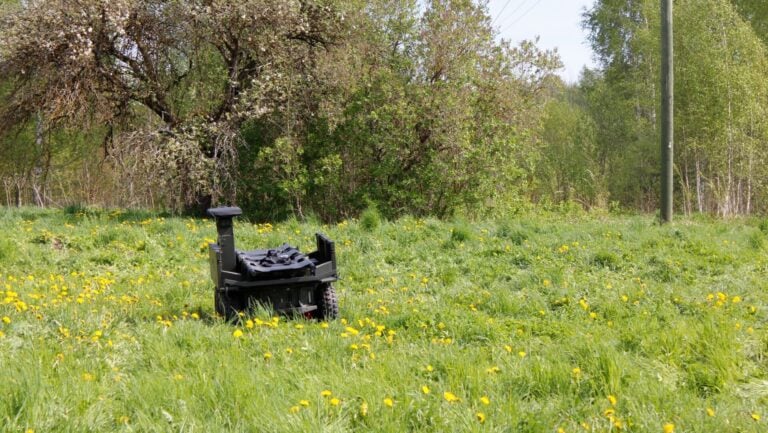
Several UGV operators reported serious communications problems in Latvia’s heavily forested training areas, particularly on platforms using Starlink as their primary link.
“A key challenge of operating a Starlink-equipped UGV is under a canopy of trees, which degrades communication links very rapidly or blocks the line-of-sight required to maintain high-speed, continuous connection,” a Latvian National Guard soldier said, speaking on condition of anonymity.
He was operating the Natrix UGV, a Latvian-made platform previously tested in Ukraine. Natrix is designed for a wide range of missions but during Crystal Arrow was used mainly for logistics and medical evacuation. In addition to Starlink, the vehicle carries two other communications systems — a medium/long-range radio and a short-range radio — intended to provide redundancy if the satellite link fails.
Reliance on commercial space: strategic asset or single point of failure?
Asked about depending on an American commercial satellite network as the backbone of connectivity, the Latvian operator was blunt: he would not be comfortable if Starlink were the only option.
“With recent developments we’ve seen it can be beneficial but also subject to disappearing suddenly,” he said, capturing a growing concern among NATO militaries about relying on privately controlled space infrastructure they do not fully govern.
The communications problem went beyond ground robots. Aerial drones also struggled, with vegetation acting as a physical barrier to their signals. Canadian troops from a reconnaissance unit assigned to NATO’s Multinational Brigade in Latvia reported similar issues while operating the US-made Raven-B drone.
“How high and dense the tree line is messes with our equipment and signal,” Corporal Elana Clement told reporters during the drill.
Latvia is not Ukraine: why the robot war doesn’t copy-paste to the Baltics
Latvia is one of several countries looking to gradually integrate UGVs into its force structure and doctrine, as a complement to existing capabilities. Ukraine, which today fields the largest number of combat robots in active war, plans to contract industry to produce 25,000 UGVs in the first half of 2026, citing “increased demand.”
But Latvian officers are clear: Kyiv’s experience is not directly exportable, even against the same adversary.
“In Ukraine, the line of sight is much further — in Latvia it is much closer, and this allows us to utilize this terrain for our needs and as an advantage where it’s easy to block the roads, for example,” said Maj. Eduards Šinkūns, exercise director and commander of a Latvian infantry battalion.
According to Latvia’s Investment and Development Agency, forests cover about 50 percent of the country, making it one of Europe’s most wooded states. Ukraine, by contrast, has roughly 16 percent forest cover, offering a far more open battlespace where radio and satellite links face fewer physical obstructions.
Mud, season and mobility: when UGVs are fair-weather assets
Beyond the trees, Latvia’s harsh climate further complicates the picture for unmanned systems.
“Winters here force us to rethink how we fight,” Šinkūns said. Warmer months allow vehicles, including UGVs, to maneuver off-road far more easily. In winter, however, mud and soft ground can effectively shut down cross-country movement.
That means robotic platforms which in Ukraine can drive relatively freely across open fields run into a double barrier in the Baltics: forests that choke communications and months of the year when terrain itself becomes impassable.
Crystal Arrow’s warning: high-tech doesn’t cancel out geography
Exercise Crystal Arrow has given NATO a rare chance to test cutting-edge ground robots and small drones at scale and in a realistic environment on the alliance’s front line. But behind the demonstrations lies a sobering conclusion.
No matter how advanced the unmanned systems, they are still bound by the physical realities of the terrain and climate in which they operate. For the Baltic states and other Eastern Flank allies, integrating UGVs will not mean copying Ukraine’s playbook, but crafting new concepts of operation tailored to a battlespace where forests and mud can be as decisive as missiles and artillery.