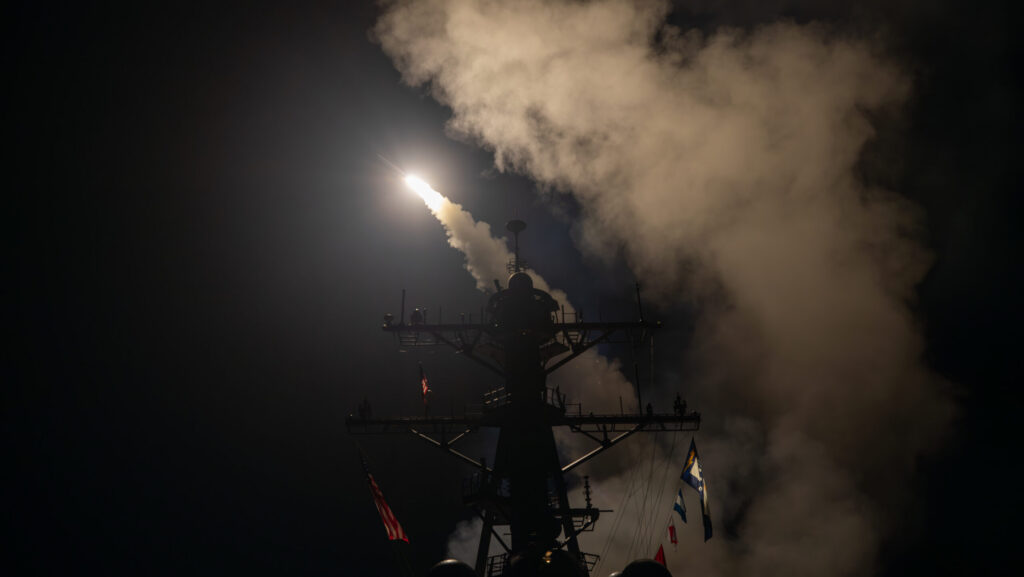
The US Navy has taken another major step in its drive to rebuild and expand its precision‑guided weapons stockpiles, awarding RTX subsidiary Raytheon a massive $22.9 billion contract to increase annual production of the Tomahawk cruise missile to 1,000 rounds per year.
The deal, announced by RTX, follows a framework agreement signed in February with the Pentagon that set the broad terms for future contracts but did not lock in final funding levels. The newly awarded contract turns that framework into a firm, multiyear commitment designed to fundamentally expand America’s industrial capacity for long‑range missiles.
“We are making significant investments in our workforce, technology, supply chain and facilities to dramatically boost production capacity and meet surging demand,” Raytheon President Phil Jasper said in a statement. The company did not disclose a precise timeline for reaching the 1,000‑per‑year target, saying only that the ramp‑up will occur over a “multiyear period.”
RTX officials note that the surge is already visible: in the first half of 2026, the company delivered three times more Tomahawks than in the same period last year, indicating that production lines are already being expanded and streamlined.
Multiyear contracts as leverage on industry
Against the backdrop of the war in Ukraine and rising tensions in the Indo‑Pacific, the Pentagon has been reshaping its approach to the defense industry. Instead of fragmented, year‑by‑year purchases, it is turning to multiyear contracts for what it considers critical munitions.
The logic is straightforward: in return for long‑term visibility and guaranteed volume, major defense primes like RTX are expected to make far more aggressive investments in production capacity, infrastructure and labor.
“The Department called upon industry to expand munitions production, and RTX has answered that call,” said Michael Duffey, the Pentagon’s top acquisition official. “This Tomahawk award increases our ability to equip the Joint Force, ensuring our Warfighters never face a fair fight.”
The message is clear: Washington is not just trying to top up depleted inventories, but to build a production base capable of sustaining a high‑intensity conflict over time, where long‑range cruise missiles like Tomahawk are central to precision strikes against hardened or heavily defended targets.
Heavy investments in people, plants and supply chains
To reach the new 1,000‑per‑year production level, RTX has launched a broad investment program in four key areas:
- Workforce – large‑scale hiring, specialized training for missile manufacturing, and retention efforts in a tight labor market;
- Technology – modernizing assembly lines, increasing automation, and digitizing industrial processes;
- Supply chain – diversifying suppliers of critical components (engines, guidance systems, sensors, electronics) and reducing vulnerability to bottlenecks or delays;
- Facilities – expanding and upgrading existing plants, and potentially opening new production capacity where demand and funding justify it.
The Tomahawk surge is part of a wider missile portfolio push. In parallel, Raytheon has signed framework agreements to increase output of several other high‑demand systems:
- the AMRAAM air‑to‑air missile, a cornerstone of Western air superiority;
- Standard Missile‑6 (SM‑6), with roles in air defense, missile defense and anti‑ship missions;
- Standard Missile‑3 IIA, a key element of ballistic missile defense architectures;
- accelerated production of the Standard Missile‑3 IB variant.
During a July 23 earnings call, RTX CEO Chris Calio said the company has had “very, very productive and constructive conversations” with the Pentagon about turning those framework agreements into definitive, funded contracts, signaling that industry is bracing for a sustained wave of orders rather than a one‑off spike.
Industrial base consolidation and a signal to allies
The dramatic increase in Tomahawk output has implications well beyond US internal planning. The missile is already in service with, or under consideration by, multiple US allies, from the United Kingdom to Japan and Australia. A higher American production ceiling:
- supports foreign military sales and joint acquisition programs;
- strengthens interoperability within NATO and Indo‑Pacific partnerships;
- sends a signal to potential adversaries that the replenishment rate of Western stockpiles is becoming less of a structural vulnerability.
For the Pentagon, the stakes are twofold: avoid being forced to choose between supporting allies and preserving US reserves, and demonstrate that long‑discussed acquisition reforms can actually translate into tangible results “at the speed of war.”
Whether the promised investments fully materialize remains to be seen. But for now, the $22.9 billion Tomahawk contract stands out as one of Washington’s clearest moves to transform its defense industrial base from a system optimized for peacetime into one capable of sustaining, if necessary, a prolonged, high‑end conflict.