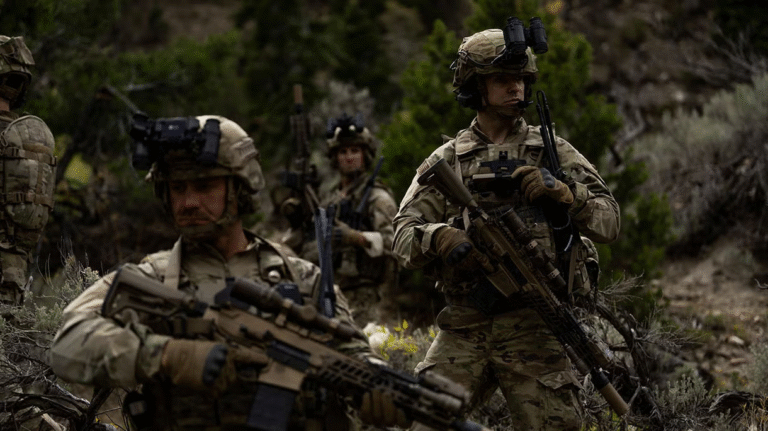
As small drones inflict heavy losses on both sides in Ukraine, defense electronics firm L3Harris is trying to flip the script: the company is reprogramming its widely fielded Falcon IV handheld radios to generate a personal protective electronic‑warfare “bubble” around the troops who carry them.
Branded Wraith Shield, the new capability requires no additional hardware, executives say — just a software upgrade to the existing Wraith communications waveform, which is already compatible with more than 100,000 Falcon IV radios worldwide.
Counter‑UAS by download: a software upgrade as a soldier’s shield
“At the cost of a software upgrade … single digit thousands of dollars … you can add this capability to a radio they’re already carrying,” Chris Aebli, president of L3Harris’s Mission Critical Communications division, told reporters. “[It’s] their own protection bubble for counter‑UAS.”
The company says Wraith Shield is ready for delivery, though international sales are still awaiting US export approval. While no formal orders have been placed yet, Aebli said there is “a tremendous amount of interest, both internationally and domestically,” with “a handful of customers” close to buying.
The US Army, he suggested, may shift electronic‑warfare funds to one of its radio program offices to buy the software: “They might execute the acquisition as a radio upgrade, at least initially.”
SDRs as EW tools: exploiting the ‘digital brains’ of modern radios
Fundamentally, L3Harris and partner DataShapes AI are leveraging the processing power built into modern software‑defined radios (SDRs), whose flexibility blurs the lines between military handhelds, commercial smartphones, and specialized EW gear.
To run the Wraith waveform — developed in 2022–2023 with extensive Ukrainian input, according to L3Harris — a Falcon IV already has to scan the spectrum, identify other Wraith‑equipped friendly radios, form an ad hoc local network, and exchange data.
Wraith Shield layers on a new function: detecting which signals an adversary is using to control their drones, sharing that information across the local net, and coordinating all radios in the net to transmit, effectively, white noise on the same frequencies, jamming the control links.
Platoon‑scale jamming: 40 radios now, 100 in the next upgrade
The current version of Wraith Shield can synchronize jamming from up to 40 Falcon radios at once, enough to equip a typical infantry platoon. L3Harris engineers are working on boosting that figure to 100 radios in a future update.
What happens to the drones once the link is cut depends on how each platform is programmed: some may loiter aimlessly, some may execute a return‑to‑base routine, and others may simply crash.
Beyond immediate effects in the field, Wraith Shield can also push data on detected threats back to command posts or more powerful counter‑UAS systems, plugging the local “bubble” into a broader defensive architecture.
Not a silver bullet, but a missing layer against small drones
Aebli and other executives stress that Wraith Shield is no cure‑all for every unmanned threat and works best as just one element in a layered defense that includes sensors, dedicated jammers, and kinetic interceptors.
What it does add, they argue, is a new layer of close‑in electronic protection at the individual soldier and small‑unit level — a layer that has been largely absent so far, even as cheap, lethal drones have become a defining feature of modern war.