As the U.S. Army rolls out new weapons and learns from the battlefield experiences in Ukraine, soldiers from the 3rd Infantry Division are actively evaluating what works and what doesn’t with their latest combat vehicles.
“What we’re doing right now is maximizing our existing resources and experimenting within our units to adapt to the rapid changes we are witnessing globally,” said Maj. Gen. Christopher Norrie, commander of the 3rd Infantry Division, during a press briefing on September 20.
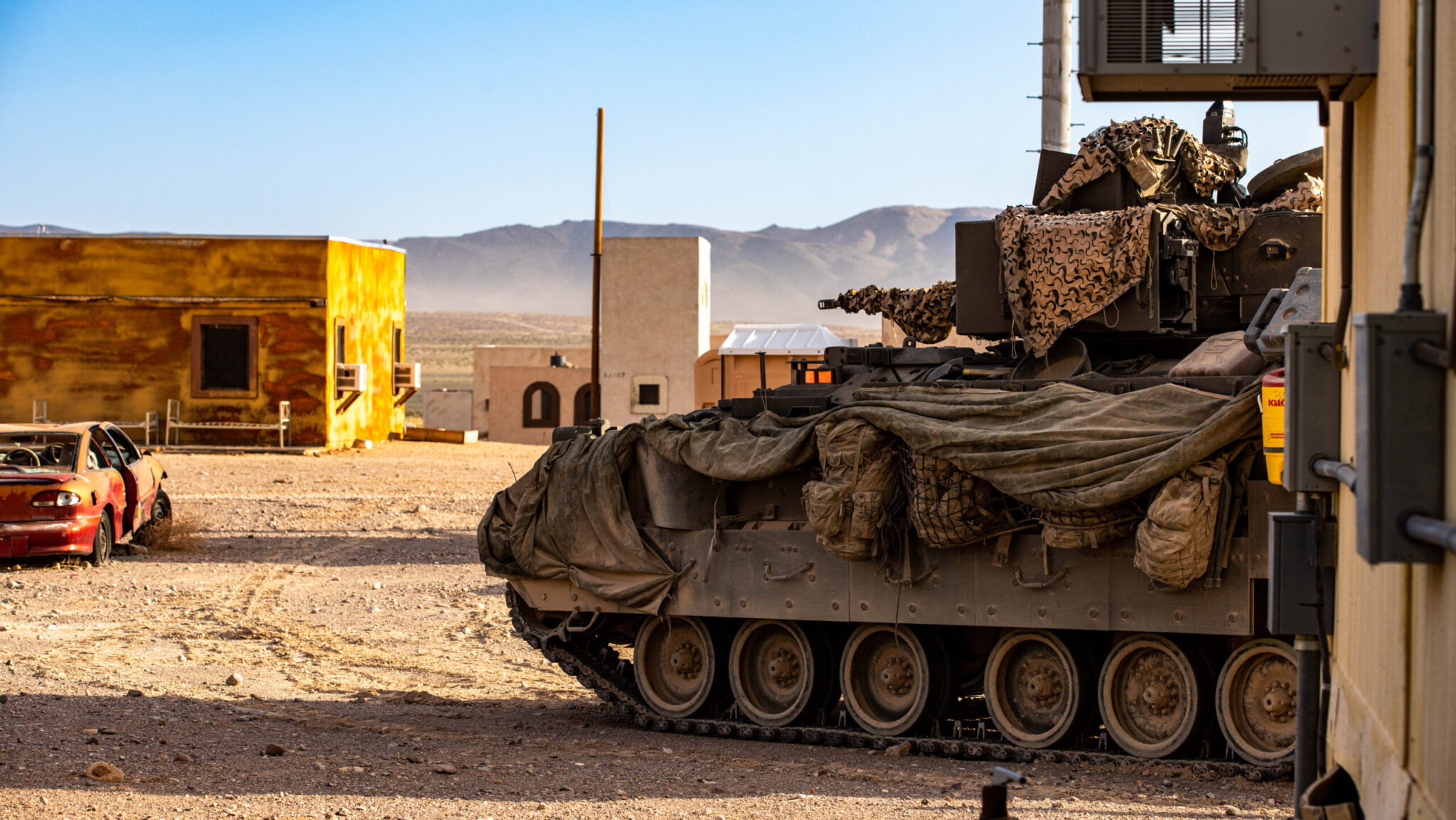
Recently, the division replaced a significant amount of outdated equipment with the new M1A2 System Enhancement Program version 3 (SEPv3) Abrams main battle tanks, M2A4 Bradley Fighting Vehicles, M109A7 Paladins, and the Armored Multi-Purpose Vehicle (AMPV), among others.
The 3rd Infantry Division trained extensively with these new vehicles before an eight-month deployment to Europe, covering locations such as Poland, Lithuania, Latvia, and Estonia. They further enhanced their training at the National Training Center in Fort Irwin, California, focusing on increasing the survivability of their formations.
“We’ve been undergoing significant transformation both during our recent European deployment and back here in the United States,” the two-star general added.
Soldiers of the 1st Armored Brigade Combat Team (ABCT) are the first to utilize the Army’s new tracked combat APMV, designed to replace the M113 family. While Norrie and the 1st ABCT commander, Col. Jim Armstrong, did not provide specific insights on how this new vehicle might alter infantry tactics, they noted that it enhances command and control integration, partly due to the inclusion of the field artillery digital fire system within the vehicle.
The unit has also restructured the way it distributes and conceals its command posts across the battlefield. For a training exercise in California, they kept the main larger servers located at Ft. Stewart, Georgia, while soldiers there conducted defensive cyber operations, according to Armstrong.
Smaller servers were then relocated forward, allowing for a more innovative organization of command posts. Soldiers positioned out of the enemy’s firing range established a command post centered on intelligence, targeting, and logistics. The deployment of smaller, more agile command posts, alongside decoy setups, complicated the efforts of the opposing force—represented by the 11th Armored Cavalry Regiment, known as the Blackhorse Cavalry—to locate the right targets.
„These strategies effectively masked our formations while drawing the enemy out for counter-targeting,” Norrie stated, adding that these tactics were informed by lessons learned in Europe.
“Just a few years ago, brigade-level command posts took over 14 hours to dismantle,” Norrie noted. “We issued lengthy orders merely to mobilize our units, without considering emerging challenges like drones or threats in the air space, and we neglected the electromagnetic spectrum.”
In a bid to enhance the effectiveness of new equipment and operational frameworks through the “transformation in contact” initiative, these smaller command posts are designed to be set up and taken down in just 15 minutes. To mitigate electromagnetic signatures, the Army has implemented antenna farms positioned several kilometers away from these smaller command posts and connected them via fiber optics.
Drones have also gained increased prominence, with soldiers from the 1st ABCT arriving in California with 90 platforms and systems designed to neutralize potential enemy drones. “Our focus is on discovering innovative ways to organize our operations around these technologies,” Armstrong stated.
„We had battalions and squads equipped with unmanned aerial systems (UAS) that hadn’t previously operated at such volumes or command levels,” Armstrong explained. “Our objective was to engage unmanned systems first, prior to revealing and directing our indirect fire capabilities, putting our troops in direct-fire positions at advantageous times and locations.”
Though Armstrong and Norrie did not disclose whether the ABCT employed 3D printing during their training at Fort Irwin, the Army continues to explore the best methods to implement this capability in the field and within armored formations. A separate training event with soldiers from the 2nd Brigade, 101st Airborne Division involved the use of a 3D printer on a simulated battlefield to create small plastic replacement parts.
In an interview with Breaking Defense on September 20, Lt. Gen. Christopher Mohan, acting commander of Army Materiel Command, explained that his team is learning from these events to streamline the printing of replacement parts in future operations.
“Our digital repository is currently cumbersome for field users, as it was developed to operate at the strategic level of the organic industrial base (OIB),” Mohan noted. “We need to simplify access for units in the field and ensure that the right personnel are trained to navigate it effectively.”