In a powerful bipartisan move, U.S. lawmakers are pushing a comprehensive three-bill package designed to revolutionize the Pentagon’s aerial procurement and human capital management. The initiative aims to greenlight multiyear contracts for the F-35 and F-15EX programs, with supporters working to fold these critical measures into the Fiscal Year 2027 National Defense Authorization Act (NDAA).
Breaking the One-Year Cycle: Multiyear Procurement as a Shield Against Fiscal Inefficiency
The cornerstone of the package, the Airpower Acceleration Act, seeks to end the practice of purchasing sophisticated fighter jets in isolated annual tranches. Proponents argue that shifting to multiyear contracts is the only way to drive down unit costs and provide the defense industrial base with a stable demand signal. This long-term vision is expected to incentivize major capital expenditures, allowing vendors to establish secondary production lines and transition from incremental output to exponential growth.
By authorizing advance procurement of key components in economic quantities, the legislation aims to protect both the taxpayer and the warfighter from the volatility and high costs associated with year-to-year budgeting.
A Force in Flight: Countering the 2,000-Pilot Shortage with Bonuses and Flexibility
The legislative push also recognizes that advanced hardware is useless without elite operators. With a staggering deficit of over 2,000 pilots, the RETAIN Act and the Fighter Aircrew Career Flexibility Act introduce aggressive measures to stabilize the force. The plan involves significant hikes in bonus and incentive pay for veteran aviators, alongside a novel „career intermission” program that allows pilots to take up to a year off without jeopardizing their military trajectory.
Legislators emphasize that while air power is increasingly being asked to dominate the modern battlefield, funding distribution has yet to fully acknowledge the proportional reality of these operational demands.
The F-15EX Factor: Scaling Production to Meet Next-Gen Warfare Needs
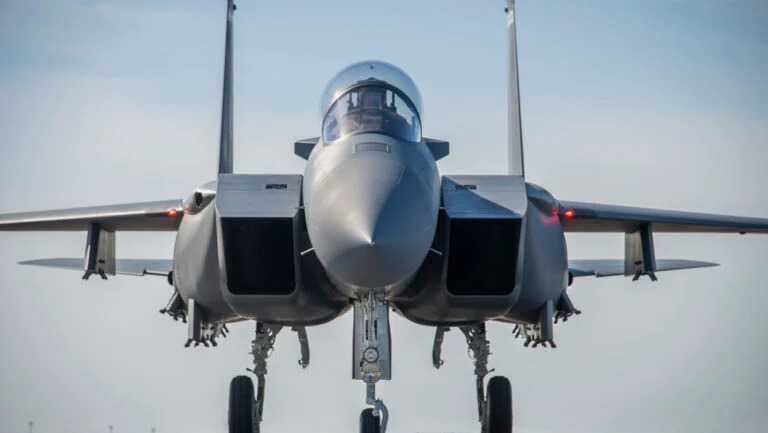
The bills set rigorous mandates for the U.S. fighter inventory, requiring at least 1,369 combat-coded jets by 2030 and 1,558 by 2035. Central to this expansion is the F-15EX—a platform described as a hybrid between a high-performance „Corvette” and a heavy-hauling „Chevy Suburban.” The legislation pushes to increase the total program of record to 329 aircraft, significantly higher than previous Air Force projections.
However, scaling production remains a primary challenge. While Boeing and the Air Force are discussing ways to ramp up the assembly line to three or four units per month, current efforts are still focused on consistently meeting the contracted rate of two aircraft per month. The proposed multiyear stability is seen as the vital catalyst needed to bridge the gap between legislative ambition and industrial reality.