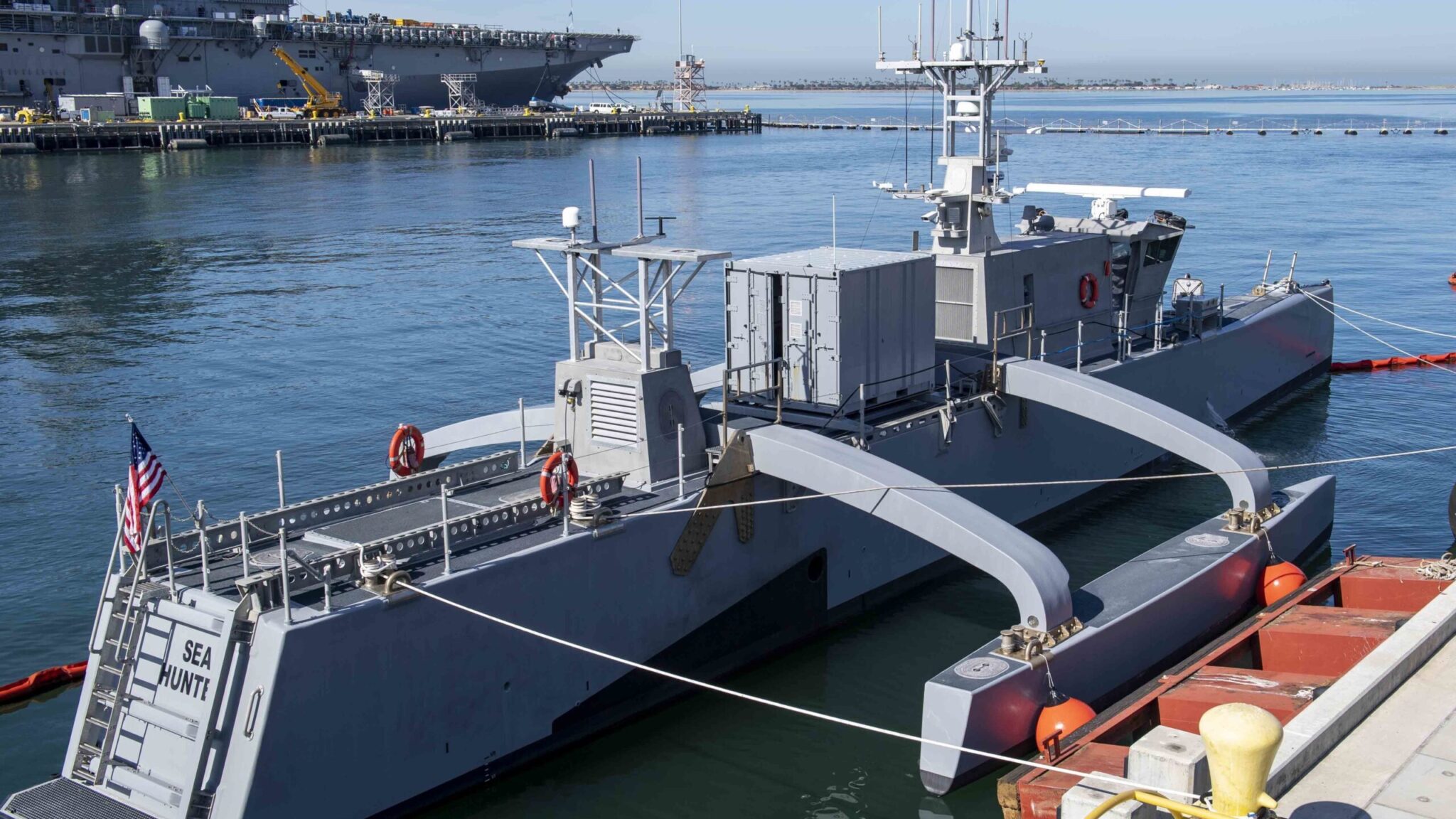
The United States Navy is poised for a significant transformation in its fleet composition, announcing the imminent operational deployment of its medium-sized drone boats. After extensive prototyping and testing, two such vessels are slated to join the active fleet this year, with a landmark integration into a carrier strike group scheduled for 2026, marking a decisive move from experimental trials to frontline capability.
From Lab to Fleet: Drones Take the Helm The vessels in question, the Sea Hunter and Seahawk – formally known as medium displacement uncrewed surface vessels (MDUSVs) – are no longer confined to test waters. „They will actually be under fleet control, assigned to surface forces to be able to actually go out and do great things,” stated a senior Navy official at a recent conference in Washington. This year will see both MDUSVs transition into operational roles. The Seahawk, specifically, is anticipated to deploy with a carrier strike group by 2026, a groundbreaking step for integrating autonomous systems into core naval formations.
Scaling Up: A New Command Structure Emerges The Navy’s commitment to unmanned systems extends beyond immediate deployments. Plans are in motion to establish three „early command” USV divisions within the coming week, laying the groundwork for widespread integration. The long-term vision projects „operationalized USV squadrons in every fleet.” The inventory of MDUSVs is set for rapid expansion, with 11 expected by 2027 and a dramatic surge to over 30 vessels by 2030. This aggressive timeline underscores the strategic imperative placed on autonomous capabilities.
The Tech Behind the Transformation Both the Seahawk and Sea Hunter are manufactured by Leidos, a testament to industry partnership in advancing naval technology. The Sea Hunter, initially developed under a DARPA program, pioneered capabilities as an unmanned sub-tracker and sensing platform. Lessons learned from its development informed the 2017 contract for the Seahawk, which was subsequently delivered in 2021. Leidos officials emphasize their commitment to delivering these „dynamic capabilities” to the Navy, underpinned by their „proven mission-ready Leidos Autonomous Vessel Architecture (LAVA)” validated through rigorous testing.
Augmenting, Not Replacing: The Future Force These uncrewed ships are designed to bolster a diverse range of maritime missions, encompassing counter-mine activities, kinetic strikes, and critical intelligence, surveillance, and reconnaissance (ISR). While the Navy acknowledges ongoing work to craft specific concepts of operation, the overarching philosophy is clear: drones will augment, rather than replace, manned ships.
Unmanned systems are projected to constitute a considerable bulk of the Navy’s overall displacement in the coming decades, forming a key component of the envisioned future Golden Fleet. Projections indicate that by 2045, approximately 45 percent of the surface force could consist of unmanned systems. „The future is now,” remarked a Rear Admiral during a panel discussion, encapsulating the sentiment. „Unmanned systems, autonomous systems. AI, it’s not the future. It’s happening right now.” This marks a pivotal moment in naval warfare, heralding an era where autonomous technology becomes a cornerstone of maritime power.