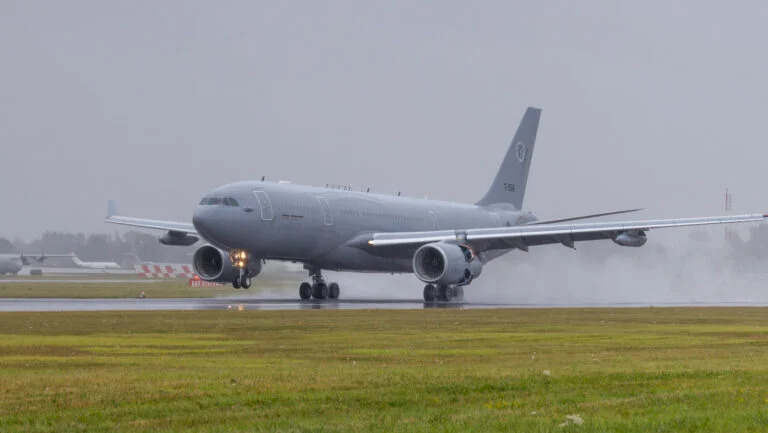
The European aerospace giant is betting big on Seville to meet booming MRTT demand, even as industrial friction clouds the future of the continent’s next-generation fighter.
In a decisive move to capitalize on its growing defense backlog, Airbus has unveiled plans to establish a new A330 Multi Role Tanker Transport (MRTT) conversion center in Seville, Spain. Expected to be operational before the end of 2027, the facility is a direct response to the escalating global demand for aerial refueling capabilities.
Seville’s Strategic Ascent: Boosting Production Capacity
The upcoming site is designed to augment Airbus’s existing operations in Getafe, aiming to increase the annual conversion rate of civil-to-military aircraft from five to seven units. Beyond conversions, the Seville hub will serve as a specialized center for maintenance, repair, overhaul, and critical upgrades for the aging global A330 fleet.
Industry leadership emphasized that Seville was the logical choice for this expansion, given its existing world-class infrastructure as the home of the A400M and C295 final assembly lines. The expansion will be backed by a significant investment to modernize industrial assets within the company’s hangars, ensuring the site can handle the increased technical complexity.
Turning the Tide: Securing the Italian Contract Over Boeing
The expansion comes on the heels of a major geopolitical and commercial victory. Italy recently awarded Airbus a €1.4 billion ($1.6 billion) contract for six A330 tankers, a move that effectively sidelined Boeing’s KC-46 Pegasus. Rome’s decision to pivot away from its 2022 plan to buy American-made tankers underscores the growing dominance of the MRTT platform in the international market.
Pioneering Autonomous Teaming in the Mediterranean
Airbus is also pushing the boundaries of maritime warfare through successful „crewed-uncrewed teaming” trials. In a recent exercise conducted in Rota, Spain, the company demonstrated a high-speed maritime intercept mission.
Utilizing Flexrotor and Alpha 900 drones to track a target, the system broadcasted live intelligence to a Spanish Navy H135 helicopter and an offshore patrol vessel. This simulation highlights the future of Intelligence, Surveillance, Target Acquisition, and Reconnaissance (ISTAR) missions, where autonomous systems and manned assets operate in seamless synchronization.
Industrial Deadlock: The Sixth-Generation Fighter at a Crossroads
However, the outlook is not without its challenges. During a defense summit in Manching, Germany, Airbus CEO Guillaume Faury addressed the ongoing friction surrounding the tri-national sixth-generation fighter jet program.
A bitter industrial dispute with French partner Dassault has stalled progress, leaving the project’s fate in the hands of the German, French, and Spanish governments. Despite high-level diplomatic efforts to resolve the impasse, a breakthrough remains elusive, forcing the aerospace giant to wait for political clarity on how—or if—the flagship defense program will proceed.