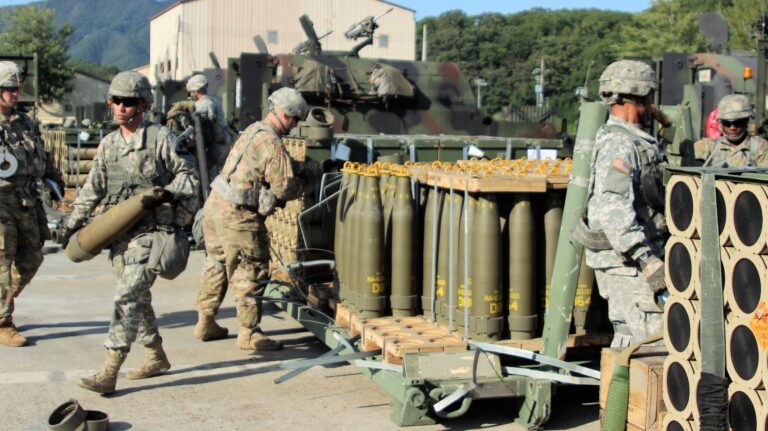
In a strategic move aimed at bolstering the precision strike capabilities of land forces, General Atomics Electromagnetic Systems (GA-EMS) has secured a contract to develop a 155-mm projectile under the Extended Range Artillery Projectile (ERAP) program. This phase marks the expansion of the company’s production and innovation capacities, as it joins other major defense industry names like General Dynamics and BAE Systems in the race for next-generation munitions.
Beyond the 65-kilometer barrier: The ambitious goals of the XM1155 program
The Army’s initiative, also known by the codename XM1155, aims to create a projectile capable of eliminating moving targets at ranges exceeding 65 kilometers. The program seeks lethal solutions against a wide range of threats, from self-propelled howitzers and infantry fighting vehicles to tanks and maritime targets. This need for enhanced standoff range and lethality became a priority after a previous extended-range cannon project was scrapped in favor of developing advanced ammunition.
Fierce competition among defense giants: General Dynamics and BAE Systems join the race
The smart projectile market is experiencing a surge in activity, with General Dynamics Ordnance and Tactical Systems (GD-OTS) already presenting the Vulcano 155 system. Developed in collaboration with European partners from Italy and Germany, this projectile promises a range of up to 70 kilometers. Meanwhile, BAE Systems is working on its own version of the 155-mm munition, reinforcing a competitive landscape where technological innovation is the primary driver for ensuring battlefield supremacy.
Precision technology for contested environments and the 2030 deployment timeline
The newly proposed solutions rely not only on brute force but on surgical precision supported by advanced aerodynamics, GPS guidance, and laser or infrared sensors. These technologies allow for target engagement even in environments where GPS signals are contested, an essential requirement in modern warfare. The timeline is tight: military officials aim to reach Initial Operational Capability by fiscal year 2030, with low-rate production scheduled to begin as early as the second quarter of FY29.