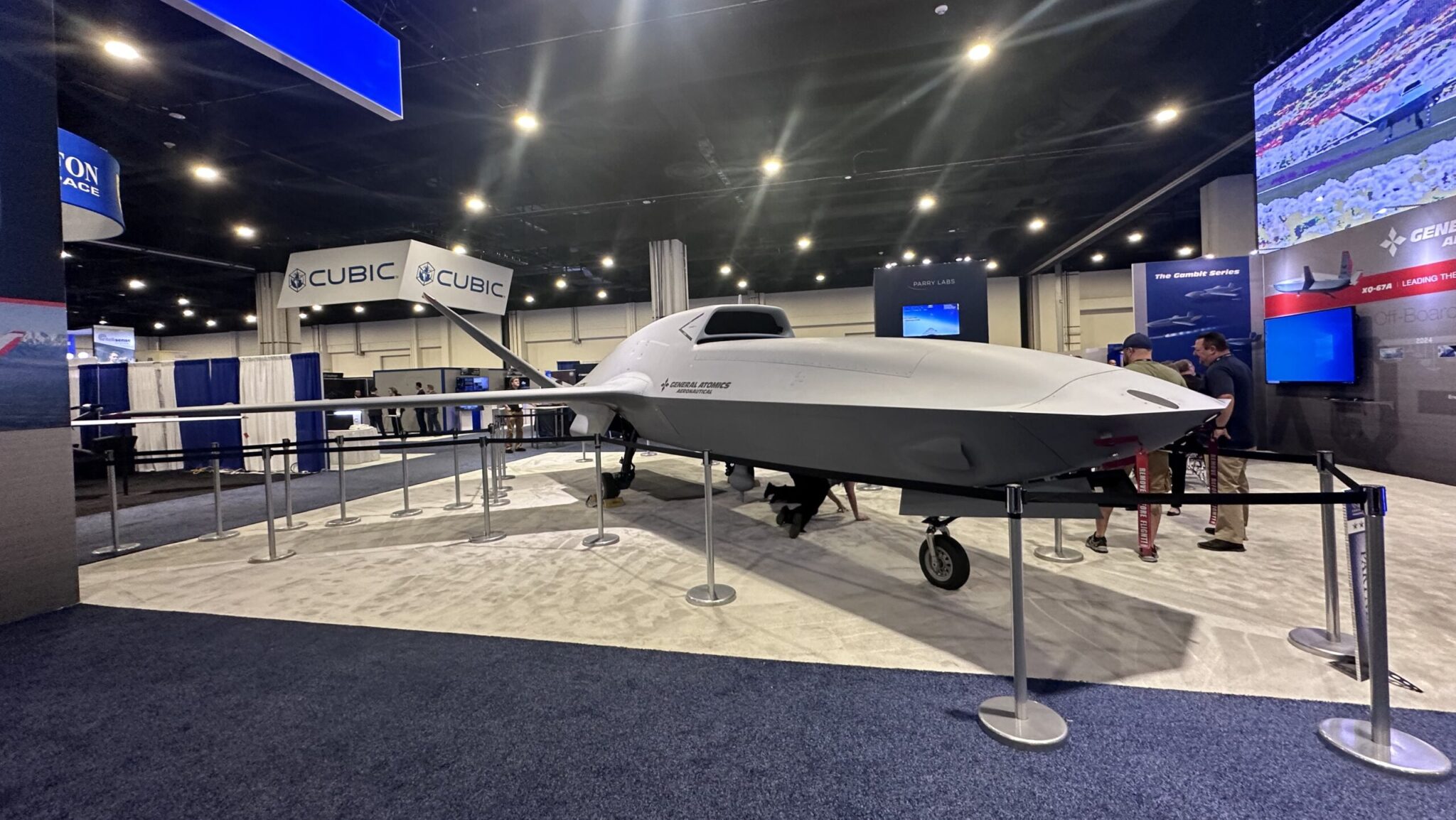
General Atomics could significantly increase the production rate of its autonomous combat drones, known as Collaborative Combat Aircraft (CCA), to one unit per day within two to three years, contingent on direction from the Defense Department, according to Dave Alexander, the company’s head of aeronautics.
Despite the U.S. Air Force yet to award a production contract for the CCA or outline a definitive acquisition plan for at least 1,000 drones, General Atomics is proactively evaluating its production capabilities to meet potential needs from other U.S. services and international clients, which may drive demand closer to 2,000 units.
“The question is, how quickly can you get them there?” Alexander remarked, emphasizing the urgency in ramping up production capabilities.
In the past, General Atomics has manufactured its unmanned vehicles at a rate of one every three days, translating to around 100 aircraft annually. However, with current investments in production automation, Alexander believes that transitioning to a daily output for a single model is quite feasible.
To achieve this accelerated production, General Atomics could easily reach a rate of one CCA every two days utilizing its existing 5 million square foot facility in Poway, California. For a more aggressive production schedule, additional facilities would be necessary, though Alexander noted that capital investments for expansions would not be excessive.
In April, the Air Force awarded contracts for CCA prototypes to both General Atomics and technology startup Anduril, with the expectation that prototypes will take to the skies next year ahead of a production decision set for 2026. Air Force officials have indicated that they may opt to procure CCAs from one or both of the vendors or consider other previously eliminated competitors.
Since the announcement of the prototype contracts, General Atomics and Anduril have engaged in a competition to promote their capabilities in developing a semi-autonomous combat drone designed to operate alongside fighter jets—an unprecedented innovation for the Air Force. General Atomics is leveraging new technologies to streamline CCA production, contrasting earlier hand-fabrication processes used for both the MQ-1 Predator and early MQ-9 Reaper models.
“Our goal right now is to minimize manual labor and integrate automation into the process,” Alexander stated. The company is exploring how robotic systems can be utilized to assemble parts more efficiently, akin to automotive production techniques, thereby expediting the construction of the drones with reduced manual processes.
To illustrate these advancements, General Atomics is implementing robotic technologies capable of laying up composite materials—key for efficiently constructing aircraft components like wings. Additionally, the integration of more additive manufactured parts aims to further decrease human labor and minimize material waste.
Anduril, a competing manufacturer, has also expressed ambitious production plans, aiming to build weapon systems, including the CCA, at “hyperscale” in a facility referred to as “Arsenal,” with an announcement regarding its location expected later this year.
Beyond the CCA initiative, Alexander mentioned that General Atomics is also assessing new variants of the Gambit drone, which serves as the base for its CCA model. One proposed variant, the Gambit 5, is designed for launch from aircraft carriers and aims to augment expeditionary capabilities, including takeoff from extremely short runways. While specifics on the takeoff requirements and launch mechanisms were not disclosed, Alexander expressed optimism about their development concepts, emphasizing the company’s innovative vision and strategic direction.