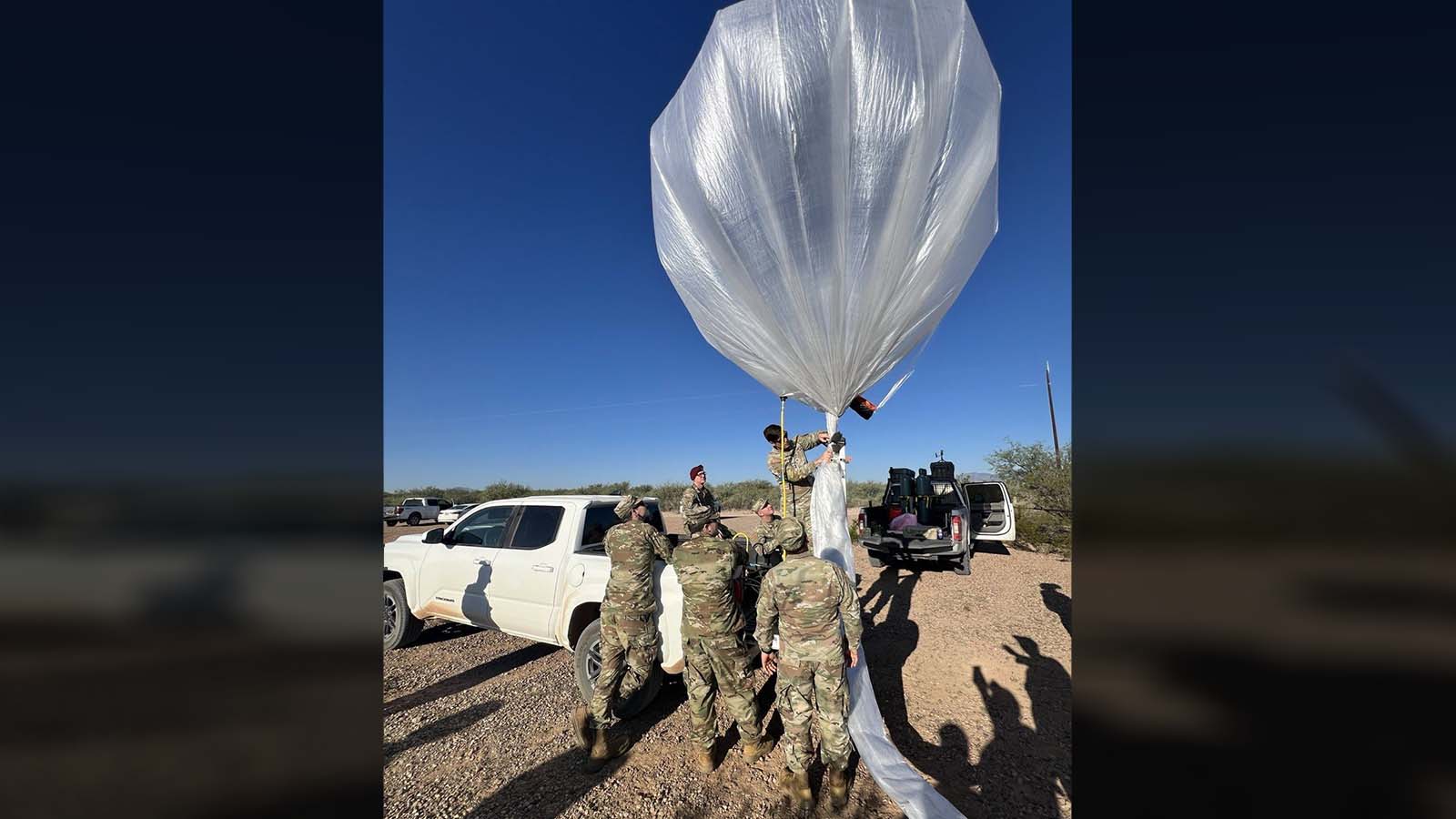
The U.S. Army is poised to approve a new initiative focused on micro-high altitude balloons (mHABs) for advanced sensing capabilities deep within enemy territory, as announced by Andrew Evans, director of the Army’s Intelligence, Surveillance, and Reconnaissance (ISR) Task Force. During comments made to Breaking Defense at the Association of the U.S. Army Conference, Evans outlined the tactical advantages of these smaller, highly portable balloons.
Evans explained that mHABs will be smaller and carry lighter payloads, making them more maneuverable and suitable for rapid deployment. “Imagine them being man-portable, potentially easier to launch from field conditions, and requiring less logistic support,” he stated.
The formal requirement for these micro balloons will facilitate the Army’s official acquisition of this new capability. The Army Space and Missile Defense Command has indicated that the service is examining various high-altitude platforms to meet operational needs and support multi-domain operations across joint forces. Over the past few years, the Army has particularly focused on stratospheric platforms for ISR missions.
The Army’s Program Executive Office for Aviation is spearheading the microHAB initiative, overseeing systems designed to operate at the upper tiers of the stratosphere, roughly between 60,000 and 100,000 feet and just below the boundary of orbital space. „The only way to get there is with balloons or ultra-light, solar-powered vehicles,” Evans noted, emphasizing that traditional aircraft cannot reach such altitudes.
In July, the Army issued a request for information aimed at gathering insights on small, lightweight electronic intelligence, communication intelligence, and radar payloads suitable for microHABs, which are expected to weigh under 15 pounds—relatively light compared to systems like the Joint Land Attack Cruise Missile Defense Elevated Netted Sensor System (JLENS).
Two weeks ago, the Army’s Program Executive Office for Intelligence, Electronic Warfare, and Sensors reported that testing on microHABs was underway, with systems successfully completing extensive communications and intelligence relay missions during the Vanguard 24 exercise conducted in September.
Although microHABs share similarities with larger high-altitude balloons, the capabilities afforded by their reduced size differ significantly. The Project Director for Sensors-Aerial Intelligence is currently working to advance these microHAB systems for deployment by soldiers.
Evans emphasized that the Army’s plans for high-altitude balloons are still evolving, as the service continues to experiment with alternative platforms, including solar-powered aircraft. Notably, the Army has engaged in experimental tests with the Airbus-manufactured Zephyr long-endurance drone since 2022.
The first funding allocation for the High Altitude Platform for Deep Sensing program is anticipated in the FY 2025 budget, although specifics on the funding amount have not yet been disclosed.
“It’s all very nascent,” Evans described the program’s development stage. „While we all universally agree that we need to pursue this, the specifics on scale and the exact nature of the solution—whether it will be a balloon or a solar glider—are still being determined. What we fully support is the need to exploit the stratosphere.”