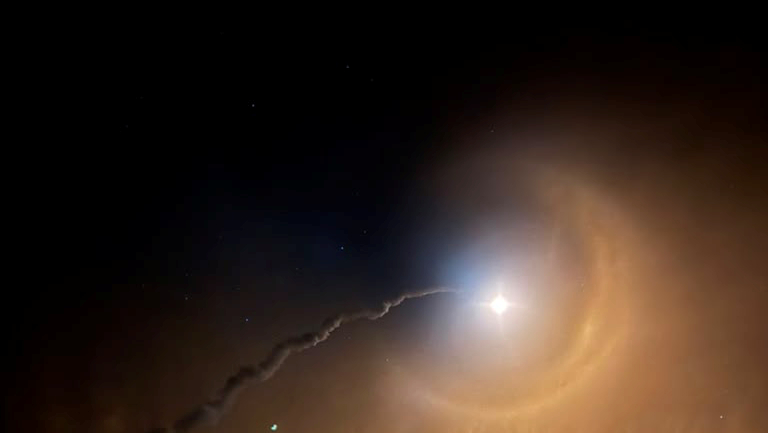
Japan has launched the second of two long‑planned US Space Force space situational awareness sensors, hosted on a Japanese satellite, marking a new milestone in US‑Japan strategic cooperation in space.
The twin missions constitute “the first bilateral” US‑Japan space effort “specifically focused on national security,” according to an Aug. 14 statement from US Space Systems Command (SSC). The first sensor flew in February 2025; the second reached orbit in August 2026.
The Space Force sensors, designed and built by MIT’s Lincoln Laboratory, are intended to keep watch over the geosynchronous belt above the Indo‑Pacific, tracking objects in orbit as part of broader space domain awareness efforts.
QZS‑7: Final satellite in Japan’s QZSS navigation constellation
The Japanese satellite Quasi‑Zenith Satellite‑7 (QZS‑7) was successfully lofted on an H‑3 launch vehicle from Tanegashima Space Center (TNSC) on Aug. 10, SSC reported.
- Built by Mitsubishi Electric Corporation, QZS‑7 is the seventh and final satellite in the Quasi‑Zenith Satellite System (QZSS), stationed in geosynchronous Earth orbit.
- QZSS serves as Japan’s regional positioning, navigation and timing (PNT) system – effectively Japan’s GPS augmentation and complement – supporting both civilian and military users.
- The constellation is operated by Japan’s space agency JAXA, but supports a wide range of governmental and defense applications.
Hosting US Space Force sensors on QZS‑6 and QZS‑7 does not change the primary navigation mission of the satellites, but adds a critical secondary role: monitoring orbital activity and potential threats over the Indo‑Pacific for the benefit of both nations.
Program launched in 2019 to deepen space situational awareness ties
The Pentagon kicked off the hosted‑payload initiative in 2019, as part of a broader package of agreements with Japan aimed at bolstering space situational awareness (SSA) cooperation.
- The US Space Force first provided funding in fiscal 2021, with initial expectations that QZS‑6 would launch in 2023 and QZS‑7 the following year.
- Despite some schedule slips, both satellites with US sensors are now on orbit, completing the bilateral hosting plan.
This approach – US national security payloads flying on an ally’s satellites – lowers cost and accelerates deployment for Washington, while significantly tightening strategic integration with Tokyo.
Feeding directly into the US Space Surveillance Network
The two sensors will feed data into the US Space Surveillance Network (SSN), which is composed of:
- powerful ground‑based radars;
- optical and infrared telescopes on the ground;
- space‑based sensors on dedicated and hosted satellites.
SSN is operated by the 18th Space Defense Squadron, headquartered at Vandenberg Space Force Base in California, and underpins US ability to:
- track thousands of objects in orbit (active satellites, debris, spent stages);
- detect unusual or potentially hostile maneuvers by foreign spacecraft;
- warn of potential collisions or anti‑satellite threats.
With the new hosted sensors on QZS‑6 and QZS‑7, Indo‑Pacific coverage of the SSN is strengthened, providing:
- improved visibility into geosynchronous orbit, home to critical communications and early‑warning satellites;
- shareable data for Japan, tightening military and intelligence cooperation amid increasingly sophisticated space activities by China and, to a lesser extent, Russia.
Taken together, the program signals that the US‑Japan alliance is evolving beyond traditional land, maritime and air cooperation into a much deeper integration in the space domain, now viewed as a fully fledged warfighting arena on par with sea and air.