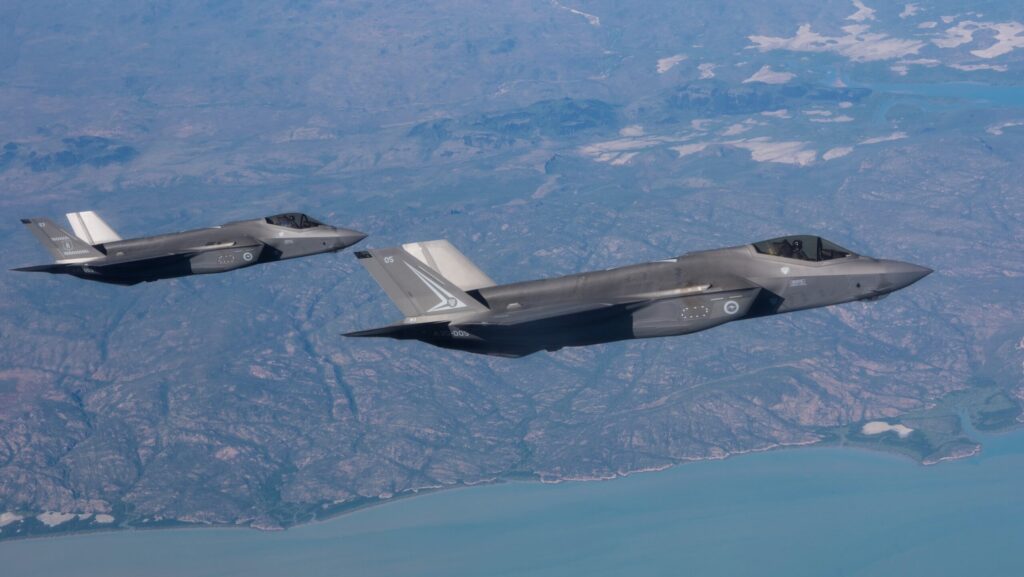
Canberra says the parts are not believed to contain sensitive information
Australian Defense Minister Richard Marles said he did not believe that components from F-35 Joint Strike Fighter aircraft reportedly sent to Hong Kong contained sensitive technology. Nevertheless, Australian authorities are reviewing the incident in cooperation with the U.S. government and aircraft manufacturer Lockheed Martin.
“We are examining very much everything that has occurred at the Australian end,” Marles said, adding that Canberra remained confident in the way it had participated in the F-35 program and worked through Lockheed Martin, the project’s prime contractor.
The minister declined to provide details about the nature of the missing components, referring questions to the U.S. government and Lockheed Martin. He said, however, that his understanding was that the parts were not considered sensitive.
A repair shipment was diverted to Hong Kong
The incident involves a shipment of F-35 components that had been classified as unserviceable and was supposed to be sent to the United States for repairs.
The shipment was handled by a Lockheed Martin intermediary. After leaving Australia, it was apparently diverted and eventually ended up in Hong Kong.
The shipment reportedly included one of the aircraft’s canopies. F-35 canopies are coated with radar-absorbing material that contributes to reducing the aircraft’s radar signature. According to the available information, the canopy has not yet been recovered.
Pentagon and Lockheed Martin seek to ease concerns
The Pentagon office responsible for the F-35 program acknowledged that U.S. officials were aware of the incident and were investigating it.
American authorities are working with relevant agencies and industry partners to recover the components, determine how the shipment was redirected and introduce safeguards to prevent a similar occurrence in the future.
Lockheed Martin also said it was cooperating with the U.S. government and had complied with all applicable laws, policies and export-control regulations.
The company described the components as unserviceable and assessed them as posing a low risk of exploitation. It also said that every shipment was handled under strict security procedures intended to protect the integrity of the F-35 program and the interests of its international partners.
China-related concerns raise the stakes
The fact that the shipment reached Hong Kong has generated additional concern, particularly because of Beijing’s growing control over the special administrative region.
Even if the components are unusable and considered low risk, their presence in Hong Kong raises questions about whether Chinese authorities could have obtained information related to the aircraft’s radar-signature reduction technology.
Access to such information could help an adversary better understand how to detect or counter the F-35 in combat. It could also provide useful insights for China’s own advanced fighter-aircraft programs.
For more than a decade, China has faced accusations that it obtained F-35 design information through cyber theft or other means to support its own aviation projects. Beijing has repeatedly denied those allegations.
The F-35 program depends on a global supply network
The incident highlights the complexity of the F-35’s international logistics system. The aircraft is operated by 20 foreign customers, and that number could rise following U.S. approval of a potential sale to Saudi Arabia.
Spare parts are managed through an extensive international network. The global pool of F-35 components is owned by the U.S. government but managed by Lockheed Martin. Parts are distributed among dozens of facilities in the United States and abroad.
This structure supports fleets operated by multiple countries, but it also creates numerous vulnerabilities involving inventory control, transportation and component security.
More than one million parts were unaccounted for
A 2023 report by the Government Accountability Office found that more than one million F-35 parts, collectively valued at approximately $85 million, were unaccounted for.
Auditors warned that the actual number of missing components could be higher than the official figure.
Parts shortages have contributed to disappointing F-35 readiness rates. In response, U.S. officials and international program partners have sought in recent years to expand stocks of spare components.
The Australian incident is likely to place additional pressure on procedures for tracking and securing parts across the program, where global logistics are nearly as important as the aircraft’s design and operational performance.