New platforms expand the Royal Australian Air Force’s long-range reach
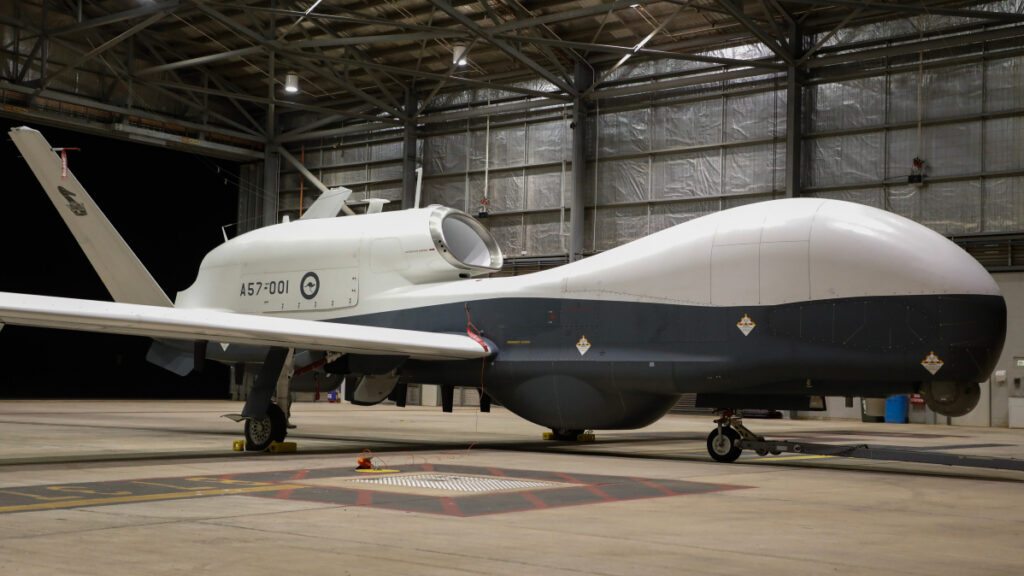
Australia’s Department of Defence has announced that the Royal Australian Air Force’s Northrop Grumman MQ-4C Triton high-altitude, long-endurance unmanned aircraft and L3Harris MC-55A Peregrine intelligence, surveillance, reconnaissance and electronic warfare aircraft have reached Initial Operational Capability.
The milestone follows an extensive period of operational testing and evaluation. According to the department, it will improve Australia’s ability to conduct long-range, persistent surveillance across the vast airspace and maritime areas surrounding the Indo-Pacific region.
In the Australian context, declaring Initial Operational Capability means that an initial group of aircraft and associated support elements is ready for operational deployment. It does not mean that the entire program has reached full operational capability.
Triton provides persistent, long-range surveillance
Jane Bishop, vice president and general manager of Northrop Grumman’s Global Surveillance division, said that achieving IOC with the Royal Australian Air Force represented an important step in strengthening the intelligence, surveillance and reconnaissance capabilities provided by MQ-4C Triton across the Indo-Pacific.
She said commanders could now take full advantage of Triton’s ability to deliver comprehensive surveillance data, including in harsh and remote environments.
The MQ-4C Triton is designed for extended missions at high altitude. The aircraft can monitor vast maritime and airspace areas while providing information needed to track naval and airborne activity across a region defined by enormous distances.
Australia currently operates three aircraft of each type
The Royal Australian Air Force has so far received three MQ-4Cs and three MC-55As, after ordering four aircraft of each type.
The fourth MC-55A is expected to arrive in Australia later this year.
The Department of Defence said that achieving IOC for the MQ-4C had significantly strengthened Australia’s ability to deliver persistent intelligence, surveillance and reconnaissance effects across its primary area of military interest.
The MC-55A, meanwhile, expands the Air Force’s ability to provide integrated intelligence, surveillance, reconnaissance and electronic warfare effects in support of Defence operations.
Peregrine has already deployed on regional missions
Since the first MC-55A arrived in Australia in February, the aircraft have been deployed overseas.
In July, one aircraft deployed to Clark Air Base in the Philippines and conducted several missions over the South China Sea, an area marked by territorial disputes and intense strategic competition involving China, the United States and regional allies.
The MC-55A Peregrine is designed to collect and process electronic intelligence while supporting electronic warfare operations and broader battlefield awareness.
First upgraded P-8A returns to Australia
The Department of Defence also announced that the first of two Boeing P-8A Poseidon maritime patrol and multi-mission aircraft being upgraded in the United States has returned to Australia.
Boeing received a contract in 2024 to upgrade Australia’s fleet of 14 P-8As to the Increment 3 Block 2 standard. The program includes improvements to the aircraft’s onboard software, systems and sensors.
The first two aircraft are being upgraded at Jacksonville, Florida, while the remaining aircraft will undergo modernization in Australia.
By combining the capabilities of Triton, Peregrine and Poseidon, Australia is expanding its airborne and maritime surveillance network and strengthening its ability to operate over long distances in an increasingly contested Indo-Pacific region.