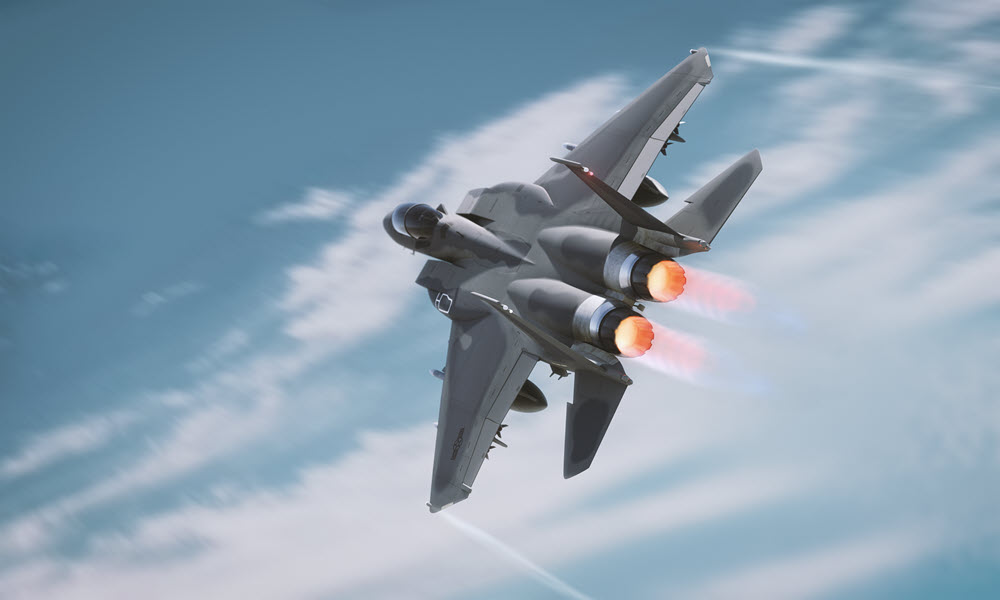
After 40 years of development and more than 11 million flight hours, GE Aerospace’s F110 engine continues to provide the speed, thrust and operational efficiency required by major fighter platforms such as the F-15EX and F-16.
Over the past three years, the company has intensified its investment in the F110 program to ensure that the F110-GE-129 continues to deliver the power and reliability U.S. Air Force pilots need to complete their missions and return safely. The effort is focused not only on technical performance, but also on delivering engines at the pace and scale required by modern military operations.
F110 production rises by 50%
GE Aerospace’s investments have improved both production and delivery performance. The company has increased its manufacturing capacity to meet growing demand from U.S. and allied operators, as the U.S. Air Force has highlighted the need for higher engine output.
Advanced manufacturing is a major part of the modernization effort, including the use of metal additive manufacturing. In 2021, the U.S. Air Force qualified an additively manufactured F110 sump cover—the first engine component designed and produced through metal 3D printing to receive airworthiness approval from a U.S. Department of Defense entity.
GE Aerospace says it has significantly modernized F110 production and upgraded approximately 90% of the engine’s parts through the use of new materials, advanced coatings, and improved manufacturing and inspection processes.
Strengthening the supply chain
Over the past two years, GE Aerospace has worked more closely with its suppliers to stabilize demand signals, improve production predictability and eliminate manufacturing bottlenecks. The company has also deployed engineering and quality resources to help suppliers address production constraints.
The approach is intended to give GE Aerospace greater visibility across its supply chain and allow targeted intervention before problems affect deliveries.
The company recently announced an agreement to acquire Consolidated Precision Products (CPP), a global manufacturer of castings. The acquisition would strengthen access to components that remain constrained across the aerospace and defense industry. GE Aerospace emphasized, however, that CPP will be only one element of its broader strategy and that the company will continue relying on its entire external supplier network.
More than $700 million invested in industrial capacity
Since 2023, GE Aerospace has invested more than $600 million in its defense manufacturing facilities. It has also committed more than $100 million to external suppliers for tooling, equipment and capacity expansion.
The investments are intended to:
- stabilize production schedules;
- increase supplier capacity;
- expand delivery commitments;
- establish alternative sources for critical components; and
- modernize key parts used across multiple defense-engine production lines.
GE Aerospace says F110 production has increased by 50% year over year since the second quarter of 2025, while total defense-engine output rose by 15% during the first half of 2026.
Artificial intelligence used to anticipate bottlenecks
The company is also using artificial intelligence to identify supply-chain risks and production bottlenecks at an earlier stage. This year, technicians applied AI tools to the F404 and F110 production lines.
“Artificial intelligence is changing how we build and sustain the F110,” said Shawn Warren, vice president and general manager of combat and trainer engines in GE Aerospace’s Defense & Systems business. “It’s giving our teams the ability to see problems before they become delays, and to move faster without sacrificing the reliability our Air Force customers depend on.”
GE Aerospace is also expanding its use of AI-enabled predictive maintenance. Through its partnership with Palantir, the company is deploying agentic AI to support aircraft-sustainment decisions and streamline its own manufacturing processes.
FLIGHT DECK cuts production time
The improvements are being guided by FLIGHT DECK, GE Aerospace’s lean-based operating model. The system is designed to systematically eliminate non-value-added work, optimize production flow and focus operations on customer requirements.
During a recent weeklong improvement effort, the team reduced overall production lead time for the F110 high-pressure compressor forward shaft by approximately 60%. The improvement was achieved by consolidating key processes and reducing the distances operators had to travel inside the manufacturing facility.
GE Aerospace plans to apply similar measures across the production line to further reduce manufacturing times.
“Forty years in, the F110 keeps getting better, because we keep investing in it,” Warren said. “From AI on the production floor to FLIGHT DECK on the shop floor, every improvement we make comes back to one goal: getting engines to our Air Force customers faster, and keeping them flying longer.”