













A Senate spending bill allocates about $77 million for the B94 but offers no explanation of its role. Experts believe it could be an air-delivered nuclear bomb designed to attack deeply buried targets.
A draft spending bill released last week by the Senate Appropriations Committee refers to a new nuclear weapon designated the B94. Experts who identified the program in budget documents believe it could be designed to penetrate deep into the ground before detonating.
The designation was first noticed by experts reviewing the Department of Energy’s fiscal 2027 spending plan online. The department includes the National Nuclear Security Administration (NNSA), the agency responsible for overseeing the production and safety of nuclear weapons.
$77 million for a weapon with no public explanation
The bill’s explanatory materials allocate roughly $77 million to the B94 program. It received no funding in fiscal 2026. The weapon is listed under “stockpile modernization,” alongside ongoing programs such as the W87-1 warhead, which officials plan to deploy on the forthcoming LGM-35A Sentinel ballistic missile.
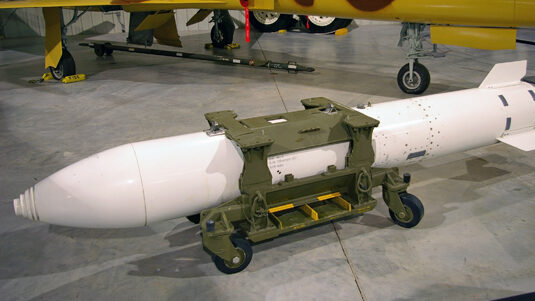
The Senate document does not explain the new designation. Arms control expert Jeffrey Lewis has suggested that the B94 could be a new name for the NDS-A program, an air-launched nuclear delivery system previously identified in budget documents. In his view, the weapon appears to be intended as a replacement for the B83-1 nuclear gravity bomb, which the Biden administration moved to retire.
As of publication, representatives for the Senate Appropriations Committee’s leadership and the NNSA had not responded to requests for comment.
A possible bunker-buster, with uncertain effectiveness
James Acton, co-director of the Nuclear Policy Program at the Carnegie Endowment for International Peace, described the B94 as a new capability. He said it appears to be an air-delivered gravity bomb capable of attacking deeply buried targets—a role that could make it a successor to the B83.
Such a weapon could expand the number of underground targets the United States can strike, Acton said, because some are currently beyond the reach of U.S. weapons.
However, he questioned how effective the B94 would be. Acton cited a 2005 National Academies report which concluded that targets more than roughly 700 meters underground cannot be reliably destroyed by any kind of penetrator. He acknowledged, however, that penetration technologies may have improved in the intervening decades.
A higher explosive yield could help a weapon reach deeper targets, he said, but the B94’s potential yield is not known.
Calls for a clear strategy and greater transparency
Acton criticized the lack of public information about the program and argued that a new nuclear weapon should be accompanied by an explanation of the broader strategy behind it, as previous administrations have provided.
Without a clear strategic framework, he warned, new missions and requirements for nuclear weapons could be invented indefinitely. Acton questioned the justification for the B94, noting that many targets would remain beyond its reach.
“We’re witnessing both qualitative and quantitative arms racing,” he said, calling on the administration to present a clear strategy and provide enough information for the public to debate the proposed capability.