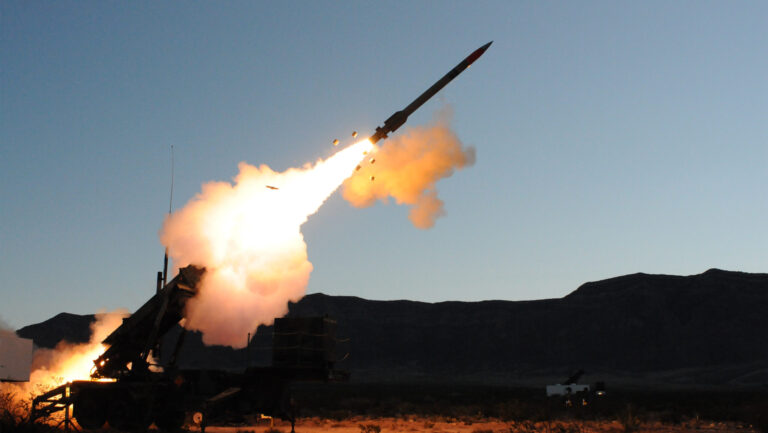
Following President Donald Trump’s announcement regarding the granting of a production license, defense giants RTX (through its subsidiary Raytheon) and Lockheed Martin have launched feasibility studies for manufacturing Patriot interceptors on Ukrainian soil. The talks, though in their early stages, mark a fundamental shift in the strategy for Ukraine’s military support, moving the focus from equipment transfers to local production under American license.
Green light from the White House: The Trump administration pushes for industrial expansion in conflict zones
The official decision to allow the licensing of interceptor production in Ukraine has set in motion the bureaucratic and technical machinery of major arms suppliers. Tom Laliberty, president of land and air defense systems at Raytheon, confirmed at Farnborough that the process is just beginning, emphasizing that the firm will closely follow U.S. government directives. This initiative aims not only to bolster the war effort but also to alleviate pressure on global stockpiles, which have already sparked tensions with other strategic customers, such as Switzerland.
The architecture of air defense: Feasibility analysis for GEM-T and PAC-3 models
The complexity of the Patriot system, which integrates technologies from multiple providers, poses significant logistical challenges. While RTX supplies the GEM-T interceptor, Lockheed Martin produces the PAC-3 variant, both critical for neutralizing ballistic threats. Officials from both companies are currently studying three lines of effort: involving the local supply chain, operating maintenance facilities, and, in the most ambitious scenario, the full assembly of missiles on Ukrainian soil to provide the level of support Kyiv desires.
Low-cost innovation: Lockheed Martin unveils the new Adapted Capability Effector interceptor
In parallel with the discussions regarding Ukraine, the defense industry is seeking solutions to meet massive demand and high costs. Lockheed Martin took advantage of the airshow to roll out a new version of the PAC-3 interceptor, called the Adapted Capability Effector (ACE). This variant, designed to be more financially accessible, is set to be developed in partnership with European industry, with a first test scheduled for 2028. This move signals an adaptation by major players to a reality where quantity and economic sustainability are becoming as vital as technological precision.