In a historic test conducted over the Mojave Desert, a robotic „wingman” demonstrated its ability to execute aerial interception missions. This achievement marks the transition from simple experimental flights to lethal combat capabilities integrated into a complex digital network.
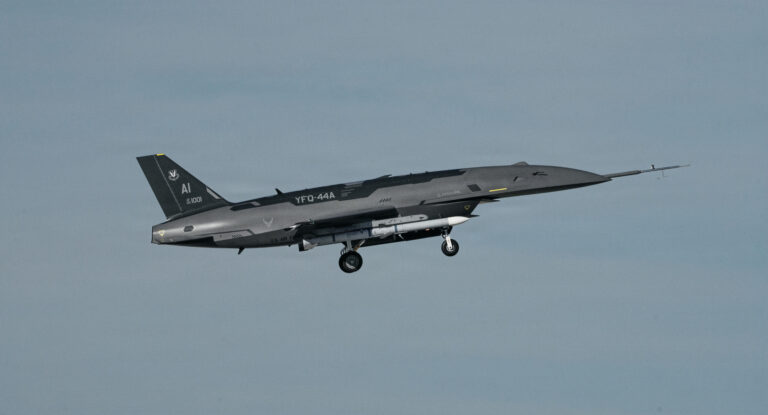
The United States Air Force has reached a fundamental technological milestone: an autonomous drone from the Collaborative Combat Aircraft (CCA) program has successfully fired an AMRAAM air-to-air missile. General Kenneth Wilsbach confirmed that this was not merely a weapon release, but a complete end-to-end tracking of a digital target. This success validates the concept of collaborative combat aircraft, designed to fly alongside human-piloted jets.
Historic test in the Mojave Desert: A victory for artificial intelligence and firepower
The star of this exercise was the YFQ-44A model developed by Anduril, which took off from Edwards Air Force Base. Utilizing the Lattice control software, the drone managed to process target trajectory data and execute the strike order. Although the drone possesses a high degree of flight autonomy, the final decision to fire remained under the strict control of a human operator, emphasizing the Pentagon’s „human-in-the-loop” doctrine.
This event ramps up pressure within the defense industry competition, as General Atomics prepares for a similar test this fall with its own prototype, the YFQ-42A. The stakes are immense: both companies have already received the „green light” to begin production, vying to prove which platform offers the best balance between tactical efficiency and reliability.
Low costs and global projection: The Pentagon’s strategy against Pacific threats
One of the primary advantages of these new robotic „missile trucks” is their reduced cost. Military officials confirmed that the goal is for such a drone to cost only one-third of the price of an F-35A, roughly $27-28 million. This financial efficiency will allow the United States to deploy massive aircraft fleets without exhausting the budgetary resources allocated for fifth and sixth-generation fighter jets.
Furthermore, strategic plans envision these drones being capable of deploying directly from the United States, flying long distances to theaters of operation in the Pacific. This self-deployment capability is vital in the context of threats posed by Chinese long-range missiles, which can endanger advanced US airbases.
The future of the robotic fleet: From reconnaissance to electronic attack
The CCA program does not stop at air-to-air interception capabilities. The US military is considering a wide range of missions for these platforms, including electronic warfare and advanced reconnaissance. With a development budget exceeding one billion dollars for the coming years, the program is advancing rapidly through successive increments involving numerous software and hardware providers.
Integrating these drones into the Space Force’s data network will create a resilient defensive system capable of responding instantly to any aggression. The message sent to allies and adversaries alike is clear: the future of air supremacy belongs to hybrid systems, where the experience of human pilots is exponentially multiplied by the precision and expendability of robotic partners.