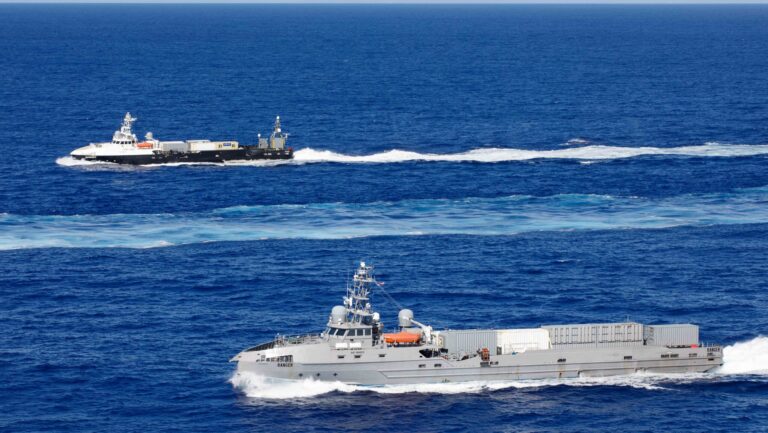
The Defense Innovation Unit (DIU) and the United States Navy have launched a major competition aimed at accelerating the development of containerized combat modules. These payloads are intended for both manned and unmanned surface vessels, covering a wide range of missions from surveillance to electronic attack. The initiative, known as the Spectacular MIST Challenge, promises to radically transform how naval forces generate combat power through rapidly adaptable technologies.
The Spectacular MIST Challenge seeks adaptable solutions for electronic attack missions
The collaboration between DIU, the Navy’s Rapid Capabilities Office, and the Naval Information Warfare Center Pacific targets the prototyping and fielding of technologies capable of providing decisive advantages in contested maritime environments. The emphasis is placed on open-system architectures and software-defined capabilities, with a specific focus on threat radar simulators, active electronic attack, and passive electronic surveillance. The ultimate goal is to integrate these modules onto autonomous maritime platforms to ensure a lethal and flexible presence at sea.
Admiral Daryl Caudle’s vision: If it fits in a container, it must be ready for battle
This competition brings to life the „containerized capability campaign” strategy strongly promoted by Admiral Daryl Caudle. In a recent statement, he emphasized the need for any military equipment that can fit in a standard container to be combat-ready anywhere in the world across multiple types of platforms. This approach allows the Navy to rapidly scale its strike force, transforming logistical ships or autonomous vessels into multi-role combat platforms without the need for costly structural modifications.
The timeline of maritime innovation: Sea trials off California and million-dollar prizes
Interested companies have until July 22 to submit their proposals, and those selected for the second round will receive funding of up to $250,000. The climax of the competition will take place in September through a live demonstration in Southern California, where the effectiveness of the solutions will be evaluated under realistic conditions. Finalists can win prizes of up to one million dollars and mass production contracts, with the winners scheduled to be officially announced in October, clearing the path for rapid fleet fielding.