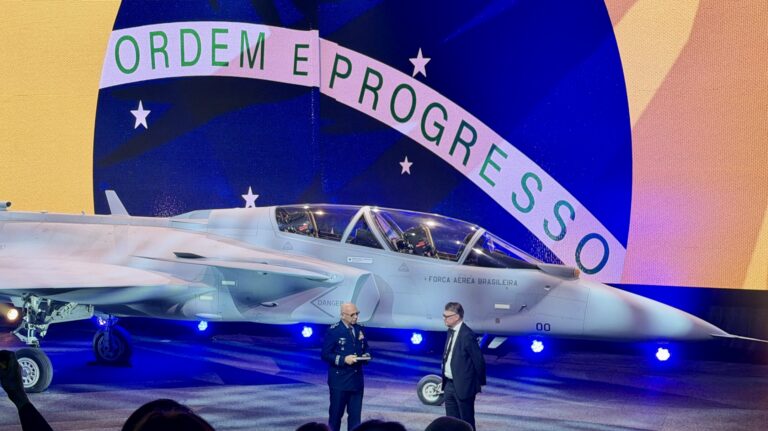
In a strategic move designed to strengthen control over its airspace, the Brazilian Ministry of Defense has announced plans to acquire an additional 20 Gripen E fighter jets. This decision will bring the total fleet to 56 aircraft, reflecting a profound reassessment of the security needs of Latin America’s largest nation.
Scaling the fighter fleet to a strategic threshold of 56 aircraft
The decision to supplement the initial order of 36 aircraft follows rigorous technical studies conducted by the Brazilian Air Force Staff. According to military officials, maintaining national sovereignty requires an operational force of between 50 and 60 modern fighter jets. Although the contract signed in 2014 included an option for a 25 percent increase, current negotiations between Stockholm and Brasilia aim for a much more ambitious expansion to reach the 56-unit Gripen target.
The Saab and Embraer partnership takes flight in Brazil
A central point of this agreement remains local production. The Embraer facility in São Paulo houses the only Gripen E assembly line outside of Sweden, a symbol of successful technology transfer. The first unit fully assembled on Brazilian soil was officially rolled out in March 2026, and expectations are that the newly ordered aircraft will also be built locally. This approach not only supports Brazil’s defense industry but also provides Sweden with the capacity to manage international orders, which are currently at record levels.
Strengthening Gripen’s global footprint amid a rearmament surge
The international success of the Gripen model is evident through a series of recent contracts and acquisition interests, ranging from Ukraine and Thailand to Colombia and Canada. Global interest in this system is fueled by advanced electronic warfare capabilities, low lifecycle costs, and the integration of AI agents. For Sweden, expanding the „Gripen user club” represents a strategic advantage, facilitating its own air force’s transition to the modernized E-variant as the current geopolitical climate forces nations to invest heavily in next-generation defense capabilities.