It’s not quite Skynet, but in a recent Air Force experiment, artificial intelligence tools managed to outperform human professionals in a crucial aspect of military operations planning, service officials have revealed. The findings signal a significant shift in how strategies might be conceived and executed on the modern battlefield.
DASH Experiment: A Strategic Duel Between Man and Machine
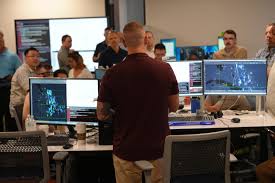
Last fall, during the Air Force’s latest „DASH” experiment (Decision Advantage Sprint for Human-Machine Teaming), AI tools from half a dozen companies were pitted against military personnel from the U.S., Canada, and the U.K. Participants were tasked with solving hypothetical „battle management” problems. These ranged from standard Air Force duties, like planning an airstrike or rerouting aircraft after a base had been damaged, to more obscure scenarios such as gathering intelligence on an anomalous electromagnetic signal or protecting a disabled and drifting Navy vessel.
AI’s Edge: Faster, More Accurate, No „Hallucinations”
The subsequent evaluation of the proposed Courses of Action (COAs) revealed a startling reality: at least one of the AI algorithms not only generated more options in less time than the human teams but also made significantly fewer errors. „These machine-generated recommendations were up to 90 percent faster than traditional methods, with the best in machine-class solutions showing 97 percent viability and tactical validity,” stated Col. John Ohlund, director of the Air Force’s Advanced Battle Management System Cross-Functional Team (ABMS CFT). The official Air Force article noted that human-generated COAs took about 19 minutes, with only 48 percent considered „viable and tactically valid.” Crucially, Ohlund added, „our team didn’t observe hallucinations during the experiment,” a stark contrast to broader concerns about generative AI’s propensity for producing inaccurate outputs.
Unfazed by Stress: AI’s Perfect Recall and Data Processing
However, Colonel Ohlund cautioned that the human-machine comparison comes with important caveats. The scenario was deliberately designed to stress and stretch the human participants, pushing them outside their comfort zones with multi-domain problems to solve within a tight one-hour deadline. Military personnel, primarily trained in specific Air Force air operations, faced unfamiliar unclassified data and simulated environments, different from the real command-and-control networks they typically use.
This is where AI demonstrated its advantage. „The computer does not forget,” Ohlund explained. While humans often became overwhelmed by the new information, forgetting or misremembering details under pressure, the best AIs retained every single piece of data. Furthermore, the top-performing AI algorithm benefited from extensive human preparation by its development team, who normalized and translated all the data. The scenario’s design to induce human stress also had no effect on the emotionless algorithms.
The Collaborative Future: AI as „Microservices” in Modern Warfare
What comes next? None of the six AI tools tested are ready for standalone operational use by planning staffs today. Instead, the intention is for them to evolve into „microservices” that plug into a larger military command-and-control system, such as ABMS. Generating Courses of Action, which the AI did in this experiment, is merely one step out of a 13-step process to develop an executable plan. More algorithmic microservices can be developed to handle those other steps as well.
Lt. Ashley Nguyen, a human participant in the experiment, acknowledged the potential: „I was skeptical about technology being integrated into decision-making. But working with the tools, I saw how user-friendly and timesaving they could be. The AI didn’t replace us; it gave us a solid starting point to build from.” This collaborative vision, where artificial intelligence augments human capabilities, is now shaping the future of military strategy.