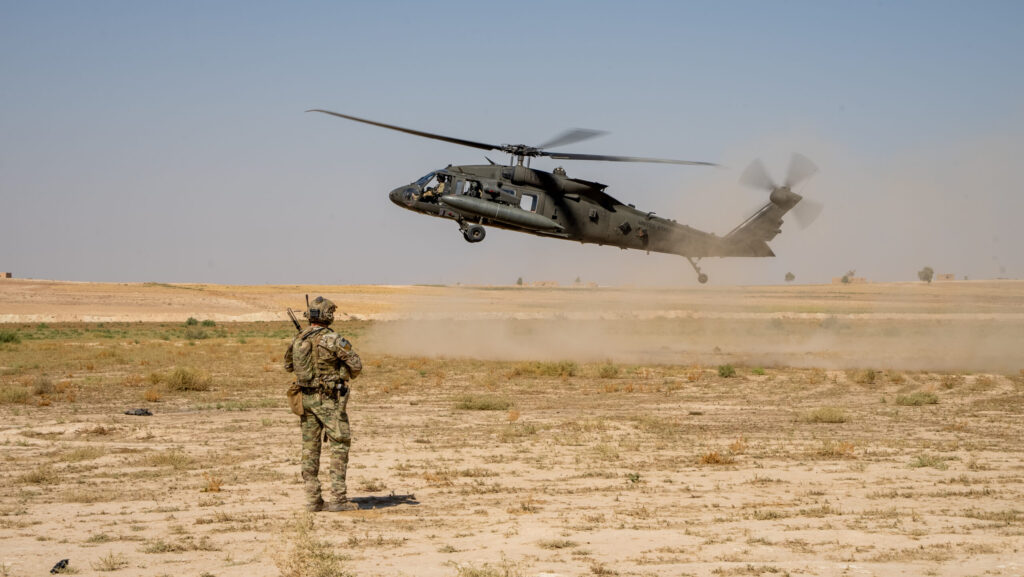
Despite program questions, Army aims to enhance UH-60M fleet with new capabilities, while Sikorsky explores unmanned Black Hawk options.
The Army Transformation Initiative (ATI) has cast a shadow of uncertainty over the service, with its aviation portfolio, particularly the Black Hawk program, facing scrutiny.
Near-Term Focus: Upgrades and Maintenance
Amidst swirling questions about the program’s future, the head of the Program Executive Office for Aviation told Breaking Defense that while the long-term future of the UH-60M Black Hawks remains unclear, the current focus is on upgrading and maintaining the Sikorsky fleet.
„I can’t speak to the long term future of the Mikes, [a common call sign for the Black Hawk UH-60M fleet], but what I’ll say is that they’re some of our newest, best platforms,” stated Brig. Gen. David Phillips, PEO of Aviation, in an interview. He emphasized that the Army is continuing to update Black Hawks with the integration of launched effects, which will occur in parallel with UAS programs next summer as part of Project Convergence.
ATI Spurs Program Questions
The Army’s aviation plans were thrown into flux after Defense Secretary Pete Hegseth initiated the ATI in May, calling for accelerated production of the Future Long-Range Assault Aircraft (FLRAA). In 2022, the Army selected Bell’s V-280 Valor tiltrotor as the FLRAA aircraft to eventually replace thousands—but not all—UH-60 Black Hawk helicopters, in a deal potentially worth $70 billion, Breaking Defense previously reported.
However, following the cancellation of the Future Attack Reconnaissance Aircraft (FARA) program last year, service leaders announced that some of the freed-up funding would be directed toward a new UH-60M multi-year deal, extending production past fiscal 2026. Army Secretary Daniel Driscoll and Chief of Staff Gen. Randy George confirmed this plan to lawmakers in the spring.
Next Black Hawk Buy Could Be the Last
The Army did not respond to a request for comment on whether the contract is still scheduled to be awarded in late 2026. Aviation Week has reported that the service has previously indicated the next Black Hawk purchase would be its last.
Jay Macklin, director of strategy and business development for Sikorsky Army and Air Force Systems, recently told reporters that the company is tracking the multi-year XI award, expected in late 2026 for the production of UH-60Ms from 2027 to 2032. The original request for information for the award, released in July 2024, called for a base order of 100-120 helicopters, with options for an additional 135-155, starting in 2027.
Enhancing Current Fleet Capabilities
In addition to integrating launched effects, Phillips outlined plans to upgrade the UH-60M fleet with an open systems architecture for improved information sharing, as well as new „survivability” capabilities enabled by the increased number of sensors on the aircraft. Maintenance of the fleet remains a top priority.
“We’re continuing to maintain that modernized, lethal capability in the fleet. That survivability and lethality across our full portfolio is still very important—it’s really about the sustainability of these platforms. Our UH-60 Mikes are some of the greatest aircraft we’ve got, but over time they will continue to get older,” he added. “We’ll have Black Hawks in the fleet likely through the [20]40s and 50s.”
Unmanned Black Hawks: A Potential Future
The ambiguity surrounding the Black Hawk fleet’s future raises the possibility of the aircraft eventually transitioning to an unmanned platform. Sikorsky unveiled plans today to convert an older UH-60L model into a Group 5 UAS, dubbed the S70 UHawk. According to Erskine „Ramsey” Bentley, director of strategy and business development for Sikorsky Advanced Programs, the funding for the new UAS, which is undergoing flight testing next year, comes from internal company research and engineering efforts.
“Basically what we’ve done is we have taken a [UH-60L] model Black Hawk, and using our MATRIX autonomy system, have turned this aircraft into a UAS. Now, one of the unique things about the S70 UAS, or UHawk, as we call it, is we have completely removed the cockpit, the pilot and also the crew chief stations of the aircraft,” Bentley explained.
When asked if Sikorsky had plans to do the same for the UH-60M fleets, Igor Cherepinsky, the director of Sikorsky Innovations, stated that it’s within the realm of possibility.
„It all depends on the economics and price point,” he told reporters last week. „Right now we’re looking at [the UH-60Ls], but who knows.”
While Phillips didn’t comment on the potential for a similar fate for the UH-60Ms, he noted, „The effort has been going on for a while, and I believe that those internally funded efforts are very informative for the requirements for the market of autonomous platforms.”