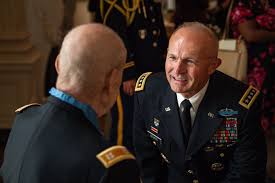
An Immediate and Unforeseen Shift at the Army’s Helm Defense Secretary Pete Hegseth has removed General Randy George, the 41st Chief of Staff of the US Army, a decision made effective immediately. The announcement, confirmed by the Pentagon, comes as a significant surprise, as General George departs his role nearly a year and a half earlier than the traditional four-year tenure, which began in the fall of 2023. A Pentagon spokesman stated that “General Randy A. George will be retiring from his position as the 41st Chief of Staff of the Army effective immediately. The Department of War is grateful for General George’s decades of service to our nation. We wish him well in his retirement.”
Succession Uncertainty and Political Connections In the immediate aftermath of the dismissal, uncertainty surrounds General George’s replacement. Speculation points to Lieutenant General Christopher LaNeve, who was recently sworn in as the service’s new vice chief of staff. LaNeve, a former 82nd Airborne Division commander, previously replaced General James Mingus, who retired unexpectedly early. Given George’s „effective immediately” exit, LaNeve is likely to step in as acting chief until a full confirmation process can be arranged. Notably, LaNeve served as a military aide to Secretary Hegseth, who recently lauded him as a “generational leader” capable of ensuring the Army “revives the warrior ethos, rebuilds for the modern battlefield, and deters our enemies around the world.”
A Short Tenure, Significant Challenges Despite his abbreviated time at the helm, General George tackled a broad array of challenges. He navigated the Army through a recruiting crisis, endeavored to accelerate the integration of new technology through the “Transformation in Contact” initiative, terminated a host of weapon development programs, and oversaw a massive overhaul of the service’s acquisition workforce. These efforts were closely coordinated with Army Secretary Daniel Driscoll, the service’s 26th civilian leader, with whom General George had worked throughout the past year. Driscoll has reportedly been at odds with Secretary Hegseth, and these internal dynamics fueled rumors for months that George could be fired.
A Controversial High-Level Purge While Secretary Hegseth did not detail the specific reasons for General George’s removal, he has previously vowed to purge the Pentagon of „woke” generals, those supporting diversity, and individuals who carried out orders related to the US withdrawal from Afghanistan. Senior officers with ties to former Defense Secretary Lloyd Austin and former Chairman of the Joint Chiefs of Staff General Mark Milley have also been deemed vulnerable targets.
This dismissal fits into a broader pattern of high-ranking official removals over the past year. These include Coast Guard Commandant Admiral Linda Fagan, Chairman of the Joint Chiefs of Staff General CQ Brown, Chief of Naval Operations Admiral Lisa Franchetti, Air Force Vice Chief of Staff General James Slife, Defense Intelligence Agency head Lieutenant General Jeffrey Kruse, and National Security Agency and Cyber Command head General Timothy Haugh, among others.
Former Defense Leaders Sound the Alarm The wave of high-level military dismissals has become a major political talking point. Five former secretaries of defense—Lloyd Austin, William Perry, Chuck Hagel, Leon Panetta, and Jim Mattis—issued an open letter to lawmakers, expressing their „alarm” at these actions. They urged Congress to hold Secretary Hegseth accountable for „these reckless actions” and to fully exercise its Constitutional oversight responsibilities, highlighting the lack of clear justification for the firings. The former secretaries warned that these dismissals „raise troubling questions about the administration’s desire to politicize the military and to remove legal constraints on the President’s power.” They concluded that „many Americans—including many troops—are therefore left to conclude that these leaders are being fired for purely partisan reasons.” They cautioned that if left unchecked, such actions could deter potential recruits and make those in uniform hesitant to „speak truth to power” for fear of retribution.
A Three-Decade Career Ends Abruptly General George, a West Point graduate who commissioned as an infantry officer in 1988, served over three and a half decades in the military, including deployments to Operation Desert Shield/Desert Storm, Operation Iraqi Freedom, and Operation Enduring Freedom in Afghanistan. Prior to his ascent to the Army’s top military post, he also served as the senior military assistant to then-Defense Secretary Lloyd Austin and later as the Army’s vice-chief of staff. His dismissal occurs at a time when the US is once again embroiled in a conflict in the Middle East, this time with Iran, adding another layer of tension to this controversial decision.