Ankara’s Answer to Modern Warfare: A Networked Approach to Air Defense
Turkish aerospace giant Aselsan is providing a closer look at its ambitious „Steel Dome” air defense project, offering insights into the development and capabilities of the system during a recent media tour. Aselsan CEO Ahmet Akyol explained that Steel Dome, or Celik Kubbe in Turkish, represents a „modern concept” of integrated and interconnected radar and air defense systems. Recent regional conflicts have underscored the urgency and importance of this project, accelerating its development. [Source: Aselsan Media Tour]
Inside Aselsan’s Production Hub: Innovation in Motion
The Aselsan facility, a modern structure of black glass and gray concrete, houses the intricate work that brings Steel Dome to life. On the roof, two of the company’s radars stand sentinel, constantly monitoring the surrounding airspace. While media has visited the location before, this latest tour revealed more of the sprawling facility, which Aselsan hopes will double its production capacity upon completion of new buildings. (Note: Breaking Defense accepted travel and accommodation from Aselsan for the trip, as did other media outlets.)
Key Components on Display: HISAR, Goksur, and Rotating Radars
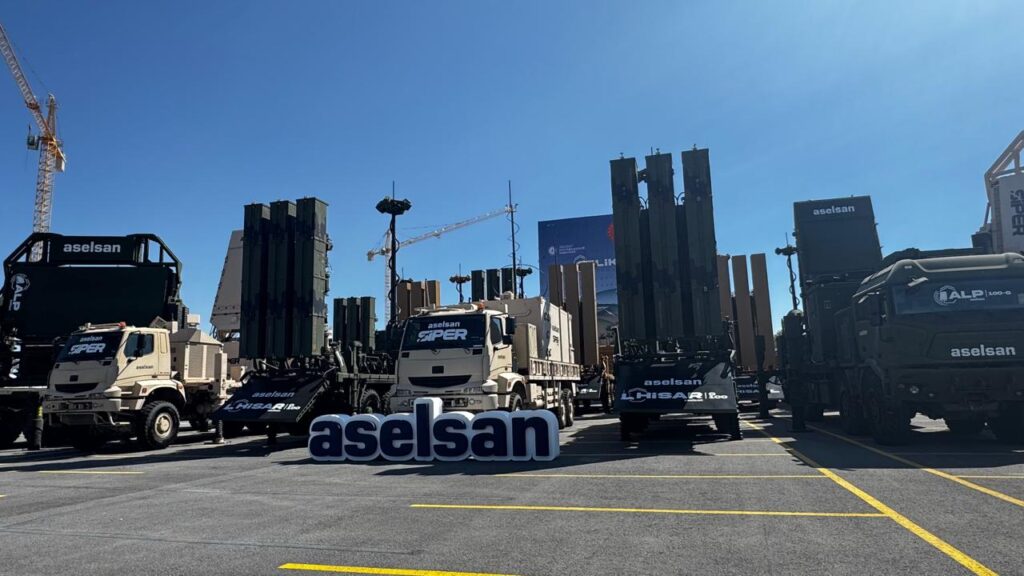
Amidst the familiar sounds of a bustling production facility, reporters witnessed the HISAR 100 medium-range air and missile defense system in what company officials called the facility’s integration area. Nearby, the Goksur point missile defense system was also on display, showcasing the diverse capabilities of Steel Dome. A bus tour around the facility revealed an outdoor display area featuring other completed Steel Dome components, including rotating radars distinguished by their flashing red lights.
Steel Dome’s Architecture: A Multi-Layered Defense
According to company officials, the Steel Dome configuration consists of a large surveillance radar and a command and control station for each battalion, which in turn controls three fire units. Each fire unit is equipped with a control radar station for its three launchers. Officials emphasized that every system within Steel Dome is field-proven, ensuring reliability and effectiveness.
AI and Data Links: The Backbone of Steel Dome
The system utilizes the Hakim airspace command and control system, the Hakim 100 radar network management system, and the Turan tactical military network. Aselsan officials stated that the backbone of Steel Dome is T-link, a tactical data-link specifically designed for Turkey’s air defense systems. Furthermore, Steel Dome employs a high-powered AI-based system to support decision-making, enhancing its ability to respond to threats quickly and effectively.
Global Interest and Expansion: Aselsan’s International Ambitions
Each component of Steel Dome is designed to safeguard Turkish airspace and potentially the skies of international customers. CEO Akyol noted that interest in air defense systems has increased, particularly since the Israeli strike on Hamas targets in Doha. He also mentioned that Steel Dome could be co-produced with foreign buyers. Aselsan is also looking to expand its global presence, with plans to open a new design office in Saudi Arabia dedicated to radar, electronic warfare, and air defense systems by next year. The company aims to increase its maintenance, repair, and operations centers worldwide to provide comprehensive support for its systems. Aselsan already has affiliates in 24 countries.
Beyond Steel Dome: Aselsan’s Diverse Portfolio
While Steel Dome is a major project, Aselsan operates in six core domains: integrated defense system technologies, radar and electronic warfare, communication and information technologies, microelectronics and electro-optics, avionics and guidance systems technologies, and transportation, security, energy, and healthcare. The media tour included a glimpse of a stand-off jammer aircraft and highlighted Aselsan’s integration of radars and payloads on Baykar’s Akinci UAV, payloads expected to be integrated onto KAAN, the Turkish fifth-generation fighter jet, along with the firm’s platforms integrated on-board the Turkish satellite Turksat 6A.