A new center for military shipbuilding
Australia has announced the official location of its future naval defense precinct, which will support the construction, maintenance and sustainment of submarines expected to be acquired under the AUKUS agreement.
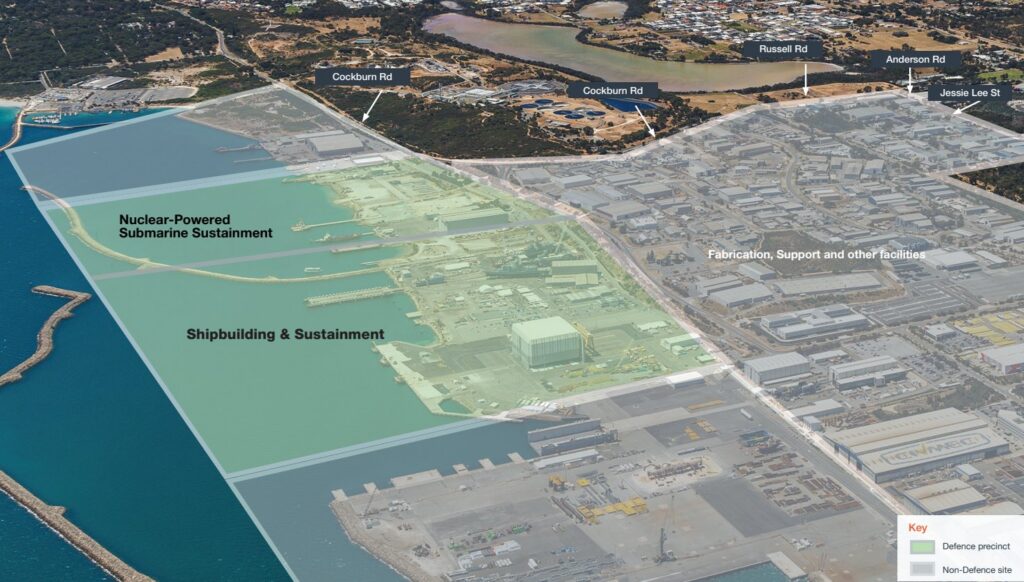
The precinct will be established at Henderson, in Western Australia, approximately 11 kilometers across the water from the Royal Australian Navy base where the country’s submarine fleet is based. The selected site includes the preferred location for naval shipbuilding and sustainment activities, as well as for supporting Australia’s future conventionally armed, nuclear-powered submarines.
Henderson to drive Australia’s military shipbuilding industry
The new precinct will become a key site for developing critical maritime capabilities for the Australian Defence Force. These capabilities will include the Navy’s future general-purpose frigates and the Army’s landing craft.
Australian authorities expect the project to support continuous naval shipbuilding and sustainment in Western Australia for generations to come.
Australian Defence Minister Richard Marles described the site selection as a major step toward establishing a world-class naval shipbuilding and sustainment hub in the state.
According to Marles, the decision will allow the next phase of planning and development to move forward rapidly. The goal is to deliver the infrastructure required to maintain continuous naval shipbuilding and sustainment in Western Australia, while also developing the ability to own, operate and sustain conventionally armed, nuclear-powered submarines.
An industrial zone transformed into a strategic hub
The official outline of the future precinct, overlaid onto an aerial image of Henderson’s existing industrial area, shows that the site will be located immediately south of Austal’s current shipyard.
The area also includes facilities currently occupied by BAE Systems Australia, along with several civilian boatyards. The defense precinct will be surrounded by industrial areas unrelated to defense, designated for fabrication, logistical support and other associated activities.
Billions in investment and up to 10,000 jobs
The Australian government estimates that the project could support up to 10,000 jobs over the next 20 years. Its development will be backed by investments worth billions of dollars, including a package of 12 billion Australian dollars announced last September.
The project will now enter the conceptual design phase. Australia’s federal government and Department of Defence are expected to work closely with the Western Australian government, local industry and other stakeholders.
First Hunter-class frigate reaches a major milestone
The same day also saw the keel-laying ceremony for the first of Australia’s six Hunter-class frigates at the BAE Systems Australia shipyard in Osborne, South Australia.
Based on the British Type 26 frigate design, the Australian vessels will be equipped with the CEAFAR active electronically scanned array radar system, developed by domestic company CEA Technologies.
The frigates will be capable of launching SM-2 and SM-6 air-defense and missile-defense weapons, as well as Tomahawk land-attack cruise missiles.
Anti-submarine warfare becomes a central priority
The Hunter class is expected to provide the Royal Australian Navy with an advanced anti-submarine warfare capability, regarded as one of the country’s most important maritime security assets.
The new frigates are also designed to strengthen Australia’s ability to operate alongside its allies and partners during joint naval missions.