Australian Defense Minister Richard Marles recognizes that the country must construct a large and costly dry dock, along with several other maintenance facilities, to accommodate an expanding surface fleet. However, the timeline for the construction, the location, and the estimated costs for what is expected to be a decade-long project remain what former U.S. Defense Secretary Donald Rumsfeld termed „known unknowns.”
When asked about a timeline for the dry dock project, Marles did not provide specific dates. Instead, he told Breaking Defense during an exclusive interview in Washington that, “We’re working very intensely on ensuring that there is the full capability of what we need in WA [Western Australia] to do the suite of maintenance required for the Virginia-class submarines, both American and ours. And it’s an ongoing process.”
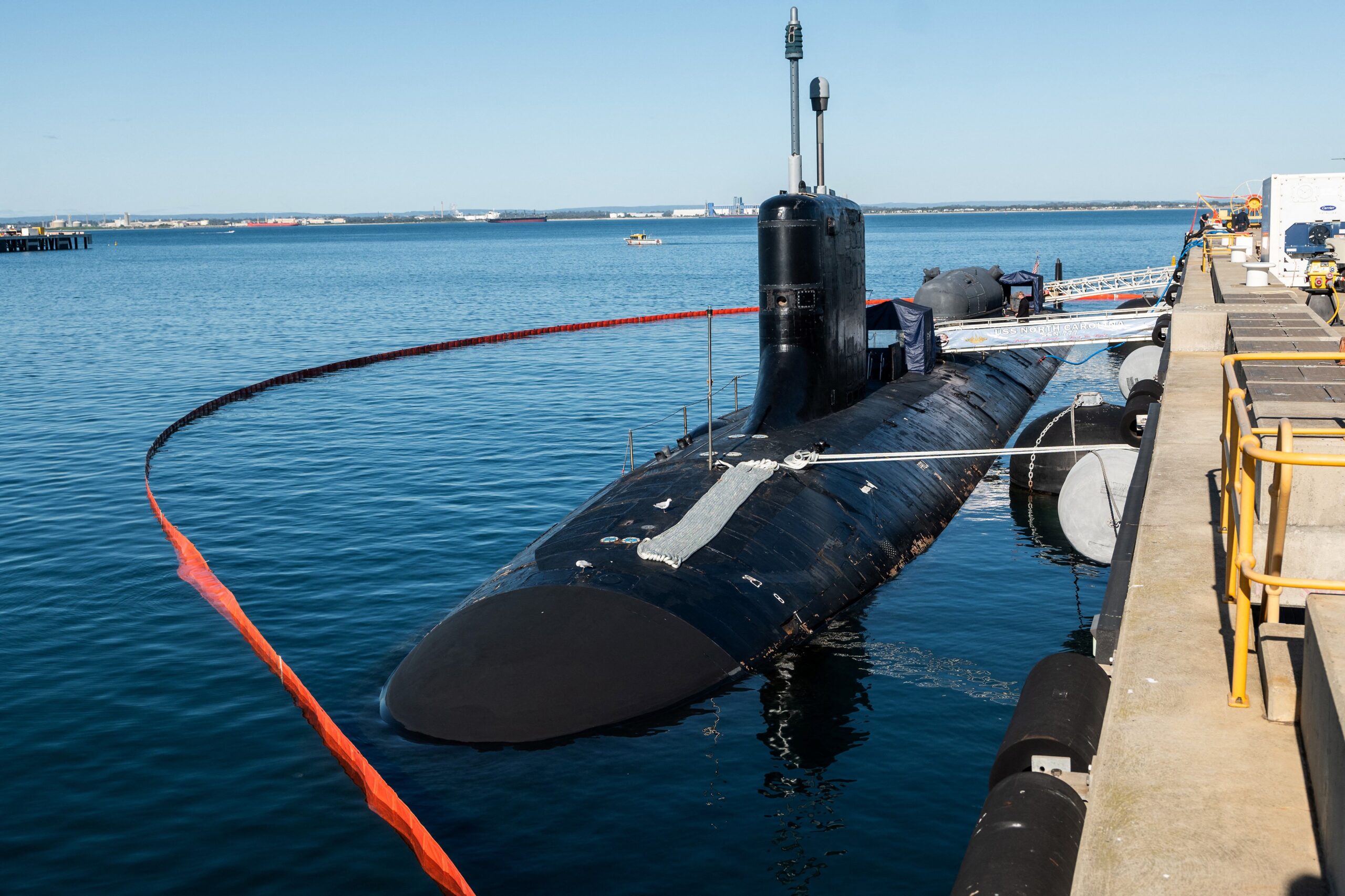
Initially, the Virginia and SSN AUKUS class submarines will be based at HMAS Stirling, the naval base near Perth, WA, which currently houses the conventionally powered Collins-class submarines. However, the long-term goal is to transfer maintenance of the new SSNs to the town of Henderson, where Australia’s new general-purpose frigates and amphibious landing craft fleet are also being constructed.
The need for a large dry dock capable of servicing nuclear-powered submarines was publicly acknowledged last month at the Indian Ocean Defence and Security Conference, where Marles was asked about its construction. He refrained from providing a timeline, and based on his statements, it appears that the breadth of this decision—including how many related facilities, such as a ship lift and new shipyard, are necessary—is affecting the speed of decision-making.
Marles emphasized that determining what is needed at Henderson is the “first step” in addressing the challenge. He remarked, “That’s been complicated because it requires both the current commercial consolidation and physical consolidation. But we’re a long way down that path, and really that’s the thing that we need to [figure out] first. That then opens the door as to what that precinct will look like and what capabilities there are, but we absolutely have to create the capabilities that enable us to do this.”
A source, speaking anonymously, highlighted the difficult choices Australia faces. If Australia wants to perform specific deep nuclear maintenance, at least one dry dock is necessary, but having two would provide greater resilience. Additionally, a floating dry dock large enough for a nuclear submarine for lower-level maintenance is also considered essential. None of these considerations even address the challenges related to accommodating the surface fleet at Henderson.
Marcus Hellyer, an acquisition expert with Strategic Analysis Australia, remarked on the project, saying, “there’s a level of complexity here that is far beyond anything defense has ever done.” He noted that coordination is required across various sectors, from the surface fleet to submarines, including construction, deep maintenance, and everyday upkeep.
Much of the public discourse on the challenges posed by AUKUS has been framed positively by the government, suggesting that while it will be difficult, Australians have accomplished the near-impossible in the past. However, Hellyer argued that such optimism does not address the fundamental needs for building dry docks, additional housing, and secure facilities necessary to protect nuclear secrets within Australia.
He pointedly stated, “So, all this talk about, if we just say ‘Aussie, Aussie, Aussie!’ and remember the Harbour Bridge and the Sydney Opera House and the Snowy Mountains scheme and the spirit of Anzac, I mean, that’s just nonsense. These initiatives compete for a finite amount of resources. The bottom line is, there simply are not enough resources. Even if you had all the money in the world, which they seem to do, there’s just not enough people, space, industrial capacity, or thought space in defense and the government to process all these things.”