After years of refining technology in the lab, Boeing is set to launch a groundbreaking quantum communications technology into space, marking a significant advancement in the global race to leverage advanced quantum physics, once dismissed by Einstein as “spooky action at a distance.”
Named Q4S, this approach incorporates quantum entanglement among four photons and aims to extend beyond existing Chinese and European experiments in Quantum Key Distribution (QKD), which have been deemed impractical by agencies like the NSA and NIST. The Q4S technology could enable the connection of widely separated quantum sensors, facilitating ultra-precise long-baseline measurements, according to the project’s chief engineer, Jay Lowell.
“We are not engaging in something that the government is skeptical of,” Lowell stated during a pre-release call for reporters ahead of the formal unveiling at the Quantum World Congress in Washington, D.C. “We are looking beyond QKD to a more generalized communication protocol needed to support a broader range of quantum applications over a network.”
Quantum Key Distribution specializes in using pairs of entangled particles to securely share cryptographic keys across vast distances. These keys can then be used to encrypt future communications over conventional, non-quantum channels. Only the keys are transmitted using quantum phenomena.
In contrast, Boeing’s Q4S employs two pairs of entangled particles (specifically photons) to establish a near-perfect correlation between distant locations. Lowell explained that if one particle in an entangled pair is affected, the other particle will react almost instantaneously, within “a couple of hundred femtoseconds”—effectively instantaneous for practical purposes. However, Lowell emphasized that this process does not break causality or occur faster than light.
So, why is this correlation significant? It’s akin to coordinating actions among team members set miles apart, achieving synchronization accurate to a fraction of a billionth of a second rather than to just minutes or seconds.
One potential application is precision timing, which is crucial for military networks and targeting systems. Even minor discrepancies in synchronization can lead to failures in encrypted communications or misfired missiles.
Furthermore, Q4S could enable widely separated sensors—perhaps radars and future quantum sensors—to compare measurements with exceptional precision. This high-precision link allows the sensors to behave as a single, large sensor, known as a very large baseline array.
Lowell also suggested that Q4S could facilitate the creation of a network among dispersed quantum computers, enabling the direct exchange of quantum information.
“We’re pushing the boundaries of what is being explored in quantum networking,” he explained. “Essentially, this is the generalized communication protocol needed for a quantum network that transcends simply sending a stream of single photons, striving for a global quantum network connecting quantum sensors and computers.”
While Lowell acknowledged that realizing this vision will take time, he assured reporters: “It’s early days.” Boeing has successfully tested the Q4S entanglement on the ground in controlled environments, but to achieve effective long-distance communication, the technology needs to be operational in a space environment. Currently, the team is working on hardening the equipment against the challenges of vacuum, radiation, and the physical stresses of a rocket launch.
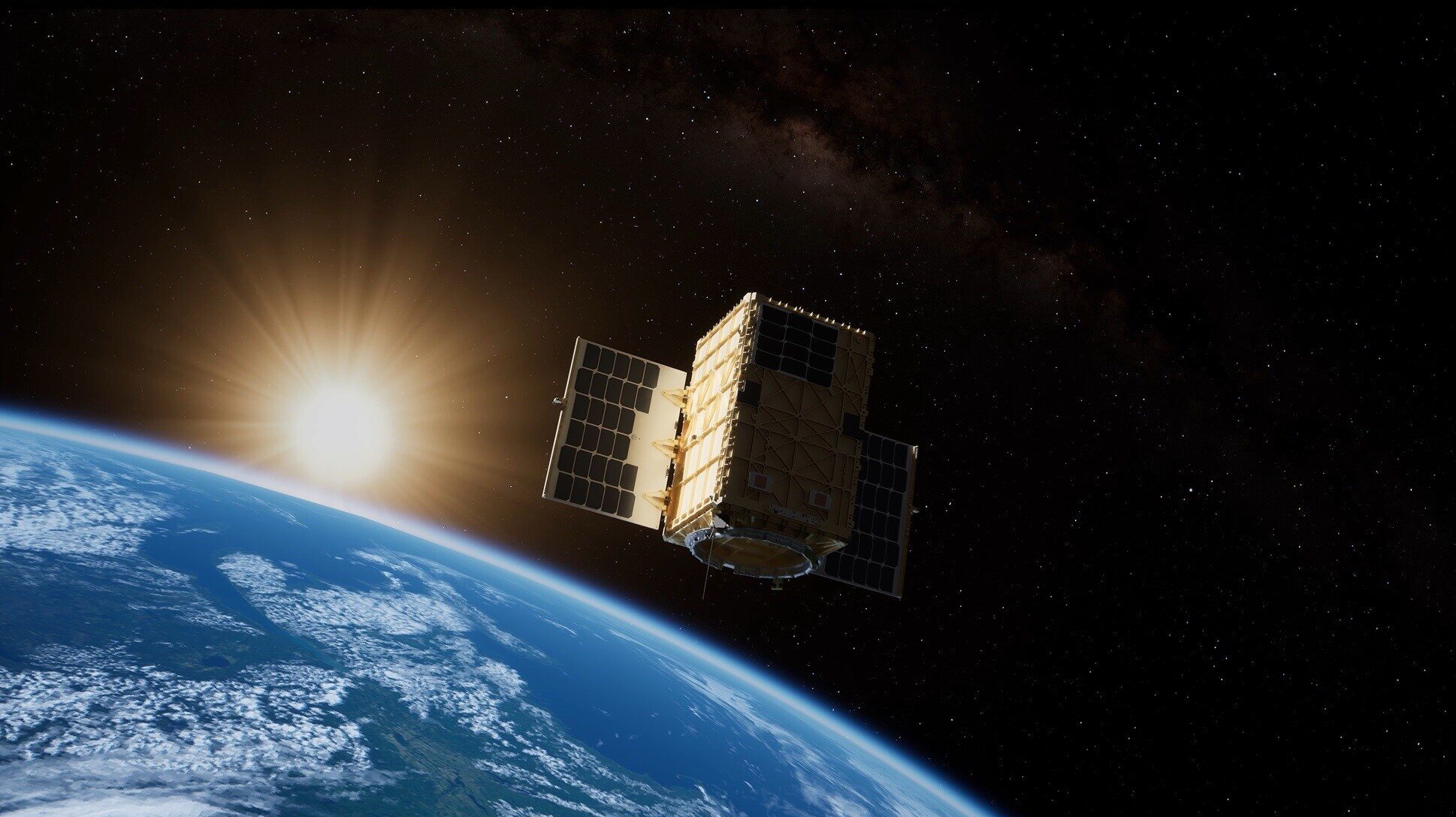
Next year, the Q4S experiment is slated for launch on an Astro Digital Corvus satellite—not a Boeing satellite, as Lowell humorously noted. “I’ve caught a bit of heat about that” from colleagues, he said, but Astro Digital has demonstrated the capability to deliver the necessary power in a compact design.
Assuming a successful launch in 2026, Boeing will need to analyze the data gathered and conduct “probably more than one” additional experiments before the technology can be utilized in real-world applications. “But we’re pretty confident this is not a question of if this happens, but when,” Lowell concluded.