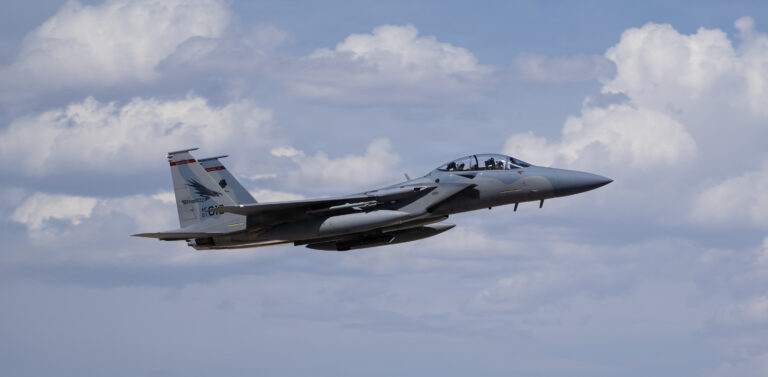
The U.S. Air Force has awarded Boeing an approximately $2.4 billion contract to build a new batch of 22 F-15EX fighter aircraft.
The award was finalized just before a deadline for obligating funds provided through the budget reconciliation process. Despite inflationary pressures and a 2025 strike that halted work on Boeing’s F-15 production line, the Air Force said it preserved all 22 aircraft planned for the program’s seventh production lot.
Agreement Protects Production Continuity
The Air Force said negotiations allowed the service to maintain the full number of aircraft originally planned, despite mounting cost and schedule pressures.
“Lot 7 reflects a disciplined approach to executing available resources while balancing the realities affecting defense production,” said Brig. Gen. Timothy Helfrich, the acquisition executive for the Air Force’s Fighters and Advanced Aircraft Directorate.
According to Helfrich, the agreement focuses on affordability, production continuity and the delivery of aircraft required to modernize the U.S. fighter fleet against current and future threats.
Reconciliation Funds Had to Be Contracted by October 1
The F-15EX award was announced on the same day that the Navy selected Boeing to develop its sixth-generation F/A-XX fighter. That naval program is valued at more than $20 billion, with Boeing defeating Northrop Grumman.
The F-15EX contract was subject to a particularly tight deadline because of the 2025 budget legislation known as the “One Big Beautiful Bill.” The law provided billions of dollars for F-15EX procurement through the reconciliation process.
Although the Pentagon was allowed to spend the funds over several years, it had to award contracts by October 1, the beginning of fiscal year 2027. Failure to do so would have triggered an 8.3 percent reduction in available funding.
The Air Force said the agreement preserves the purchasing power of congressional reconciliation funds and helps sustain F-15EX production.
Boeing Reaches 120 Aircraft Under Contract
The new award brings the total number of F-15EX aircraft under contract with the Air Force to 120. That represents roughly half of the planned fleet of 267 aircraft.
The Air Force’s fiscal year 2027 budget request also includes additional F-15EX funding through the regular appropriations process, rather than relying again on reconciliation funds.
“Boeing is committed to delivering this critically important aircraft to the U.S. Air Force. The F-15EX will strengthen the nation’s ability to project power and remain ahead of emerging threats around the world,” said Christina Upah, Boeing’s vice president for the F-15 program.
Modernized Radar and Electronic Warfare Systems
The F-15EX is a heavily upgraded version of the legacy F-15. The aircraft features a new electronic warfare suite, an updated radar and other improvements intended to extend the platform’s operational relevance.
Boeing has nevertheless faced difficulties increasing production rates because of accumulated schedule delays. The company is aiming to reach a production pace of two aircraft per month.
Full Operational Capability Delayed Until 2028
A recently issued Pentagon acquisition report says delays in the F-15EX program have affected the original timeline for achieving full operational capability.
The milestone is now expected in February 2028, approximately seven months later than previously planned.
The Air Force’s decision to expand its F-15 procurement is creating additional cost and schedule uncertainty. Pentagon officials say the program requires a major technical refresh to address the loss of manufacturing sources and suppliers.
Radar, Engines and Electronic Warfare Suite May Require Redesign
The systems identified as potential problem areas include the aircraft’s radar, engines and electronic warfare suite. Replacing obsolete components could require a substantial redesign of the aircraft.
The Pentagon does not yet have a final cost estimate for the expanded F-15EX purchase. Program officials are currently revising the program baseline to account for lost time and the technical changes needed to keep production moving forward.