The United States Army has awarded multiple contract vehicles for the development and procurement of systems designed to detect, track and neutralize drones. The total potential value of the agreements is estimated at up to $7 billion.
The contracts were issued under an indefinite-delivery, indefinite-quantity, or IDIQ, framework. This mechanism allows the government to order equipment as operational requirements emerge.
The agreements will support the Pentagon’s drone and counter-drone marketplace, as well as the Domestic Shield initiative, which is intended to protect U.S. military installations and critical infrastructure from small-drone threats.
Ten Companies Selected for the New Procurement Framework
Ten companies were selected under the IDIQ arrangement:
- Allen Control Systems – $500 million base ceiling;
- Digital Force Technologies – $500 million;
- DroneShield – $500 million;
- Echodyne – $250 million;
- Napatree Technology – $500 million;
- PVP Advanced EO Systems – $250 million;
- RADA Technologies – $500 million;
- SmartShooter – $150 million;
- SRC – $500 million;
- L3Harris WESCAM – $500 million.
The Army did not disclose what specific capabilities each company will provide. The contracts will nevertheless give the service rapid access to a broad range of technologies without tying it to a single supplier.
A Layered Defense Against Drone Threats
U.S. officials aim to build a layered defense capable of identifying drones before they reach protected targets.
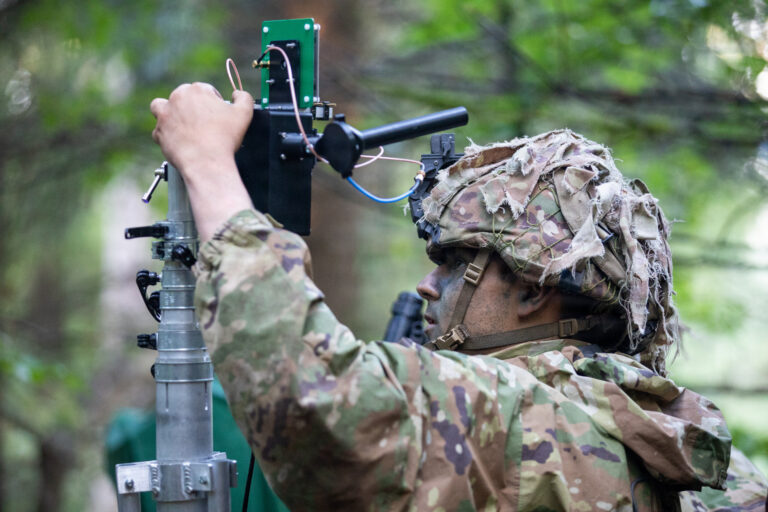
The architecture is expected to include sensors, command-and-control systems, tracking and identification technologies, as well as systems designed to disrupt, disable or capture unmanned aircraft.
Brig. Gen. Matt Ross, commander of Joint Interagency Task Force 401, said there is no single solution capable of addressing every type of unmanned aerial threat. Instead of relying on one integrated system, the Army intends to acquire multiple interoperable systems designed to perform different functions.
The strategy reflects the rapid evolution of drone threats, which range from modified commercial aircraft to military-grade autonomous systems and drone swarms.
Pentagon Moves Away From Single-Vendor Dependence
Brent Ingraham, the Army’s assistant secretary for acquisition, logistics and technology, said the new contracts cover the full range of counter-UAS capabilities, from sensors and command-and-control systems to defeat mechanisms.
By creating multiple procurement options, the Army intends to preserve competition among suppliers and avoid dependence on a single company. Officials believe the approach will accelerate the deployment of new technologies as the threat environment changes.
The contract vehicles establish the administrative and financial foundation needed before specific operational requirements arise.
Counter-Drone Marketplace Builds on Army’s Drone Program
The Army plans to use several acquisition channels, including commercial solutions openings, common command-and-control enterprise license agreements, existing service contracts and the Pentagon’s drone and counter-drone marketplaces.
Through the marketplace, U.S. soldiers, federal agencies and allied nations will be able to purchase various counter-drone technologies.
The model is based in part on the Army’s existing drone marketplace, which has generated more than $800 million in sales. Officials expect the new system to accelerate both procurement and industrial development.
Demand Is Outpacing Available Supply
U.S. officials say demand for drones and counter-drone systems currently exceeds available production capacity.
A large IDIQ contract could allow companies to raise additional capital and expand inventories because they would have a clearer expectation of future government demand.
The marketplace is also intended to connect producers more efficiently with customers across the United States, as well as with Washington’s partners and allies.
The Army has not yet disclosed when the first systems will be delivered or which units and agencies will receive them.
Expanded Cooperation to Protect Nuclear Facilities
Separately, the National Nuclear Security Administration and Joint Interagency Task Force 401 signed a memorandum of understanding to improve information sharing on drone threats.
Under the agreement, the administration will share data from counter-drone testing events with the task force, while JIATF-401 will provide relevant information in return.
The cooperation is intended to reduce duplicative testing, accelerate the deployment of effective systems and strengthen the protection of critical national-security infrastructure.
By coordinating testing and evaluation efforts, the agencies hope to use public funds more efficiently and shorten the time required to select and deploy new technologies.