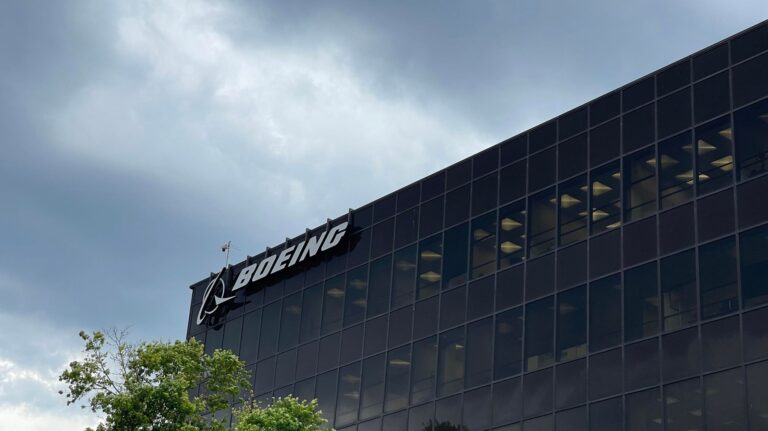
Boeing has been selected to build the U.S. Navy’s sixth-generation F/A-XX fighter, defeating Northrop Grumman in a competition for the aircraft that will gradually replace the aging F/A-18 Super Hornet and EA-18G Growler fleets.
The contract, valued at more than $20 billion, gives Boeing a dominant position in America’s sixth-generation fighter market. However, analysts warn that securing the award is only the first step. The company must now prove that it can deliver the aircraft on schedule, at scale and without repeating problems seen in earlier programs.
From Possible Fighter-Line Closure to Control of America’s Airpower Future
The decision marks a dramatic turnaround for Boeing’s defense business. The company has struggled in recent years with several major aircraft programs, including the KC-46 tanker and T-7 trainer.
Its March 2025 victory in the Air Force’s F-47 competition marked an important shift. Winning the Navy’s F/A-XX program now further strengthens Boeing’s position as the central U.S. supplier of next-generation fighter aircraft.
“For Boeing, this would be a major step in an extraordinary turnaround: from a legacy manufacturer of fighter programs nearing retirement to the company that has a lock on the future of U.S. fighters,” said Richard Aboulafia, managing director at AeroDynamic Advisory.
Stacie Pettyjohn, a senior fellow and director of the defense program at the Center for a New American Security, described the development as a complete reversal of fortunes. Boeing has gone from facing the possibility of closing its fighter production lines to holding both major U.S. sixth-generation fighter contracts.
Can Boeing Build Two Next-Generation Fighters at the Same Time?
The central question is how quickly Boeing can produce a workable F/A-XX. Much may depend on how closely the Navy aircraft is related to the Air Force’s F-47.
Jeremiah Gertler, a senior advisor at AeroDynamic Advisory and a former congressional military aviation analyst, said the timetable could accelerate if the two aircraft share major technologies or were developed in parallel.
If the programs are closely connected, the F/A-XX could enter flight testing earlier than expected. If the Navy fighter is a completely separate design, however, the program could face a longer development timeline and additional technical risks.
Workforce Shortages Could Become the Next Major Challenge
Boeing’s ability to recruit and retain enough skilled personnel is another potential vulnerability. The company’s St. Louis complex is expected to handle the F/A-XX, F-47 and T-7A Red Hawk programs simultaneously, while also preparing for a significant increase in F-15EX production rates.
“The question is whether they have — and can find — the people needed to keep all of those production lines operating at a high rate at the same time,” Gertler said.
Doug Birkey, executive director of the Mitchell Institute for Aerospace Studies, also warned that the labor demands of the F-47 and F/A-XX programs will need to be carefully balanced from the outset.
Boeing will have to prevent the two programs from competing for the same engineers, technicians and manufacturing specialists.
Investors Will Scrutinize Pricing and Contract Terms
Following the award, Roman Schweizer of TD Cowen said investors would closely examine Boeing’s pricing strategy and the structure of the contract. Both issues have caused difficulties in previous company programs.
According to Schweizer, the Navy’s decision indicates that officials placed substantial weight on Boeing’s industrial capacity and ability to deliver aircraft at scale.
Boeing has invested heavily in its St. Louis facilities and digital engineering capabilities in recent years. Those investments appear to have strengthened the company’s case that it can manage several complex aircraft programs at once.
The company has also pushed back against concerns about building aircraft for both the Navy and Air Force simultaneously. Steve Parker, Boeing’s defense chief, said that delivering two advanced fighters in parallel had always been part of the company’s plan and that investments had been made accordingly.
Northrop Loses the Competition but Retains a Strong Defense Portfolio
For Northrop Grumman, the F/A-XX defeat is a significant setback. The company had hoped to become the prime contractor for a fighter aircraft for the first time since the legendary F-14 Tomcat.
Analysts, however, believe the loss will not threaten the company’s broader future. Northrop remains involved in major programs, including the B-21 Raider bomber, the Sentinel intercontinental ballistic missile and components for the F-35 fighter, which is led by Lockheed Martin.
Aboulafia said the overall impact on Northrop would likely be limited. Gertler similarly noted that neither company depends on the F/A-XX award to keep its defense or aeronautics business operating.
Northrop is expected to examine whether it can protest the decision. Historically, however, protests involving major classified aircraft competitions have had a low success rate.
Boeing Will Also Help Shut Down the Super Hornet and Growler Lines
In a notable symbol of the transition between generations, Boeing received another Navy contract to support the closure of the F/A-18E/F Super Hornet and EA-18G Growler production lines.
Boeing has built Navy fighter aircraft for decades, but those programs are now approaching their final stages. The F/A-XX will gradually assume their role in the future carrier air wing.
Contract Covers Multiple Test Aircraft
The Pentagon said the award covers the full-scale development phase and includes the procurement of multiple test aircraft.
Those aircraft will support ground testing, airworthiness evaluations, systems testing and weapons-integration trials. The Navy has released few technical details, but officials have indicated that the F/A-XX will offer greater range than current fighter aircraft.
F/A-XX Will Anchor the Navy’s Future Carrier Air Wing
The new fighter is expected to operate alongside future Collaborative Combat Aircraft, or combat drones designed to conduct missions in cooperation with crewed aircraft.
The Navy is developing the concept as part of a new architecture for the carrier air wing. Chief of Naval Operations Adm. Daryl Caudle has confirmed that the unmanned aircraft effort and F/A-XX are connected elements of the service’s broader future air-wing strategy.
Pettyjohn said the balance between crewed and uncrewed aircraft will be critical to the Navy’s ability to project power. In her view, a crewed fighter must remain at the center of the carrier air wing, with autonomous systems operating around it.
The number of aircraft the Navy ultimately orders, the mix of crewed and uncrewed platforms, and the weapons integrated onto the F/A-XX will reveal the service’s operational priorities. Those decisions will be especially important in the Pacific, where long distances and China’s long-range weapons are increasingly challenging the ability of U.S. surface forces to operate close to contested areas.