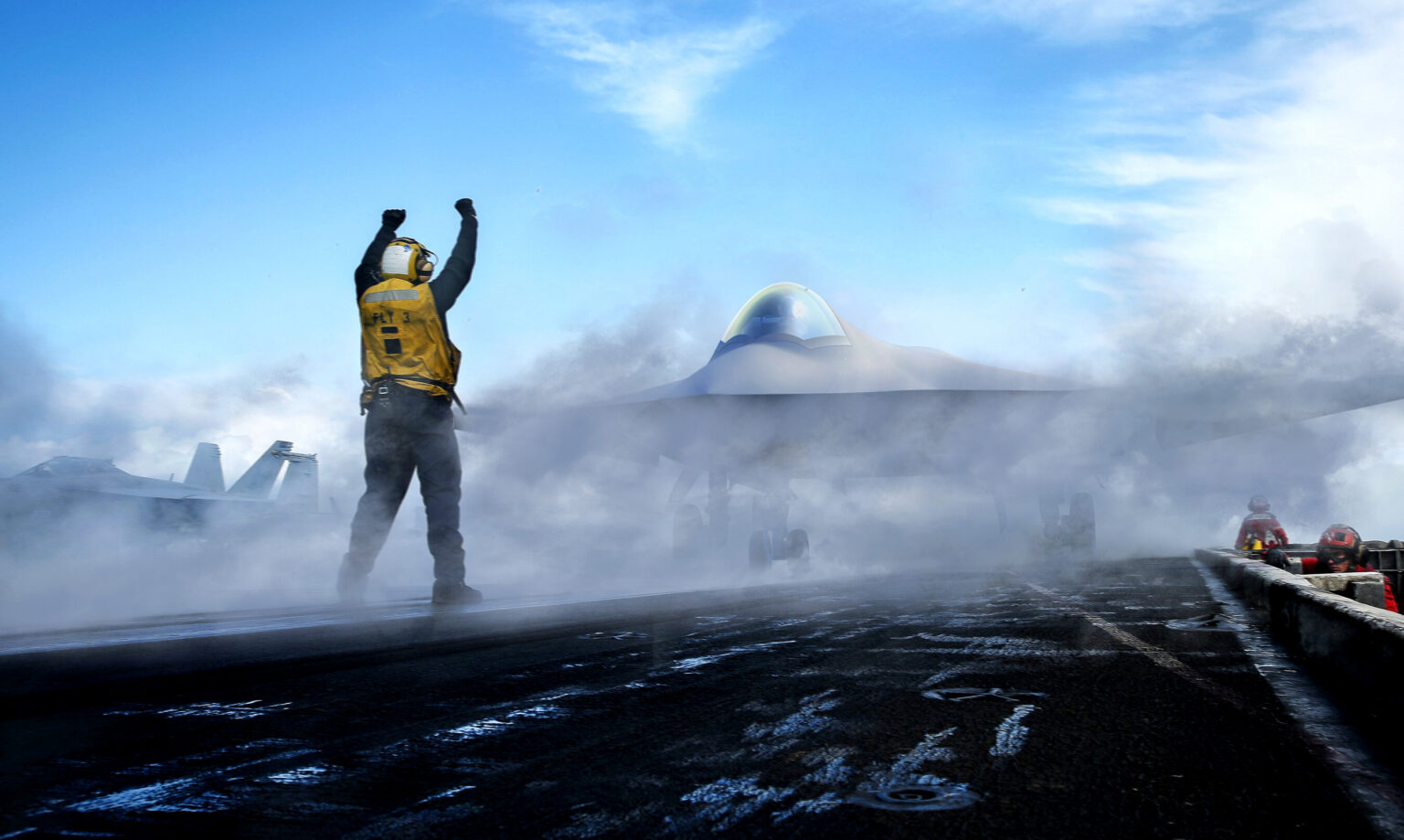
In a strategic shift of significant proportions, the U.S. Department of Defense has launched an unprecedented industrial offensive to replenish ammunition stockpiles and secure long-term air superiority. Through a series of multi-year agreements, the U.S. defense apparatus is transforming production capabilities across critical sectors, spanning from high-precision interceptors to the next generation of carrier-based fighter jets.
AMRAAM Surge: Doubling Output for Global Readiness
Re-armament efforts have received a major boost through a contract worth nearly $20.7 billion awarded to Raytheon for the production of Advanced Medium-Range Air-to-Air Missiles (AMRAAM). This multi-year agreement, spanning an initial five-year period with options for two additional years, addresses critical requirements for the U.S. Air Force and Navy, alongside 16 international partners.
The initiative comes against the backdrop of rapidly depleted ammunition stockpiles following recent military engagements in Ukraine and the Middle East. The strategy hinges on a massive scaling of manufacturing capacity, with the ultimate goal of nearly doubling current production rates to reach 1,900 units annually. The contractual mechanism employed facilitates immediate work, offering a rapid solution to industrial bottlenecks despite uncertainties surrounding current budget appropriations.
THAAD Propulsion: A $6 Billion Industrial Expansion
Parallel to air-to-air missile production, critical emphasis has been placed on core components for missile defense systems. L3Harris has secured a major contract, valued at over $6 billion, to accelerate the production of propulsion systems for THAAD interceptors.
This seven-year commitment aims to quadruple the production of solid rocket motors. To meet this ambitious benchmark, the company plans to construct a new manufacturing facility, thereby strengthening the supply chain for Patriot and THAAD defense systems, both of which have become essential in the current climate of global insecurity.
Boeing Secures the Future of Naval Air Superiority
In the realm of combat aviation, the U.S. Navy has finalized its competition for the next sixth-generation strike fighter, selecting Boeing as the sole supplier. This decision marks a strategic victory for Boeing, solidifying its dominant position against rivals such as Northrop Grumman.
The contract, valued at more than $20 billion for the full-scale development phase, focuses on the F/A-XX, a platform engineered to dominate contested airspace beginning in the 2030s. This next-generation aircraft is set to replace the existing fleets of F/A-18 Super Hornets and EA-18G Growlers, operating in synergy with the Lockheed Martin F-35. By making this selection, the Navy has confirmed its commitment to developing a platform distinct from the similar program led by the Air Force, underscoring the necessity of a dedicated capability for naval power projection.