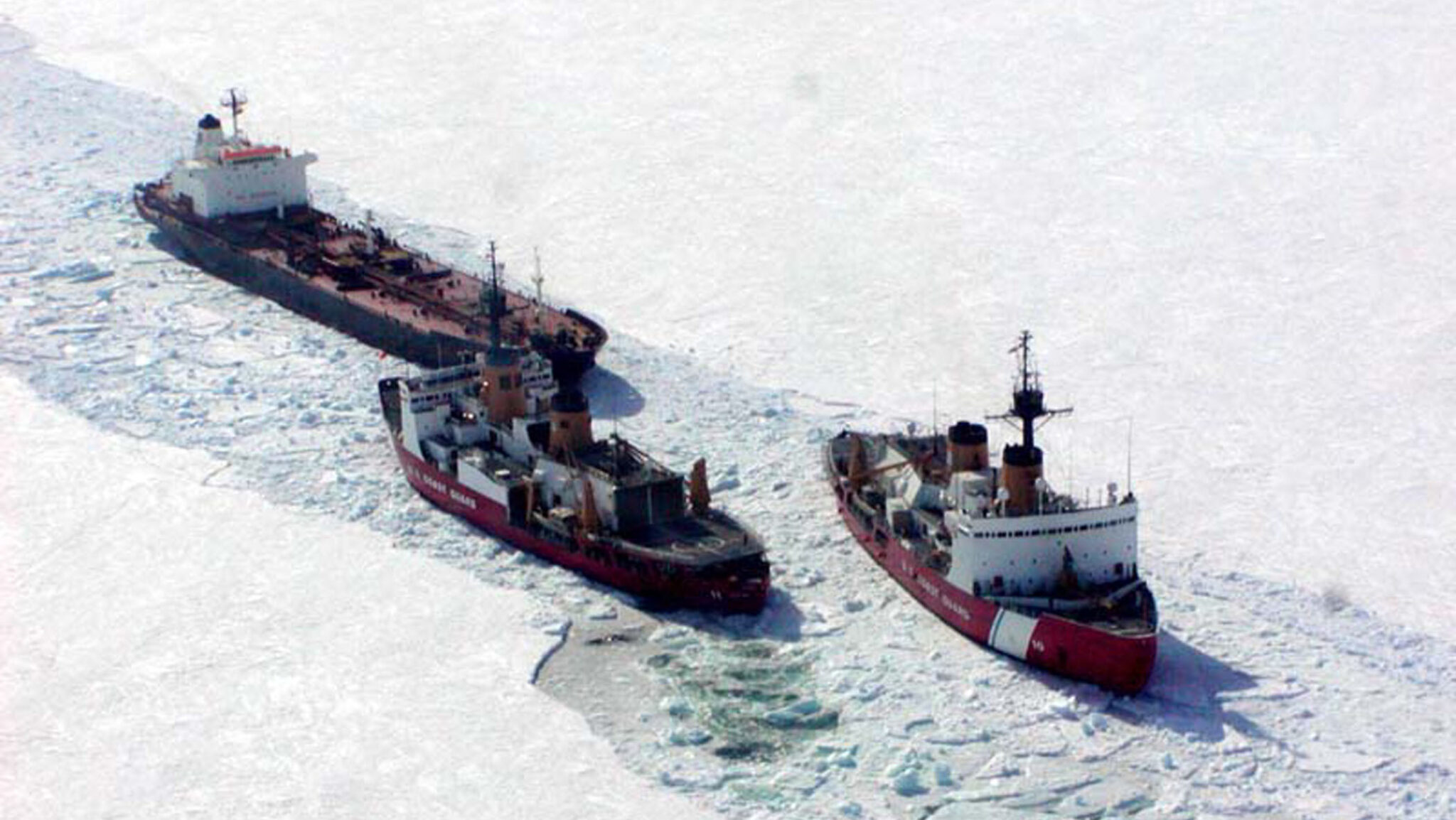
An independent government watchdog has estimated that the US Coast Guard’s initiative to construct three new heavy icebreakers will cost approximately $5.1 billion, marking a 60 percent increase over the service’s existing projections of $3.2 billion.
This information emerges from a recent report published by the Congressional Budget Office (CBO) at the request of the House Homeland Security Committee.
According to the new report, “CBO estimates that operating and supporting a force of three [Polar Security Cutters] would cost $12.4 billion between 2029 and 2063, when those vessels are expected to be in service.” The report further notes that should the Coast Guard opt to acquire more than three ships, operational costs would escalate and extend over a longer timeline. It’s not uncommon for the CBO to disagree with the Coast Guard or Navy regarding the projected costs of future ships, as these discrepancies typically arise from the assumptions analysts must make concerning inflation, material costs, and other economic factors. The Coast Guard is currently in the process of reassessing its cost estimates and intends to release updated figures later this year.
The challenge in accurately predicting the costs associated with the Polar Security Cutter (PSC) program is compounded by the fact that analysts typically reference existing ships to model future construction costs. This task is particularly difficult in this instance, as the United States has not built a heavy icebreaker in over four decades.
To perform its analysis, the CBO used the only operational American heavy icebreaker, the Polar Star; the Coast Guard’s medium icebreaker, Healy; and the Navy’s San Antonio-class amphibious warships as comparatives. However, CBO acknowledges that “none of those analogues are ideal for the analysis.” The Polar Star, completed in 1976, is the closest match as a heavy icebreaker, but its age complicates cost assessments since the Coast Guard did not provide any historical cost data for the vessel. The Healy, completed in 2000, is a medium icebreaker not designed for the same missions as the PSC. The San Antonio-class ships, still in production, are comparable in size to the PSC.
In April 2019, the Coast Guard selected VT Halter Marine from a competitive field of shipbuilders to produce the Polar Security Cutter. By December 2021, the service exercised a contract option to begin construction on the second ship in this class. Subsequently, Bollinger Shipyards in Louisiana acquired VT Halter Marine, assuming control of the program.
CBO’s report comes just weeks after the Biden administration announced a new security agreement with Canada and Finland at the NATO Summit, known as the ICE Pact. This initiative is designed to bolster the icebreaker capabilities of the three nations. During the initial announcement, leaders promised a joint memorandum of understanding would be released later this year, detailing more specific collaborative plans, with roles outlined for the Coast Guard, Pentagon, and Bollinger in this new security agreement.