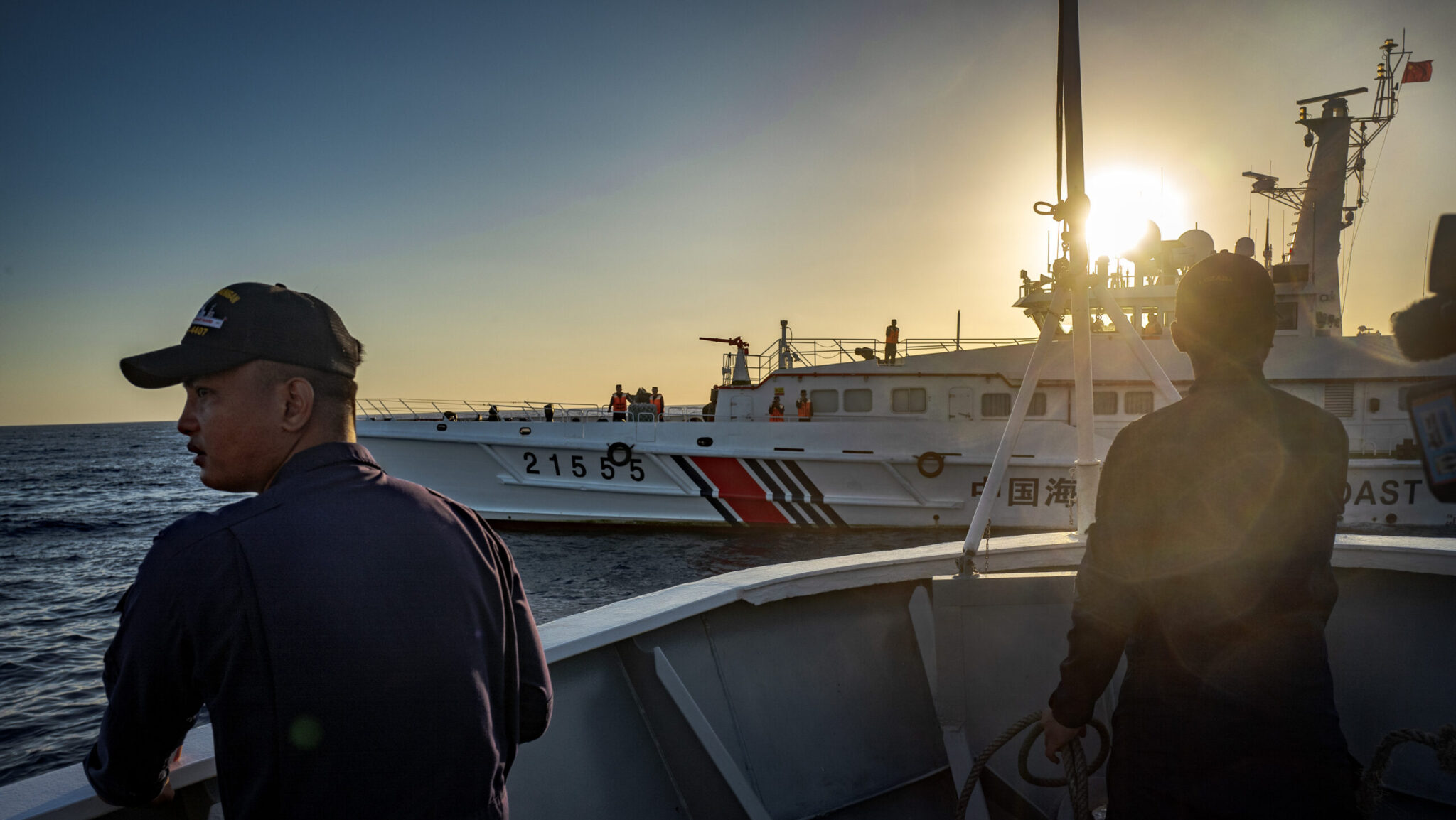
Recent collisions between Chinese and Philippine vessels in the South China Sea serve as a stark reflection of Beijing’s aggressive behavior in the region, and experts assert that these incidents are aimed at testing Manila’s relationship with Washington.
The latest encounters occurred early Monday near Sabina Shoal, a contested area in the sea, resulting in damage to two ships, though no injuries were reported.
While analysts speaking to Breaking Defense noted the complexity of assigning blame, a senior White House official, the Philippine government, and another regional expert have pointed fingers at Beijing.
US National Security Advisor Jake Sullivan relayed to his Philippine counterpart that the United States “condemns the People’s Republic of China’s deliberate collision” with Philippine Coast Guard vessels, which were “operating lawfully,” according to a White House statement.
The Philippine government has also declared China at fault, with Jonathan Malaya, assistant director-general of its National Security Council, stating that the Chinese Coast Guard was wrong and attempted to misrepresent the events.
Conversely, the Chinese Coast Guard claims that the Philippines was responsible for the collisions.
Collin Koh, a regional expert at Nanyang Technological University in Singapore, asserted that the evidence points to Chinese culpability. “Based on existing information, notwithstanding the video put out by [the Chinese Coast Guard], it’s clear that the Chinese were responsible. Their maneuvers against PCG [Philippine Coast Guard] vessels were aggressive and contravened COLREGs (collision regulations),” he wrote in an email.
Koh continued, “As it stands, Beijing appears to want to compel Manila to relinquish Sabina Shoal. Manila is keen to avoid a repeat of the Scarborough Shoal incident from 2012, and there is significant domestic pressure to ensure the PCG can maintain a presence against Chinese vessels in the shoal to prevent Beijing’s takeover. So far, the Philippines has only utilized the PCG and has refrained from involving the navy to avoid escalating the situation and to prevent providing China with a narrative to exploit.”
Two other regional analysts suggested that, while determining the cause of the recent incident might be complex, China is clearly attempting to push the Philippines out of its sovereign waters and test its relationship with the US.
“What the PRC appears to be doing is trying to wear down the Philippines so that they are not able or willing to show an effective presence,” stated Ian Chong-Ja, a China expert at the National University of Singapore, in an email to Breaking Defense. “This would allow the PRC to gain de facto control or at least a veto over the disputed waters, which they currently do not possess.”
Jennifer Parker, a naval expert at the Australian National University in Canberra, noted, “China is pushing the Philippines in a manner that they are not pushing Vietnam,” which also claims adjacent waters to the recent incidents. She added that China’s actions likely stem from the Philippines’ campaign to resist its influence, as well as a test of US resolve amid the Philippines’ ongoing relationship with America.
The recent collisions come shortly after a Chinese fighter aircraft dropped flares in the vicinity of a Philippine military plane, prompting the Philippines to file a formal diplomatic protest with China.
These incidents seem to be occurring with increasing frequency since Philippine President Ferdinand Marcos Jr. asserted that his country would not yield to China’s claims over vast areas of Philippine waters, a position that contradicts a ruling by a UN tribunal. China, a signatory to the UN Convention on the Law of the Sea, has consistently rejected the tribunal’s ruling. President Marcos has indicated that the Philippines has filed more than 100 diplomatic protests against China regarding its aggressive and unlawful actions in the region.
Last month, US Defense Secretary Lloyd Austin and Secretary of State Antony Blinken visited Manila, where Austin remarked, “The United States, the Philippines, and our other allies and partners are operating together more closely and capably than ever, and we’re working together to ensure a free and open region.”
In a call on Tuesday, the White House indicated that Sullivan “reiterated the ironclad US commitment to the US-Philippines Mutual Defense Treaty, which extends to armed attacks on Philippine armed forces, public vessels, or aircraft—including those of its Coast Guard—anywhere in the South China Sea.”