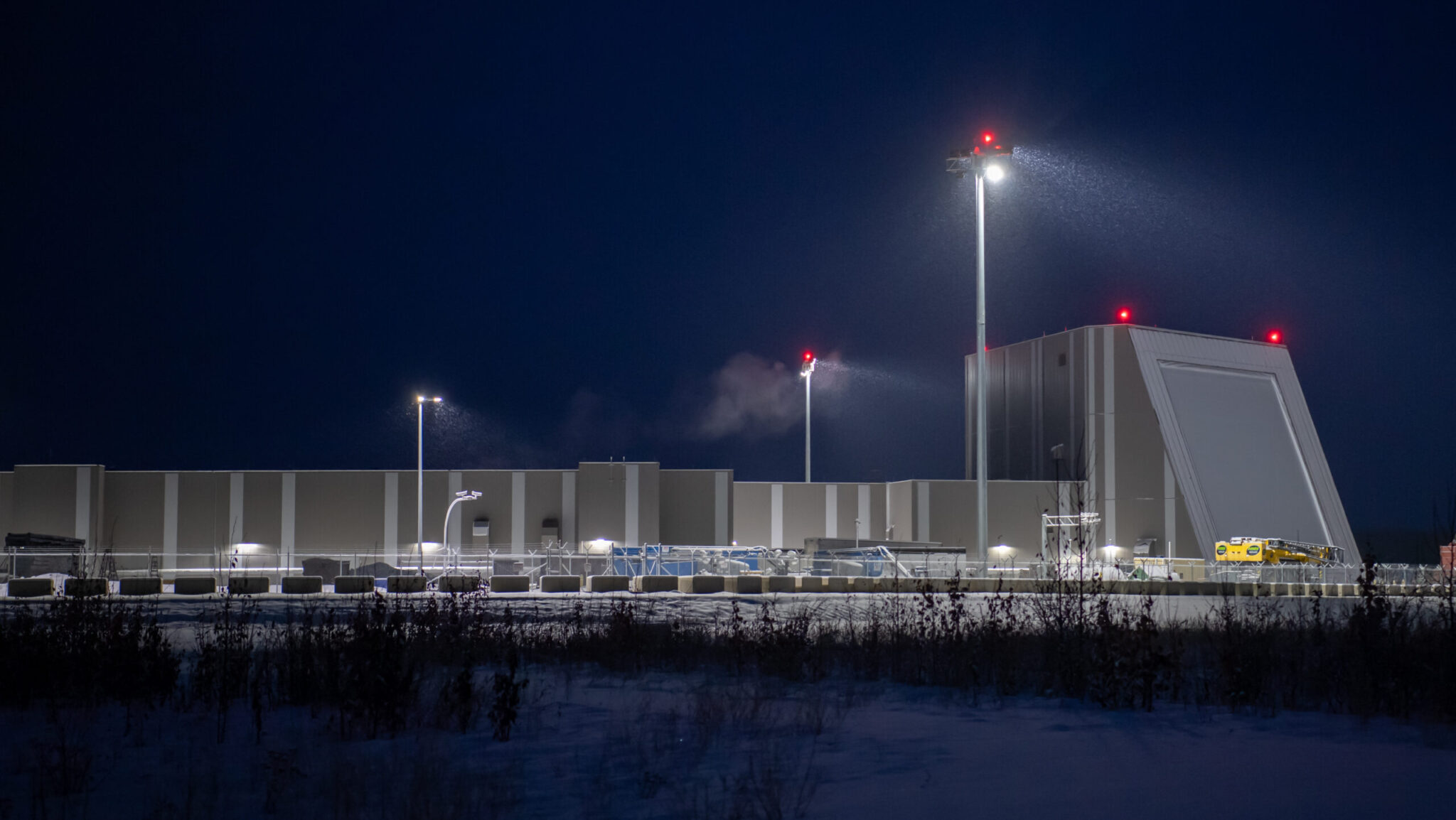
A long-delayed and crucial assessment of a new radar system developed by the Missile Defense Agency (MDA) has been rescheduled for next year, according to the agency’s director.
MDA chief, Air Force Lt. Gen. Heath Collins, announced during a Defense News webinar that the upcoming test, designated Flight Test Other-26 (FTX-26), is set to be “executed” in 2025. This decision comes after the agency reported a “target anomaly” that led to the cancellation of last year’s planned test of the Long-Range Discrimination Radar (LRDR). The MDA initially aimed to conduct this test in fiscal year 2022, as highlighted in a May 2023 watchdog report.
Developed by Lockheed Martin, the LRDR was first deployed at Clear Space Force Station in central Alaska in late 2021. However, it has yet to receive operational acceptance from its designated user, the U.S. Space Force. The LRDR is viewed as a vital component of layered defense for the American homeland, supporting the Ground-Based Midcourse Defense system’s ballistic missile interceptors, which primarily aim to counter missile threats from Iran and North Korea. The FTX-26 test will evaluate the LRDR’s performance against a live ballistic missile threat. Collins indicated that MDA has already conducted a test with a less complex target, reporting that the LRDR “worked very well” during that event. Nonetheless, the upcoming FTX-26 test is considered critical, as it “will inform the operational decision to integrate [LRDR] into the operational baseline for ballistic missile defense of the homeland,” Collins stated.
A spokesperson for MDA previously informed Breaking Defense that the LRDR should achieve operational acceptance by the Space Force in the second quarter of fiscal year 2025. Beyond its missile defense capabilities, the LRDR will also track objects in space, enhancing the military’s space domain awareness.
In addition to discussing the radar test, Collins noted that, alongside planned testing events for the MDA’s new Hypersonic and Ballistic Tracking Space Sensor (HBTSS) satellites launched earlier this year, his agency has been able to gather additional data “every time they fly over Ukraine or Israel.” The HBTSS satellites are designed to provide tracking capabilities for hypersonic and ballistic missile threats, as the Pentagon works to address the hypersonic challenges posed by Russia and China.
Looking toward the future, Collins emphasized another important objective for MDA: the fielding of a discriminating space sensor, which will help differentiate between decoys and other measures aimed at concealing inbound threats. He added that MDA intends to “probably” launch this sensor around 2029. Defense News was the first to report the rescheduled FTX-26 test and the comments regarding the space sensor.