





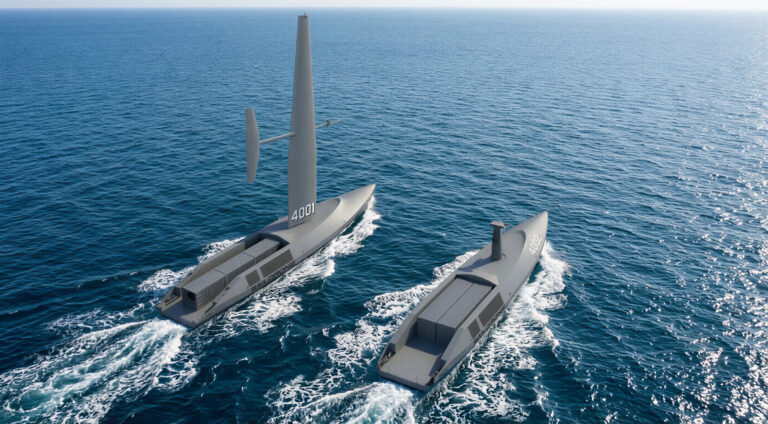
A US federal court has ruled that the Navy unfairly evaluated Saildrone’s proposal for its medium unmanned surface vessel (MUSV) program. The service must reassess the bid within 60 days and cannot spend more than $1.5 billion of the program’s $2.1 billion budget on production until the review is complete.
Court finds unequal treatment of bidders
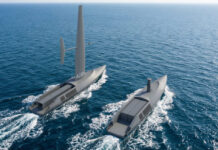
Saildrone and maritime technology startup Blue Water Autonomy sued in June after the Navy removed their respective proposals from the competition. Saildrone had offered its Spectre vessel, while Blue Water proposed Liberty. Both companies argued that their designs met the program’s requirements and that the Navy did not consistently apply the evaluation criteria in its request for proposals.
Judge Philip Hadji found that the Navy treated Saildrone differently and acted arbitrarily and capriciously. The company was disqualified before on-water testing because of discrepancies in documents relating to the design’s maximum displacement.
The court found, however, that a proposal from Sea Machines advanced despite comparable issues in its displacement documentation. The opinion said it was unclear whether the Navy evaluated Sea Machines’ Steamracer or Steamrunner, but that the distinction did not change the court’s conclusion: Saildrone had been held to a higher standard.
Navy ordered to conduct a new review
The ruling requires the Navy to reevaluate Saildrone’s proposal within 60 days using the same approach it applied to companies that advanced in the competition. The service is also barred from relying on two previously withdrawn findings as grounds for disqualifying the company.
A Navy spokesperson said the service would comply with the order and determine whether Saildrone qualifies for on-water testing.
Company founder and CEO Richard Jenkins welcomed the ruling, saying it supported fair competition, taxpayer interests and national security.
Blue Water Autonomy’s challenge rejected
The court reached a different conclusion on Blue Water Autonomy’s case, finding that the Navy reasonably rated the company’s proposal unacceptable.
One reason for its removal was a difference between the test vessel—a twin-hulled catamaran—and the proposed production vessel, a monohull with an axe-bow design. Blue Water argued that hull form and propulsion architecture were not among the assets to be evaluated. The judge disagreed, finding that the requirement for a “representative” test vessel called for comparing those features with the production design.
Austin Gray, Blue Water Autonomy’s co-founder and chief strategy officer, said the test vessel did not reflect the core elements of the company’s technology or product. He also welcomed changes the Navy has made to the program’s second phase.
Phase II eases requirements
For the first phase, proposals had to demonstrate the ability to travel 2,500 nautical miles at 25 knots in sea state 4 conditions and carry two 40-foot containers.
Phase II instead requires capacity for at least two standard 20-foot containers and removes the high-speed requirement. The changes are intended to open the competition to more companies and broaden the industrial base.
In September, Christopher Miller, the Navy’s Direct Reporting Portfolio Manager for Robotic and Autonomous Systems, acknowledged that Phase I requirements had posed challenges for industry. He said the service wants to create more opportunities for companies with mature capabilities and identify options to meet near-term operational needs.